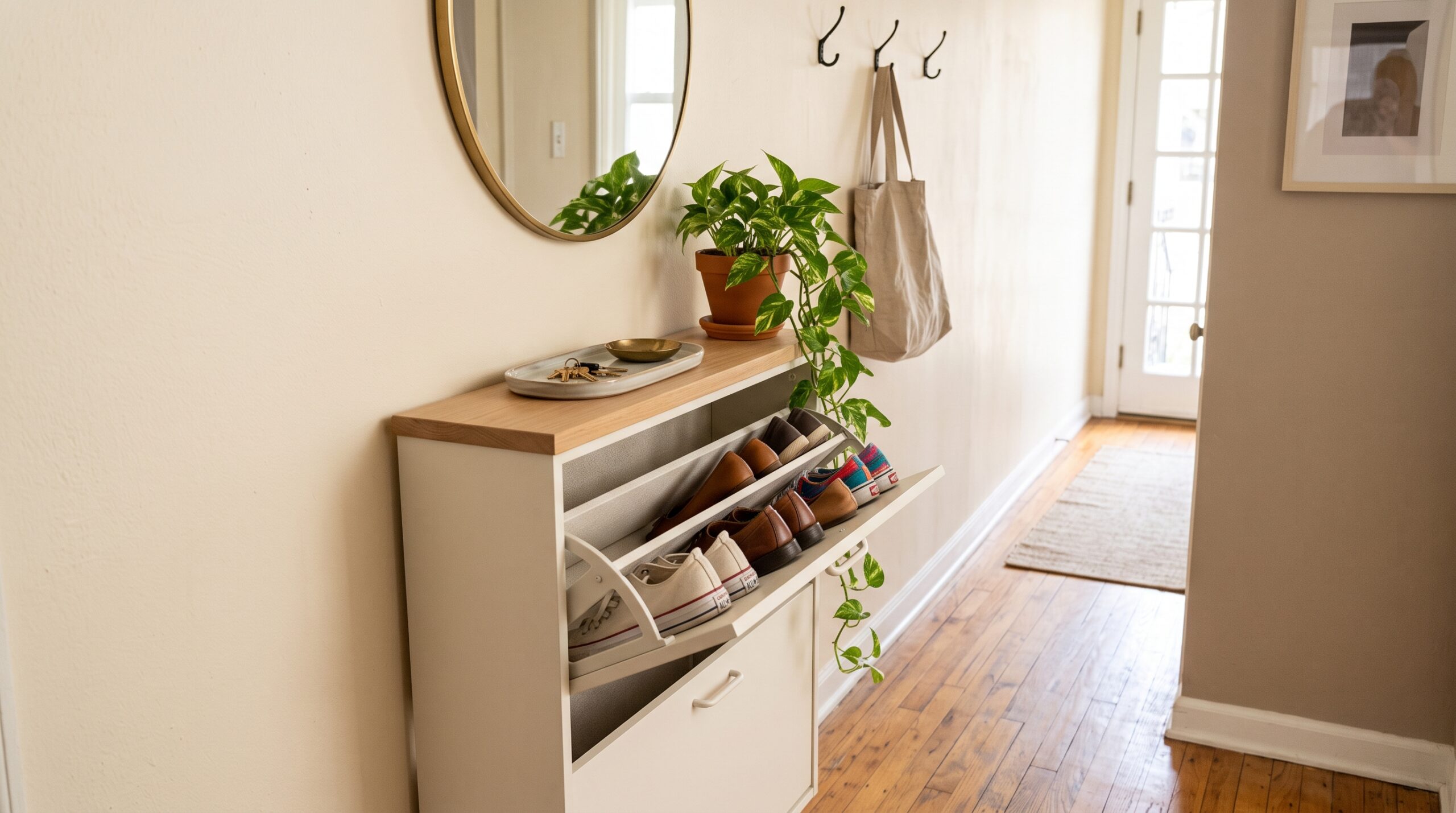
The problem with shoes in a small apartment is never really the shoes. It is the depth. A normal shoe rack sticks a foot or more out from the wall, and in a hallway that is already only a yard wide, that foot is the difference between walking straight to the door and turning sideways to squeeze past your own sneakers. Add a coat, a bag on your shoulder, and a person coming the other way, and the entryway stops working.
The fix is not more storage, it is shallower storage. A slim tilt-out shoe cabinet solves the depth problem by standing the shoes on a slant behind a flip-down drawer, so the whole unit sits nearly flush to the wall. The good ones are only about nine to eleven inches deep, roughly the depth of a stack of books, which is shallow enough to leave the walking lane clear. That is the spec I care about most on this page, and the one I lead with on every pick.
There is an honest trade-off, and I will not bury it. Shallow tilt-out drawers hold your shoes at an angle, so each tier fits fewer pairs than a deep open rack, and tall boots or chunky trainers can foul the drawer when it closes. So I sorted these by household. Some are the shallowest possible flush-to-wall units, some stack more tiers for bigger collections, some pair a seat with the storage, and a few are budget or no-cabinet answers for the tightest or most temporary spaces. If your entryway is genuinely tiny, one of these belongs by your door, the same way a lift-top storage coffee table earns its keep in a small living room.
This post contains affiliate links. If you buy something through one of my links, I may earn a small commission at no extra cost to you. I only recommend products I’d actually use myself.
As an Amazon Associate I earn from qualifying purchases.
How I picked
- Depth before anything else. I measured the cabinet depth against a real narrow hallway and favored anything in the nine-to-eleven-inch range. A unit that saves you nowhere on the floor is not slim, no matter what the listing calls it.
- A true tilt-out, not a fake. The flip-down drawer is what lets a shallow box hold real shoes on a slant. I checked the side photos to confirm a genuine tilt-out or flip-drawer mechanism, not a deep standard cabinet dressed up with a hinged front.
- Capacity matched to the footprint. A slim cabinet holds fewer pairs per tier, so I noted the honest pair count and pointed bigger households toward the taller, multi-drawer units instead of overselling a two-tier.
- Renter-safe and freestanding. Almost everything here stands on the floor with no wall anchor, so it leaves your deposit alone. Where a unit wants a tip-over strap, I say so.
- Verified live, honest on assembly. I checked every listing on Amazon the day this went up, and I flag which ones snap together in ten minutes and which ask for an evening with a screwdriver.
My top pick
If you want the safe, do-everything answer, buy the Smart FENDEE slim shoe cabinet. It nails the one spec this whole page is about. At 9.45 inches deep it sits nearly flush to the wall, so a narrow hallway stays walkable while eight to twelve pairs hide behind its slatted flip drawers. The walnut finish with gold hardware looks deliberate rather than utilitarian, it holds real capacity for a slim unit, and the anti-tip kit is in the box if your setup needs it. For most narrow entryways, this is the one to buy and stop thinking about.
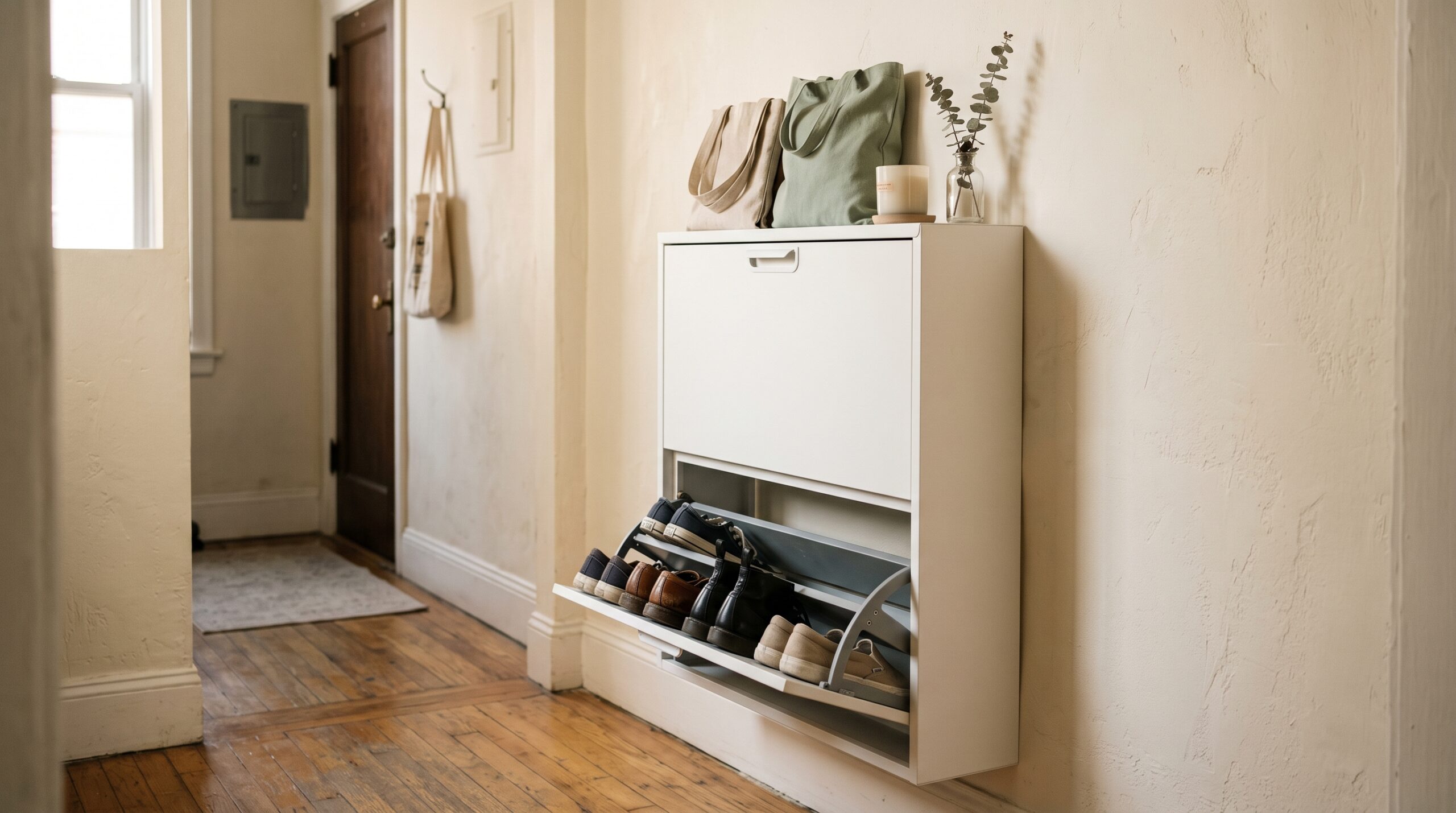
The ultra-slim tilt-out cabinets
Start here, because this is the core of the whole idea. These are the shallowest units on the page, the ones that press flat to the wall and give the hallway back to you. Each stores shoes on a slant behind a flip-down drawer, so the box can stay under a foot deep. Any one of them can be the only shoe storage a small entryway needs.
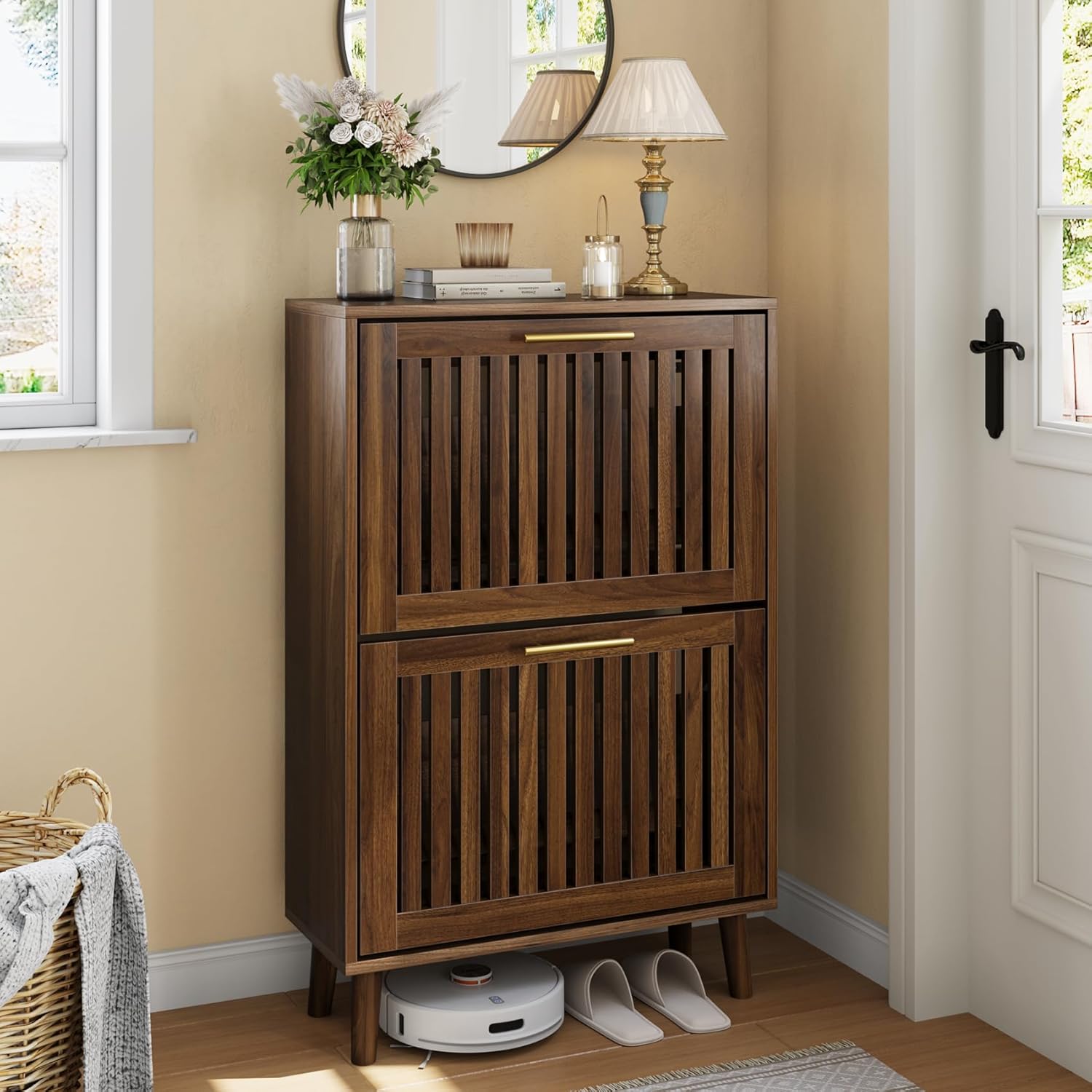
1. Smart FENDEE Slim Shoe Cabinet
The one I would put by my own door. At 9.45 inches deep it sits almost flush to the wall, and the slatted flip drawers hold eight to twelve pairs on a slant without ever crowding the hallway. The walnut-and-gold finish looks like a piece you chose, not a box you settled for, and the anti-tip kit is in the carton if you want it. For most narrow entryways, this is the one to buy and stop looking.
Check price on AmazonNot for: tall riding boots, which will not clear a shallow tilt-out drawer.
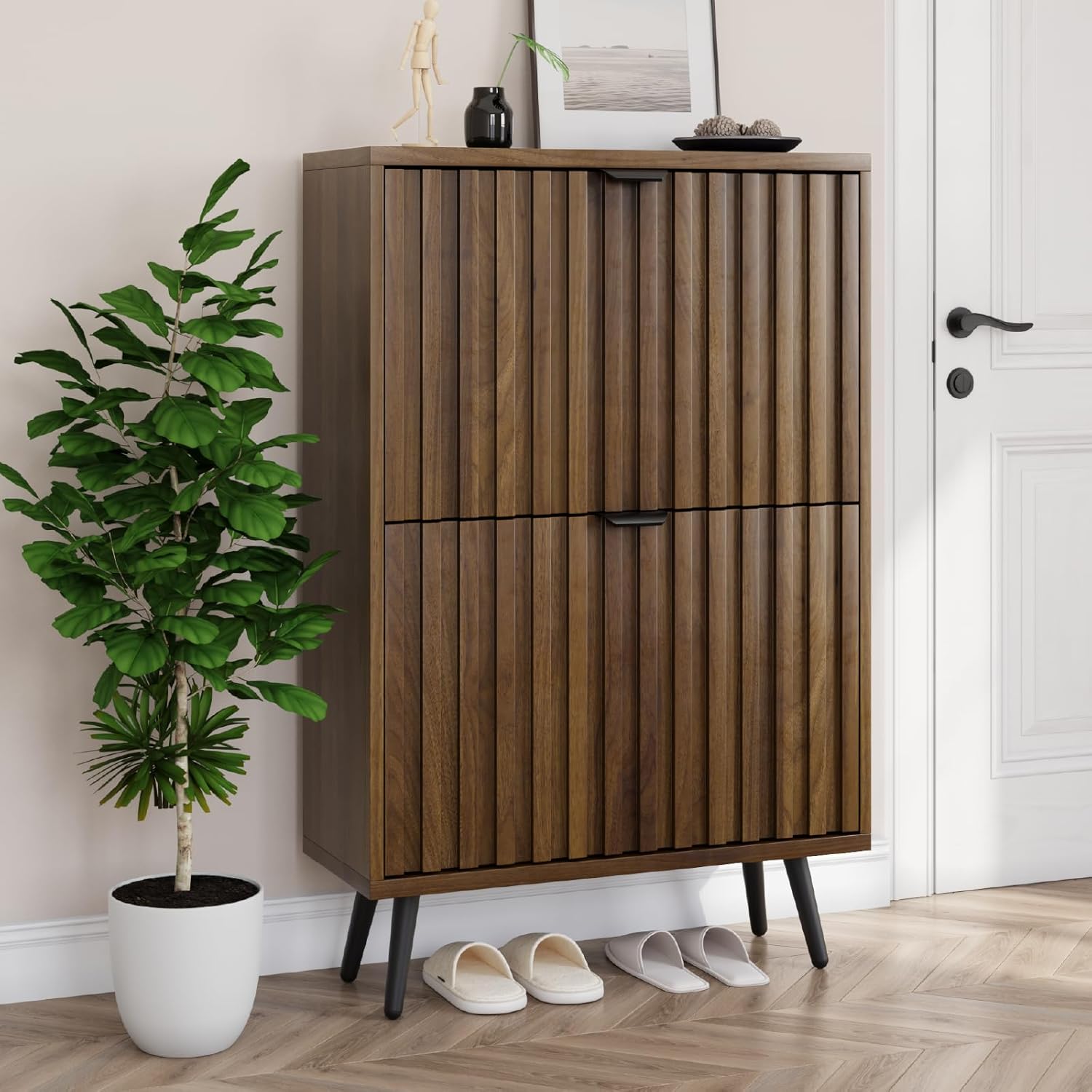
2. Smuxee Fluted Walnut Shoe Cabinet
If you want the cabinet to look like furniture, this fluted walnut unit is the prettiest slim tilt-out I found. It matches the top pick on depth at 9.5 inches, but the ribbed door fronts and matte black legs give it a mid-century look at home in a living room as much as a hallway. Each flip door hides two internal levels, so it stores more than its slim profile suggests.
Check price on AmazonNot for: anyone who wants it built in five minutes; the finish and legs take a little longer.
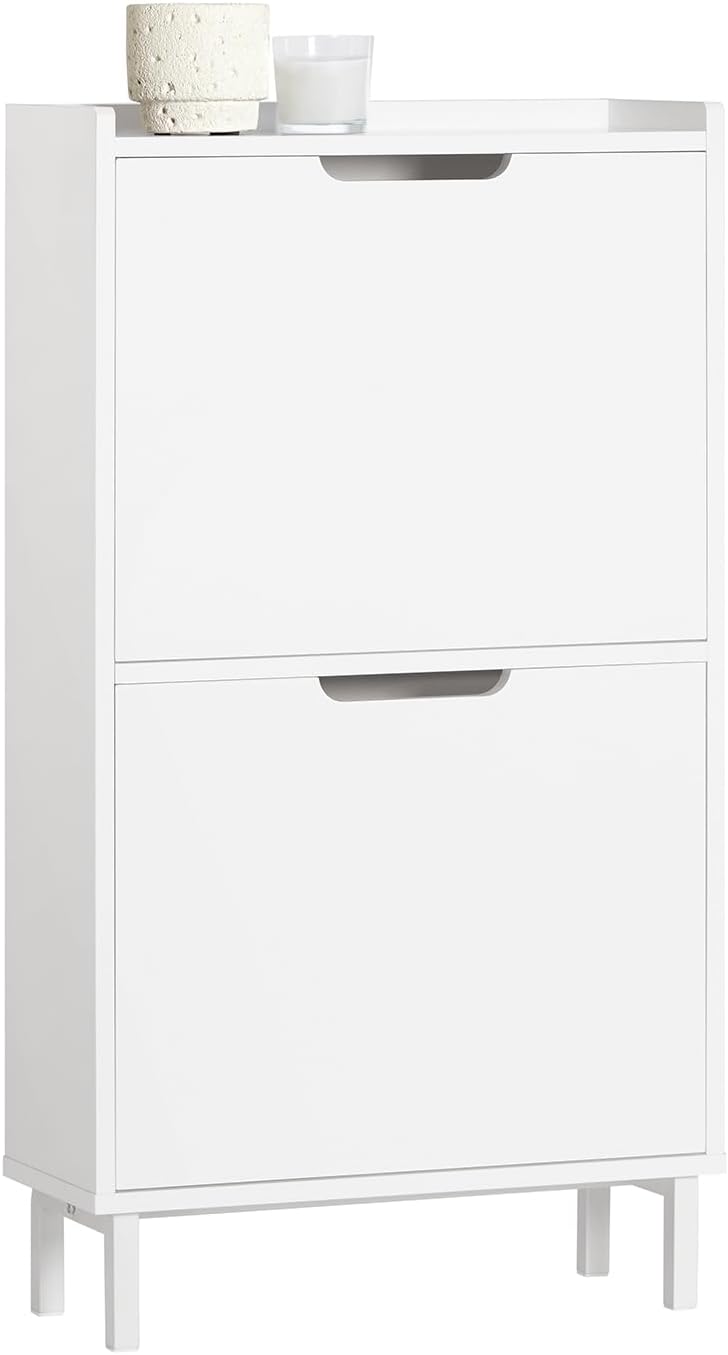
3. Haotian 7.5-Inch Slim Shoe Cabinet
When the hallway is truly tight, this is the shallowest cabinet on the page at just 7.5 inches deep, barely more than the baseboard it stands against. Two hidden-handle flip drawers keep the front flat and clean, and raised metal legs lift the base so slippers slide underneath. The trade-off for that depth is capacity, so treat it as a daily-shoe box for one or two people rather than the whole household’s collection.
Check price on AmazonNot for: big households; the shallowest depth here also means the fewest pairs.
Renter-Friendly Alternative
Every cabinet here stands freestanding on the floor, so none of them touch your walls or your deposit. A few of the taller units ship with an anti-tip strap; if drilling a single small anchor is off the table in your lease, keep to the shorter two-tier and three-tier boxes, which are stable on their own. For the overflow that will not fit, my closet-door hanging organizer guide keeps the same no-damage logic behind the nearest door.

Taller slim cabinets for more pairs
When two tiers will not cover the household, these stack three, four, or five flip drawers into the same narrow footprint. You give up nothing on the floor and gain a lot of pairs, because the cabinet grows up the wall instead of out into the room. This is the group for families, shoe collectors, and anyone sharing one small entryway.

4. Narrow 3-Drawer Tall Shoe Cabinet
This is the one I point big collections toward, because it stacks three flip drawers on a footprint just seven inches deep. It grows up the wall to 47 inches instead of out into the room, so you get roughly six to nine pairs without giving up any more floor. The rattan-and-black panels keep it from looking like an office filing cabinet, which most tall shoe towers cannot say.
Check price on AmazonNot for: anyone who hates bending; the lowest drawer sits near the floor.

5. YATINEY 2-in-1 Hall Tree
If your entry has to do the work of a whole mudroom, this hall tree folds the most jobs into a slim nine-inch base. Two flip-down shoe drawers sit under three open shelves and a coat rail with five movable hooks, so shoes, bags, and jackets all land in one narrow strip of wall. At 63 inches tall it looks like a real piece of furniture, and it ships with two anti-tip kits because of that height.
Check price on AmazonNot for: low-ceiling nooks, or anyone who only needs shoe storage and no coat rack.
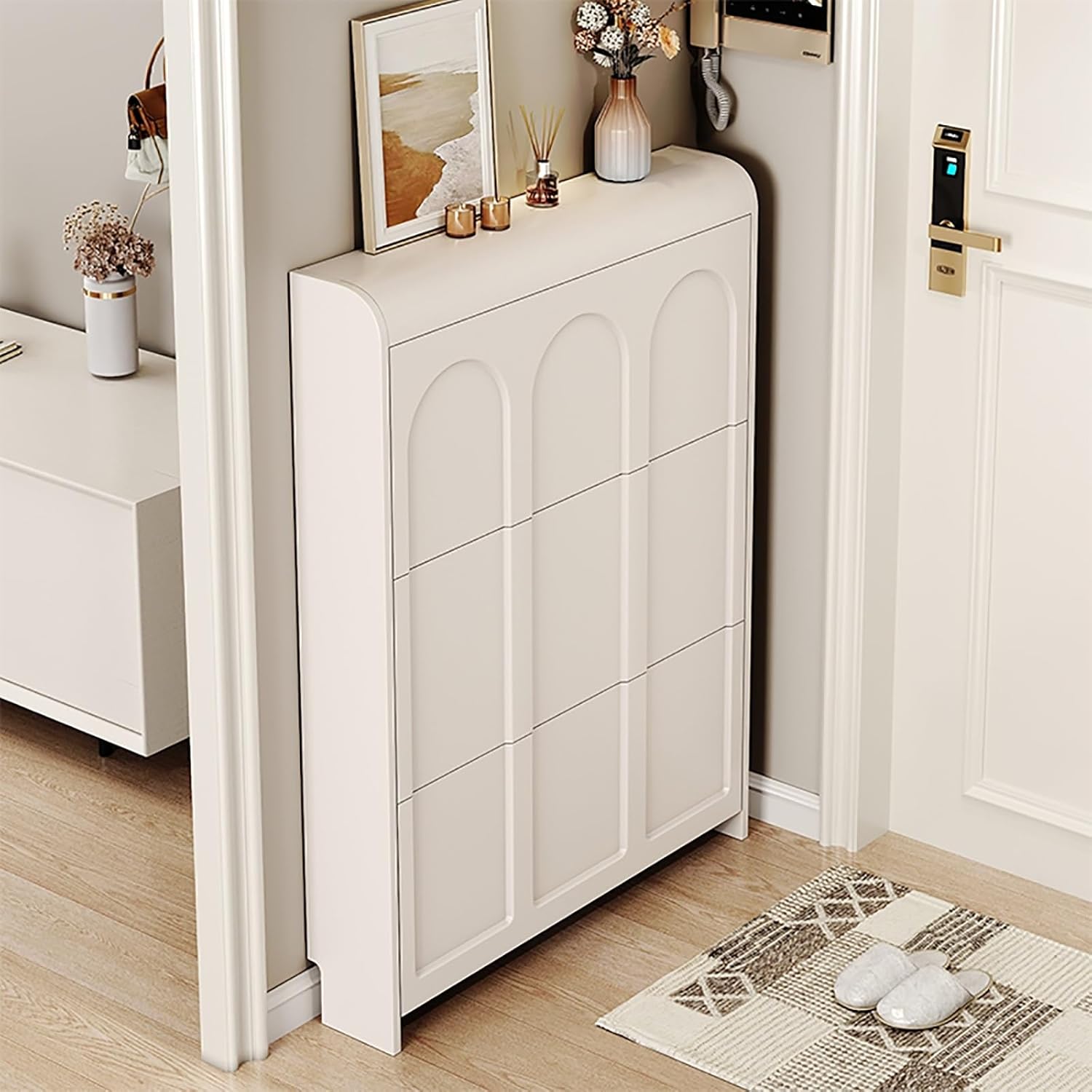
6. Vintage 3-Tier Tipping-Bucket Cabinet
The tipping-bucket design is the clever one for awkward footwear. Its three flip drawers tilt the shoes on an angle inside a 6.69-inch-deep body, shallow enough for a narrow hall yet kind to heels and low boots that would get crushed lying flat. The concealed doors hide the pile completely, and the slim vintage look suits an older apartment. Order it early, since the ship window runs about two weeks.
Check price on AmazonNot for: last-minute buyers; this one takes about two weeks to arrive.
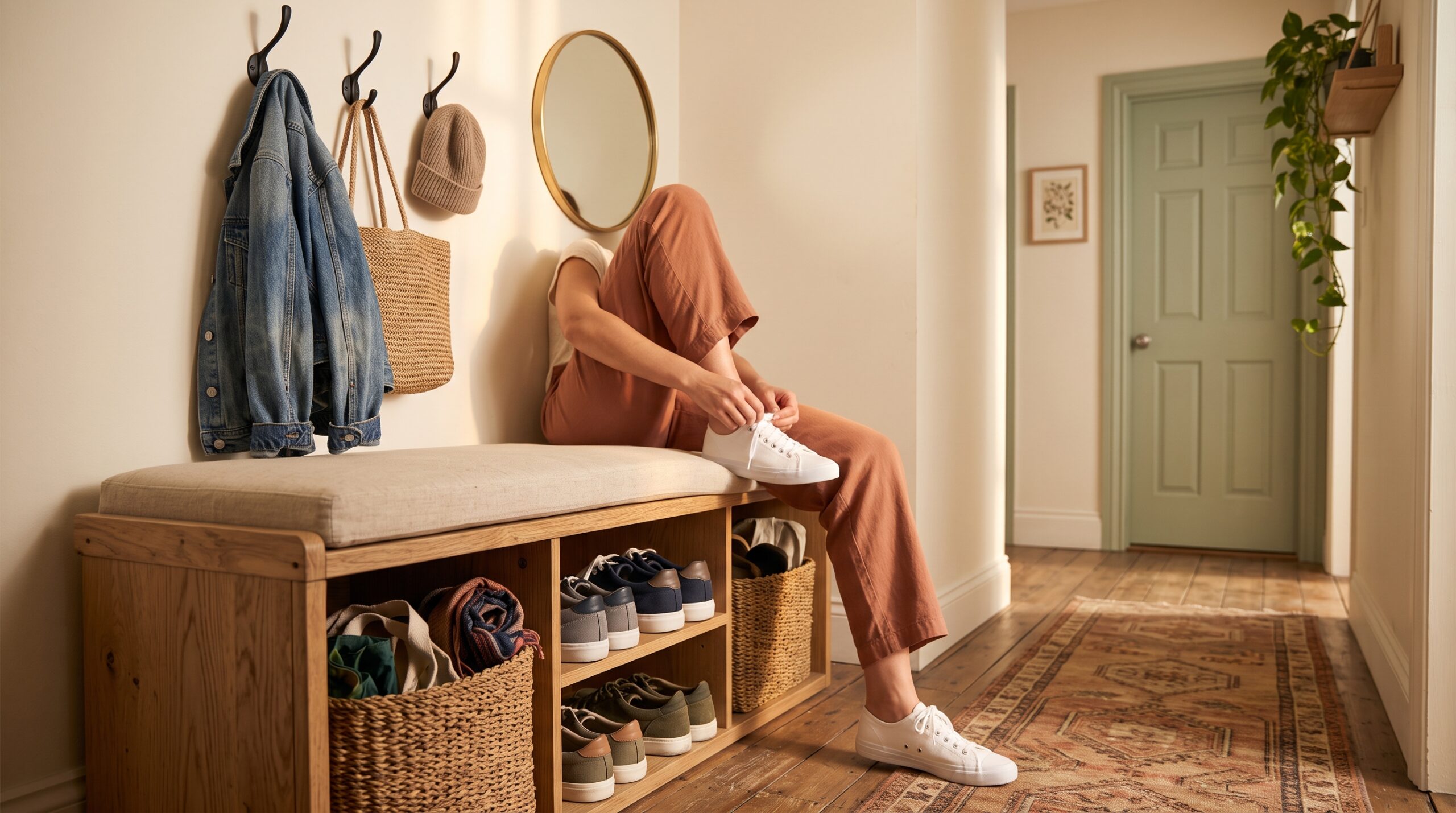
Shoe benches you can sit on to lace up
There is a real case for a seat by the door. Balancing on one foot to pull on a boot gets old fast, and a bench gives you somewhere to land while the storage lives underneath. These stay narrow enough for a small entryway, and they turn the shoe stash into a place to sit, drop a bag, and pause on the way out.
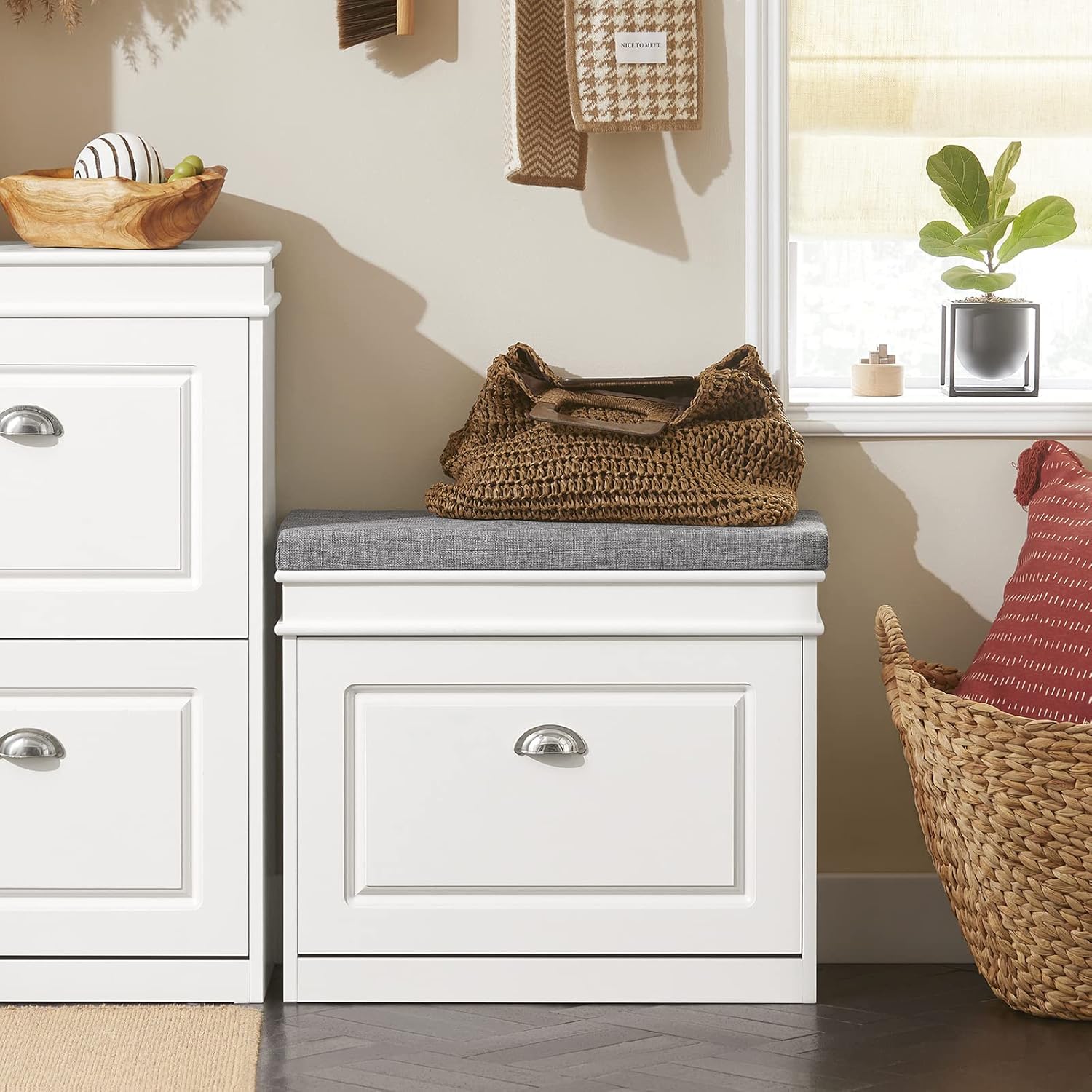
7. Haotian Slim Shoe Bench with Cushion
A seat by the door earns its space the first time you sit to pull on a boot instead of hopping around on one foot. This slim bench is only 9.4 inches deep, tucks a single flip drawer under a padded linen cushion, and is rated to hold a genuine 330 pounds. It is the bench I would choose for a narrow entry that still wants somewhere to land.
Check price on AmazonNot for: big collections; one flip drawer stores only a few daily pairs.

8. Bamboo Bench with Woven Rattan Seat
For a warmer, more natural entry, this bamboo bench with a handwoven rattan seat is the one guests notice. Two open shoe tiers sit under a low 16-inch seat, and the whole thing assembles without tools. It runs a little deeper than the flip-drawer cabinets at around a foot, so measure your lane, but those open shelves swallow the bulky trainers a tilt-out drawer would reject.
Check price on AmazonNot for: hiding clutter; the open tiers leave your shoes on display.

9. SONGMICS 3-Tier Bamboo Bench
The cheapest seat-plus-storage answer here, and a genuinely useful one. Two open shelves hold about six pairs while the solid bamboo top doubles as a sturdy seat rated to a wild 286 pounds. It assembles in minutes and moonlights as a side table or plant stand. At just over eleven inches deep it is not the slimmest, but for this price it is hard to argue with.
Check price on AmazonNot for: the very narrowest halls, where a flip-drawer cabinet saves more depth.
Budget, wood-finish, and no-cabinet picks
Two ends of the same shelf, plus an escape hatch. On one side, the cheapest slim storage I would actually stand by my own door and a warm wood-tone unit for people who hate the look of a plain white box. On the other, a couple of no-cabinet answers, an over-the-door organizer and a slim open rack, for the tightest corner or the shortest lease.
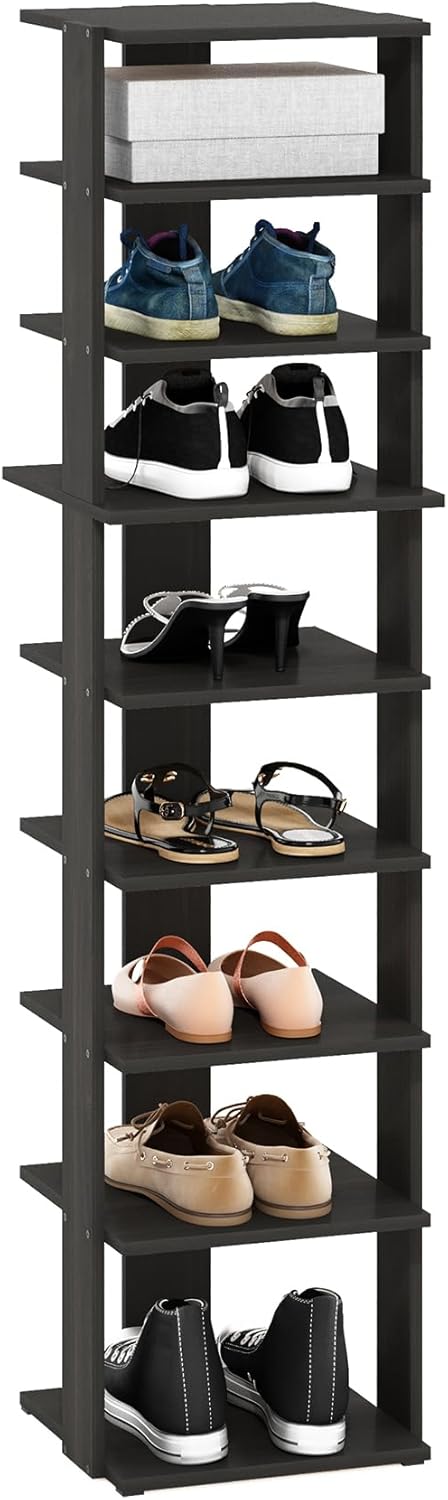
10. Furinno Narrow Vertical Shoe Tower
When you have a narrow sliver of wall to work with, this tower goes vertical instead of wide. It is only 12.6 inches across and stacks nine tiers up the wall, so it swallows a lot of pairs in a corner or the gap beside a door. The shelves are open, which means bulky boots fit freely, and there is a base bay for a shoe box or two. This one saves you on width rather than depth, so measure the gap you are filling.
Check price on AmazonNot for: readers who want doors; everything on these shelves stays visible.
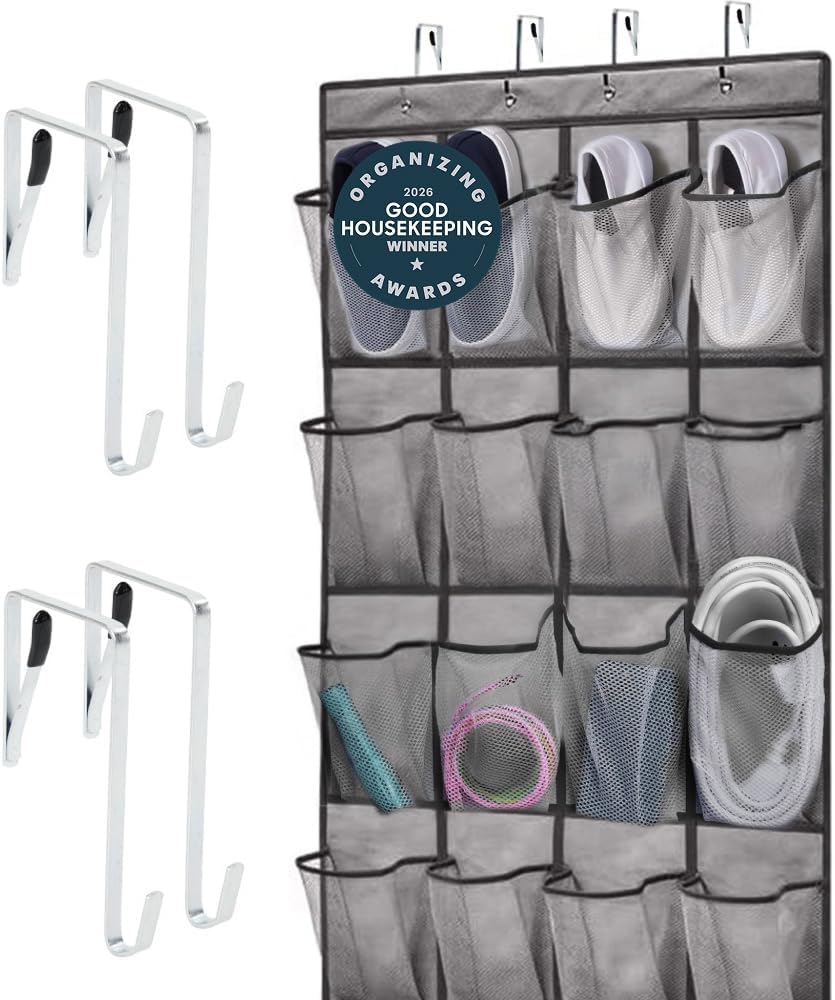
11. Gorilla Grip Over-the-Door Organizer
The answer when there is no floor to give at all. This organizer hooks over an entry or closet door and holds up to 24 pairs in breathable mesh pockets, taking zero square inches of your hallway. It hangs with no tools and comes down clean at move-out, which makes it the most renter-proof pick on the page. It even took a 2026 Good Housekeeping award, and I trust it more for sneakers and flats than for heels.
Check price on AmazonNot for: heavy boots, which drag the mesh pockets down.

12. Homleke Farmhouse Barn-Door Cabinet
For a warmer look than a plain white box, this farmhouse cabinet hides two flip drawers behind a little sliding barn door, all on a slim 9.5-inch base. Tapered legs lift it off the floor so a robot vacuum or a pair of slippers slides under, and the fenced top holds keys and a plant. It stands freestanding and renter-safe, with an anti-tip strap in the box if you want the extra security.
Check price on AmazonNot for: strict minimalists; the farmhouse styling is the whole point here.
What to look for in a slim shoe cabinet for a narrow entryway
The listings all blur together and most of them call themselves slim, so here is how to separate a cabinet that will fix your hallway from one that just moves the clutter around.
Start with the depth, then everything else. Measure how much floor you can give up and still walk past comfortably, then shop for a cabinet that fits inside that number. In a tight hallway that usually means staying under eleven inches deep, and the shallowest tilt-out units land closer to nine. Depth is the whole reason this category exists, so it is the first number I read on any listing and the last one I compromise on.
Confirm it is a real tilt-out. A genuine flip-down drawer holds shoes on a slant, which is the trick that lets a shallow box store a real pair. Study the side-view photo. If the shoes would have to lie flat, the cabinet has to be deep, and deep is the thing you are trying to avoid. The cultures that keep shoes at the door, like the Japanese genkan, have leaned on shallow angled shoe storage for exactly this reason.
Be honest about capacity. A slim tier holds fewer pairs than a deep rack, usually two to four per drawer depending on shoe size, and tall boots often will not fit at all. Count the pairs your household actually parks at the door, then buy the number of tiers that covers it. If you run over, send the off-season and bulky pairs to under-bed storage and keep only the daily shoes in the entryway.
Check stability and the anti-tip strap. Tall, shallow, and full of weight down low is a stable shape, but the tallest four and five-tier units still ship with a wall strap for safety, and I would use it if your lease allows one small anchor. The shorter boxes stand fine on their own. Either way, load the heaviest shoes in the lowest drawer.
Plan for assembly. Almost all of these arrive flat and need building. The two-tier boxes go together in fifteen or twenty minutes; the taller cabinets and the benches take longer and reward a power screwdriver. None of it is hard, but clear the time for the bigger units. If you want more no-drill storage nearby, my no-drill floating shelves guide runs on the same renter-safe logic above the cabinet.
Frequently asked questions
How deep is a slim shoe cabinet, really?
The slim tilt-out cabinets worth buying run about nine to eleven inches deep, compared with fourteen to eighteen inches for a standard shoe rack or cabinet. That few inches is the entire point in a narrow hallway. The drawer holds shoes on a slant rather than flat, which is how the box stays shallow while still fitting a real pair inside.
How many pairs does a slim tilt-out drawer actually hold?
Plan on roughly two to four pairs per tier, depending on shoe size and how bulky the shoes are. A two-drawer cabinet suits one or two people who keep their daily shoes by the door; a four or five-tier unit covers a couple or a small family. Slim storage trades capacity for depth, so match the number of tiers to the pairs you park at the entrance, not your entire closet.
Will tall boots and chunky sneakers fit?
This is the honest weak spot of the tilt-out design. Because the shoes sit on a slant in a shallow drawer, tall boots usually will not close, and very chunky trainers can foul the door. Keep those pairs in an open rack or a taller cubby, and use the slim cabinet for flats, loafers, sneakers, and low shoes, which is most of what piles up by a door anyway.
Do slim shoe cabinets need to be bolted to the wall?
The shorter two and three-tier cabinets stand fine on their own and need no anchor, which is what makes them renter-friendly. The tallest four and five-tier units ship with an anti-tip strap, and I would fit it if your lease allows a single small screw, since a top-heavy cabinet full of shoes is safer strapped. Loading the heaviest shoes into the bottom drawer helps either way.
Are these hard to assemble?
Most arrive flat-packed. The small two-tier boxes take about fifteen to twenty minutes with the included hardware, while the taller cabinets and the benches ask for more time and go faster with a power screwdriver. The wood-frame benches tend to be the longest builds. Nothing here needs a pro, but do not start a five-tier cabinet ten minutes before guests arrive.
What if my entryway is too narrow even for a slim cabinet?
Then skip the cabinet. An over-the-door shoe organizer uses the back of your entry or closet door and takes zero floor at all, and a slim open rack tucks flat against a wall for a few pairs. Both come down clean at move-out, so they suit the shortest leases and the tightest corners where even a nine-inch box is too much.
The short version
In a narrow entryway, shallower storage beats more storage every time, and a slim tilt-out cabinet is how you get it. My top pick, the Smart FENDEE, gets the balance right: a 9.45-inch depth that hugs the wall, genuine flip drawers that still hold eight to twelve pairs, and a finish that looks chosen rather than settled for. Buy that if you want the safe, walk-past-it-every-day answer.
From there it comes down to your household. Stack more tiers if a lot of pairs share one door, add a bench if you want somewhere to sit and lace up, and reach for a budget box or a no-cabinet organizer if the space is truly tight or the lease is short. Pair it with the rest of your small-space storage, like a wall-mounted folding drying rack down the hall, and the whole apartment starts to breathe a little easier.