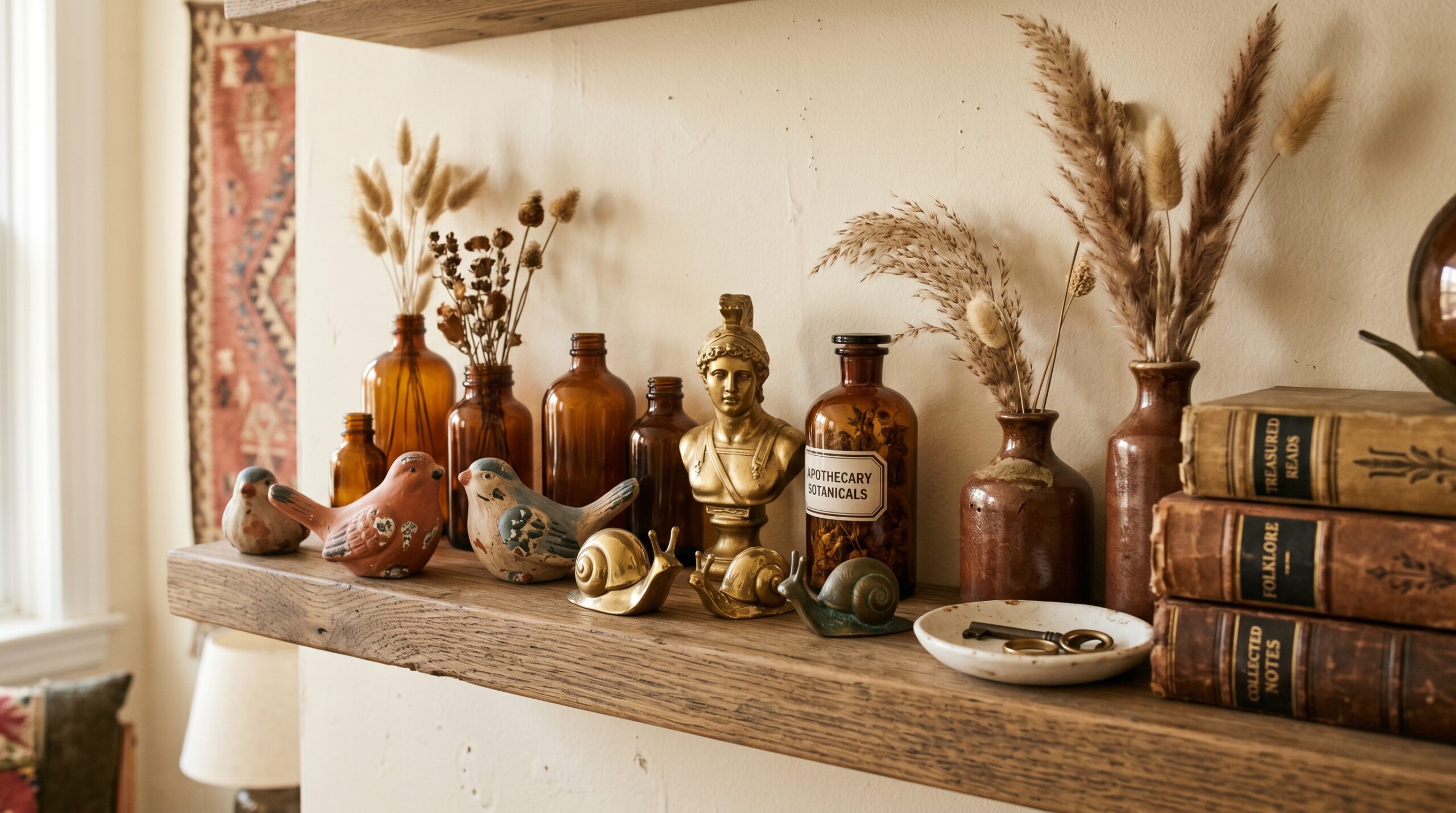
Cluttercore looks expensive, and that is the trick of it. A shelf packed with little brass animals, amber bottles, and stacks of old books reads like years of estate sales and inherited oddities. Most of it costs less than lunch.
I love this aesthetic for renters specifically. You are not painting anything, not drilling anything, not committing to a sofa you will regret. You are buying small, cheap objects and arranging them well. If you move in six months, the whole look fits in one box.
The budget version has one rule the expensive version hides: it is about the collection, not any single object. A lone ceramic bird looks like a thrift-store reject. Three birds, a brass snail, and a tiny gold bust grouped on a riser look like taste. So this is the cheap starter kit, ten thrift-look finds I would actually buy, most of them under $25, every one verified in stock on Amazon as of June 2026.
This post contains affiliate links. If you buy something through one of my links, I may earn a small commission at no extra cost to you. I only recommend products I’d actually use myself.
As an Amazon Associate I earn from qualifying purchases.
My budget anchor: a set of five brass snails
If you spend money on one thing off this list, make it the set of five little brass snails. Here is why it is the smartest first buy: one box gives you five objects in the same finish, and repetition is what reads as a collection instead of clutter. Scatter them across a shelf, tuck one beside a plant, set two on a stack of books. For under twenty dollars you have already done the hardest part of cluttercore, which is having enough small things that share a thread. Everything else builds off this.
How I picked
- Cheap on purpose. Almost everything here is a small-object buy, most under $25. The point of budget cluttercore is that no single piece hurts to buy or to leave behind when you move.
- Thrift-look without the thrift hunt. Real thrifting takes weekends and luck. These fake the aged, collected look out of the box, so you get the payoff without driving to six estate sales.
- Buy in sets where you can. A set of three birds or six bottles does more than one of anything, because density is the whole aesthetic. I leaned toward multipacks that hand you a collection in one order.
- Renter-safe by default. Nothing here drills, mounts, or marks a wall. It all sits on a shelf, a sill, or a console and leaves with you.
- Verified, not guessed. I checked every piece on its live Amazon page for stock on June 11, 2026, before it made the list.
One note before the picks. Cluttercore in a small apartment only works if the density is controlled, not actual mess. If you want the full method behind that, my guide to cluttercore without the chaos covers the containment rules, and this list is the cheap way to stock the look.
Start a collection with repeated shapes (3 picks)
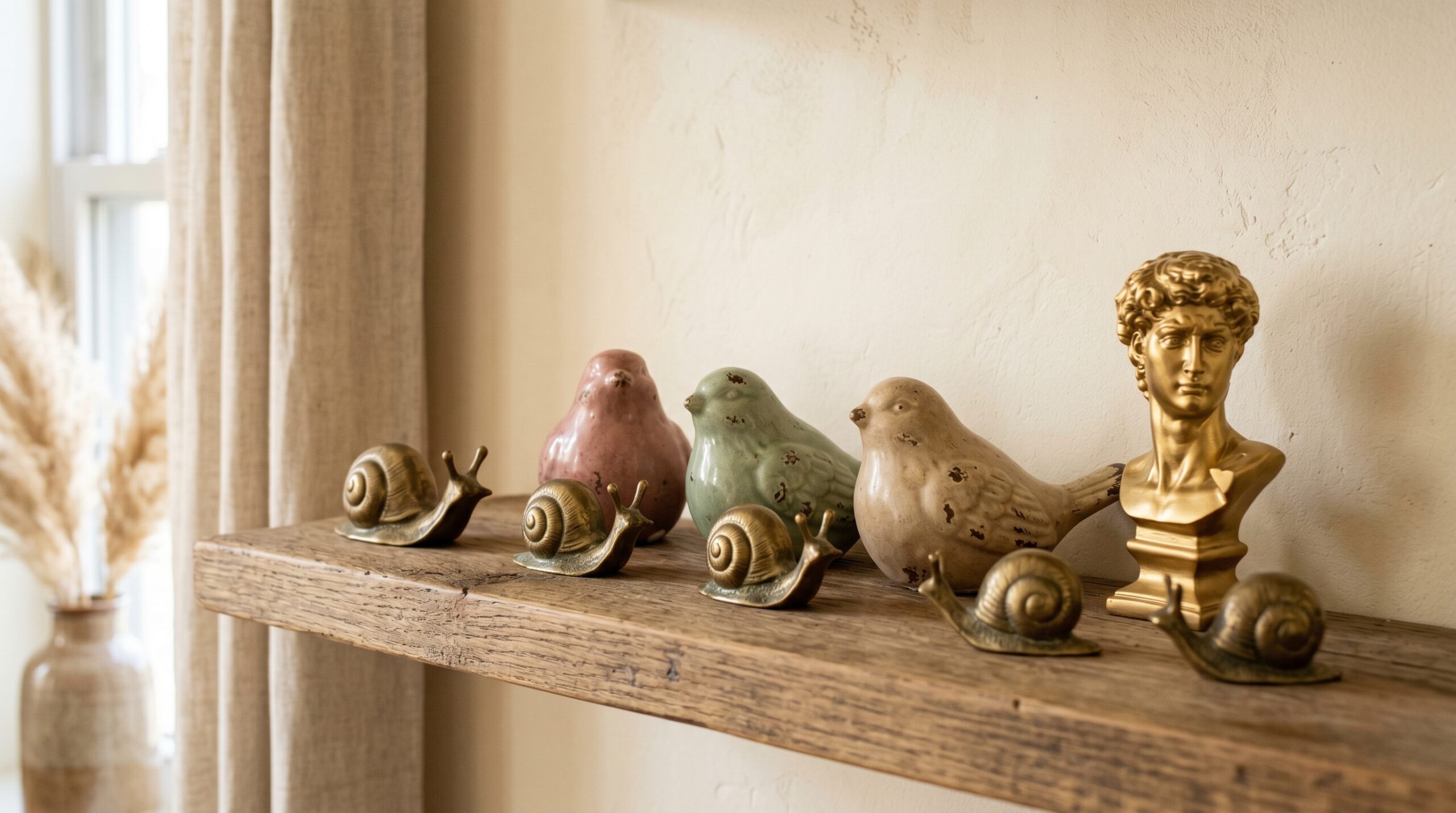
The cheapest way into cluttercore is figurines. Small, sculptural, and easy to group, they do the most work per dollar. Buy in sets so you start with density, and let one slightly bigger shape anchor the group.
1. 5-Piece Brass Snail Figurines (top pick, budget anchor)
The piece I would buy first, and the cheapest real lesson in cluttercore. Five small brass snails in a matching antique finish give you instant repetition, which is the difference between a collection and a stray knickknack. They are tiny, so they fill the awkward gaps a bigger object cannot, between books, on a windowsill, at the foot of a lamp. The solid alloy has real weight, so they do not read as the plastic dollar-store version. One box, five objects, the foundation of the whole shelf.
See the Brass Snail Figurine Set on Amazon →
Set of 5 · solid brass and alloy · antique finish · about 1.6″ each
Not for: anyone who wants one big statement object. These are deliberately small scatter pieces.
2. Distressed Ceramic Bird Figurines, Set of 3
This is the “inherited from grandma” look for a few dollars, no inheritance required. Three plump ceramic birds in different colors, each with an aged crackle glaze that fakes decades of mantel time. At about 4.5 inches they are bigger than the snails, so they read from across the room and break up a shelf of tiny things. Buying the set of three matters here: a single bird looks lost, but a small flock looks intentional. I scatter them so they are not lined up like a shelf in a gift shop.
See the Ceramic Bird Set on Amazon →
Set of 3 · glazed ceramic, aged crackle finish · about 4.5″ tall each
Not for: a clean modern shelf. The distressed glaze leans cottage and vintage.
3. 8-inch Gold David Bust
Every busy shelf needs one shape bigger than the rest, or the eye has nowhere to land. This 8-inch gold resin David is that anchor, cheap enough to count as a budget pick but substantial enough to hold the center of a vignette. The classical bust is peak dark-academia cluttercore, the kind of object that looks like it cost real money and did not. I set it slightly off-center and let the snails and birds collect around its base. One of these per shelf is plenty; two starts to look like a museum gift shop.
See the Gold David Bust on Amazon →
8″ tall · gold-finish resin · felt-padded base
Not for: a minimalist corner. This is an unapologetically decorative focal object.
Once you have the figurines, the next question is where they live. A set of cheap picture ledges or a leaning shelf gives the collection a stage, and my picks for no-drill floating shelves are the renter-safe way to get one on the wall. For a deeper styling method, the cluttercore bookshelf guide walks through layering a full shelf.
Fill it out with vessels, stems, and faux books (4 picks)
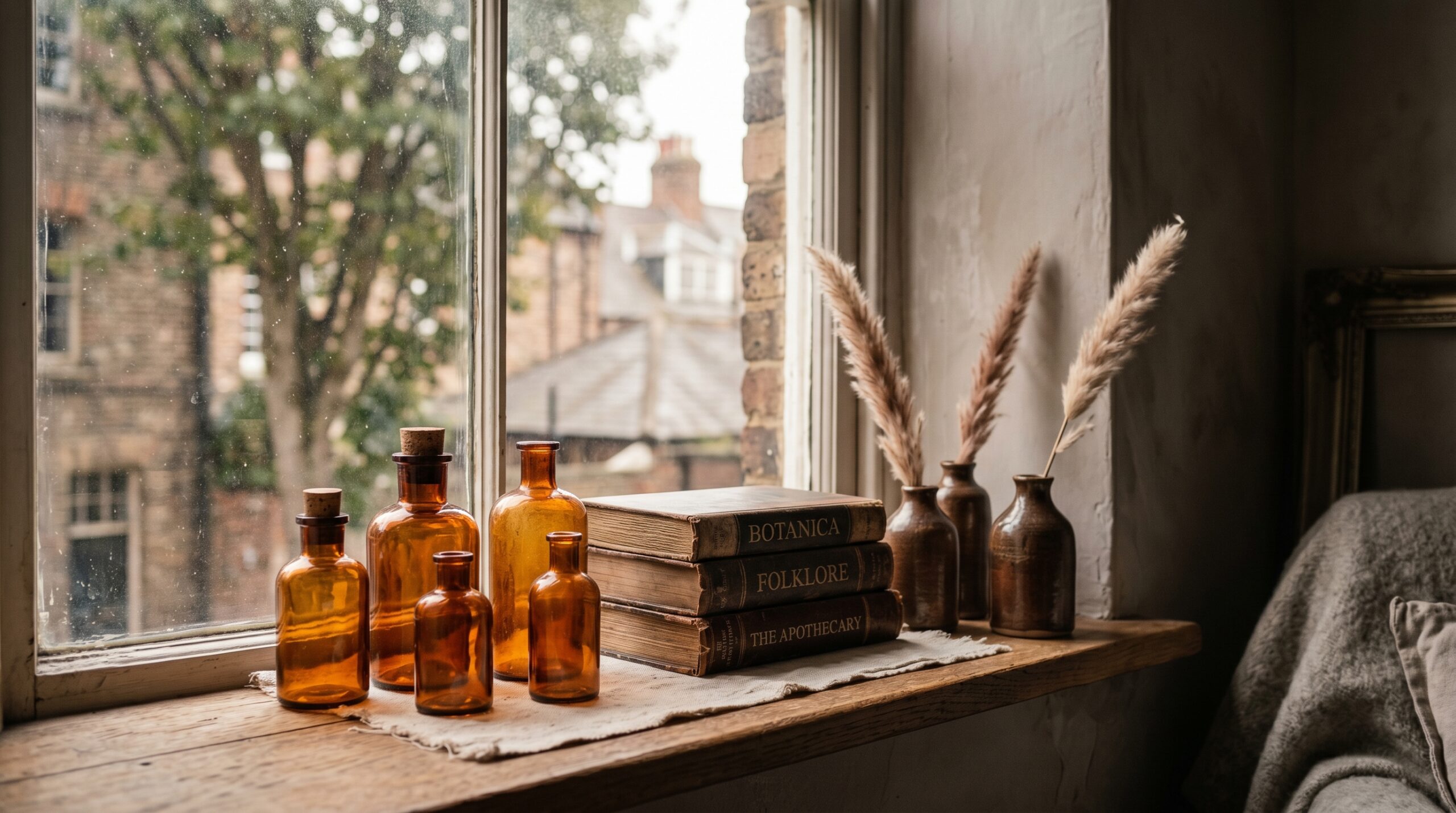
Figurines alone read a little flat. Vessels add height and a place to tuck greenery, and a stack of old books adds the bookish texture cluttercore lives on. This group is where the shelf goes from a few objects to a layered scene.
4. Ceramic Bud Vases, Set of 3
Three small ceramic bud vases in graduated metallic browns, the soft fill that rounds out a shelf full of hard brass and ceramic. They are short, so they slot under taller pieces without blocking them, and the warm brown palette ties into the brass through-line. Each one holds a single dried stem, which is exactly the restraint a small shelf wants. I like that they come as a set of three at slightly different heights, so they already group like a little still life.
See the Ceramic Bud Vase Set on Amazon →
Set of 3 · ceramic, graduated metallic brown · bud-vase scale
Not for: big arrangements. These hold a single stem each, not a bouquet.
5. Amber Glass Apothecary Bottles, Set of 6 (best density per dollar)
Six amber bottles for the price of one decent candle, and they might be the highest-impact buy on the list. Amber glass is instant old-apothecary character, and getting six in one order means you can cluster them and create real density on a windowsill or shelf the day they arrive. Group all six together for a moody chemist’s-shelf look, or split them across a couple of surfaces. They also catch light beautifully, which earns them a spot near a window in a dim small apartment. A cleaning brush is included, a small thing I appreciated.
See the Amber Apothecary Bottle Set on Amazon →
Set of 6 · amber glass · vintage medicine-bottle shape · cleaning brush included
Not for: a bright, cool-toned room. Amber glass reads warm and moody.
6. Dried Pampas Grass, 100 Stems
One cheap bundle fills every vessel you just bought. A hundred mixed dried stems, including fluffy bunny tails and thin reed grass, splits across the bud vases and the amber bottles and still leaves extras. Dried means no water and no upkeep, which is the whole appeal for a renter who travels or forgets to water things. At 17 inches the stems are short enough for small-scale vessels without towering over the shelf. Trim a few even shorter for the bottles and let the longer ones spray out of a vase.
See the Dried Pampas Bundle on Amazon →
100 stems · 17″ · dried natural grasses · white and brown tones
Not for: anyone sensitive to shedding. Dried grasses drop a little; not ideal right over a bed.
7. Faux Antique Book Stack
A solid resin block molded and painted to look like three stacked antique hardcovers, and from a few feet away nobody can tell. Cluttercore leans hard on old books, but real ones are heavy, dusty, and take up shelf you may not have. This fakes the bookish layer in one light, dust-proof piece. I use it as a riser, setting a small bird or the brass dish on top to add a level. It is the laziest way to get the dark-academia texture without hauling home a crate of thrifted paperbacks.
See the Faux Book Stack on Amazon →
Single resin piece · faux stack of 3 books · 7.5″ x 5.5″ · no storage, pure decor
Not for: anyone wanting real storage. It is a solid block, not a hollow box.
Budget cluttercore is not about finding rare things. It is about buying cheap things in sets and grouping them like they are rare.
If you are weighing this dense, layered look against the bolder, more saturated end of the spectrum, my cluttercore versus maximalism breakdown sorts out which one your taste is actually reaching for. Both sit inside the broader maximalist “more is more” tradition, just expressed through different kinds of density.
Make cheap look collected: the styling cheats (3 picks)
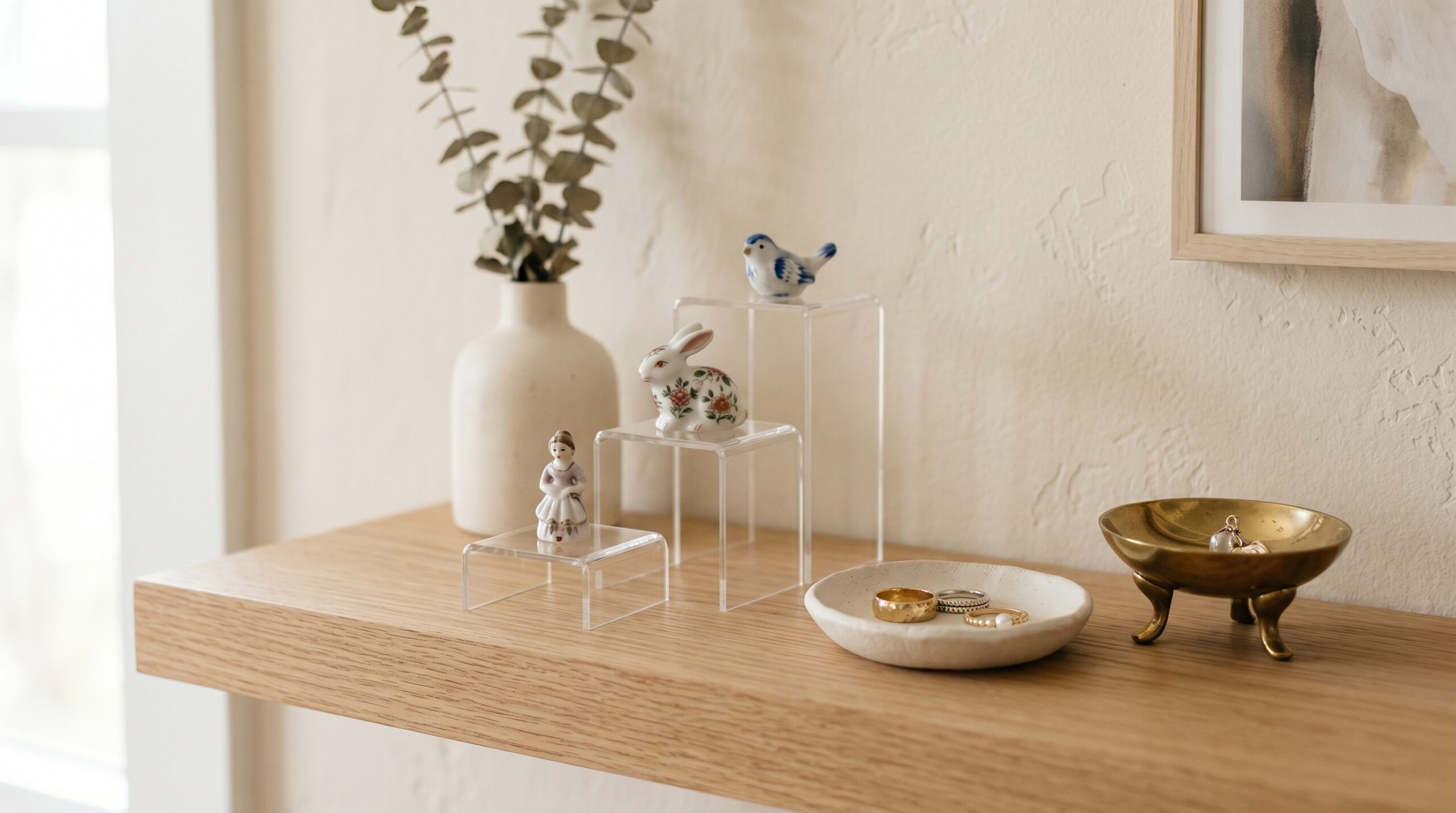
This is the group most people skip, and it is the one that separates a pile of trinkets from a styled shelf. Risers add the levels, and small dishes corral the loose stuff so the density reads as composed instead of scattered. Cheap pieces, big difference.
8. Clear Acrylic Display Risers, Set of 6
The single best styling trick on this list, and almost nobody buys it. Six clear acrylic risers in tiered heights let you lift the back row of a shelf so every object is visible, the way a good shop display stacks levels. Because they are clear, they disappear under whatever sits on them, so you get the height without adding visual clutter. Set the David bust on the tallest, a bird on a middle one, and suddenly a flat row of objects has depth. This is how a budget shelf stops looking like a junk drawer.
See the Acrylic Riser Set on Amazon →
Set of 6 · clear acrylic · tiered heights · wipe-clean
Not for: a shelf you want to keep ruthlessly flat and minimal. These are about adding layers.
9. Ceramic Trinket Dish, 4.75″
The cheapest piece here and one of the most useful. A small round ceramic dish gives the loose little things a home, rings, a stray brass snail, matches by a candle, so the shelf has a deliberate catchall instead of scattered debris. Containment is half of what makes cluttercore look styled rather than messy, and a single dish does that job for a couple of dollars. I keep one on every surface that tends to collect small objects anyway, which turns a problem spot into a planned one.
See the Ceramic Trinket Dish on Amazon →
4.75″ round · lead-free ceramic · white surface
Not for: holding much. It is a small catchall, not a tray for a full vignette.
10. Solid Brass Clawfoot Pedestal Dish (the one splurge-feel piece)
If you let one piece feel like a small splurge, make it this. A solid brass clawfoot dish on little pedestal feet brings real metal weight and a hand-cast vintage character that the plastic-feeling budget pieces cannot fake. It costs a bit more than the trinket dish but still lands in cheap-treat territory, and one genuinely nice object lifts the perceived value of everything cheap around it. I use it for the small things I actually reach for, rings and a watch, so it earns its keep daily and anchors the styled corner of the shelf.
See the Brass Clawfoot Dish on Amazon →
4.5″ round · solid brass · clawfoot pedestal · antique finish
Not for: the absolute rock-bottom budget. It is the priciest small piece here, by design.
How to make ten cheap things look like a collection
- Group in odd numbers. Three or five objects clustered read as styled; two or four tend to look like bookends. The snail set and the bird set already hand you odd-numbered groups to work with.
- Vary the height, not the palette. Keep the colors in one warm family (brass, amber, brown, gold) and create interest with levels instead, which is exactly what the risers and the faux book are for.
- Give every loose thing a dish. The fastest way to make density look intentional is to corral the small stuff. A trinket dish or the brass pedestal turns “stuff left out” into “a curated catchall.”
- Leave a little air. Even budget cluttercore needs one or two small gaps so the eye can rest. Pack a shelf 80 percent full, not 100, or the density tips into genuine clutter.
- Repeat one shape across the room. Put a snail or a bird on more than one surface. Repetition across a small space is what makes a handful of cheap objects feel like a deliberate collection rather than random buys.
Where to put it all in a small apartment
You do not need a big bookcase. A single picture ledge, the top of a dresser, a windowsill, or one shelf of an existing unit is enough to hold a full budget-cluttercore vignette. In a studio I would pick one surface near a light source and make it the collected corner, rather than scattering objects thinly across every flat surface, which just reads as untidy.
If you want more specific object ideas beyond this starter kit, my roundup of the best cluttercore knickknacks on Amazon goes wider on the curio-cabinet pieces, and pairs naturally with everything here.
Frequently asked questions
How do I do cluttercore on a small budget?
Buy small objects in sets rather than single statement pieces, and keep them in one warm color family so they read as a collection. A set of figurines, a few vessels, some dried stems, and a couple of small dishes get you most of the look for under a hundred dollars total. The styling, grouping in odd numbers and adding height with clear risers, costs nothing and does more than spending more would.
Does cluttercore work in a small apartment?
Yes, as long as the density is contained to chosen surfaces instead of spread everywhere. The trick in a small space is to make one shelf or console the collected corner and keep the rest of the room calmer. Containment pieces like trinket dishes and risers are what keep the look styled rather than cramped, which matters more the smaller the room is.
Is cluttercore renter-friendly?
It is one of the most renter-friendly aesthetics there is. Nearly all of it is small objects that sit on existing surfaces, so there is no painting, no drilling, and nothing to repair when you move. The entire look packs into a box and comes with you, which is exactly why it suits people who move often or cannot alter the apartment.
What is the difference between cluttercore and just being messy?
Intent and containment. Mess is objects with no relationship to each other left wherever they land. Cluttercore is objects chosen to share a thread, grouped deliberately, lifted and corralled so the density looks composed. The same shelf can read as either, and the difference is almost entirely in the styling, not the number of things.
The short version
Start with the brass snails, because a set of matching little objects is the cheapest way to make a shelf read as a collection. Add the ceramic birds and the gold bust for variety and an anchor, then fill in with bud vases, amber bottles, and a cheap pampas bundle to spread across them. The faux book adds bookish texture for next to nothing.
Then spend your styling effort, not your money: lift the back row on clear risers and corral the loose pieces in a dish or two. Ten cheap things, grouped well, look like a collection you spent years building. That is the entire trick of budget cluttercore, and as a renter it leaves with you in a single box.