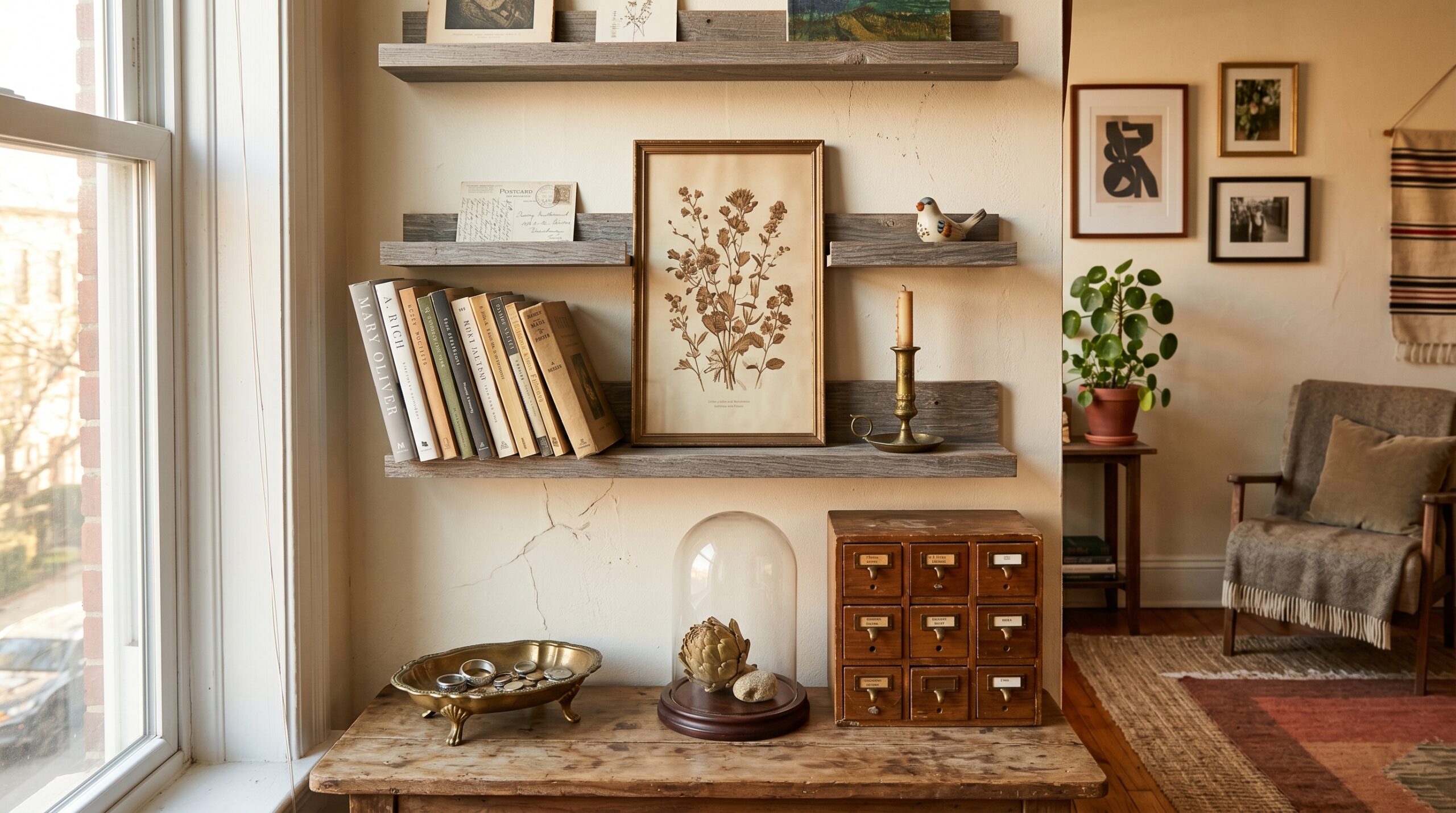
Cluttercore is the only maximalist trend that gets harder the smaller your space is. The aesthetic asks for shelves of objects, gallery walls, layered textures, and visible personality. A 400 square foot apartment punishes every one of those choices if you let it. The line between “curated cluttercore” and “I haven’t unpacked yet” is so thin that most people never find it.
I think the trick is treating cluttercore as a containment problem, not a styling problem. The vintage figurines, the inherited postcards, the tray of foreign coins, those all stay. What changes is where they live, what frames them, and what stops them from spreading. Below is the framework I use, and the eleven specific products that make it work without the room feeling chaotic.
This post contains affiliate links. If you buy something through one of my links, I may earn a small commission at no extra cost to you. I only recommend products I’d actually use myself.
As an Amazon Associate I earn from qualifying purchases.
The five rules that keep cluttercore from tipping into clutter
I keep coming back to these when I edit a shelf or rebuild a vignette.
- Every object needs a container, a frame, or a peer. A figurine alone on a shelf reads as overlooked. The same figurine on a tray with two coins and a small candle reads as collected.
- Vertical density beats horizontal sprawl. Stack and layer upward before letting objects creep along a surface.
- One material gets to be the through-line. Mine is brass. It can be antique, it can be polished, it can be a single bracket; if a piece has a brass element, it belongs.
- Hide the chaos that has no aesthetic value. Receipts, charger cables, spare batteries, medication boxes, all of that goes behind lids and inside drawers. The visible mess has to be the good mess.
- Negative space is the framing. Even a maximalist shelf needs an empty corner, or the eye has nowhere to rest.
Step 1: Corral every surface
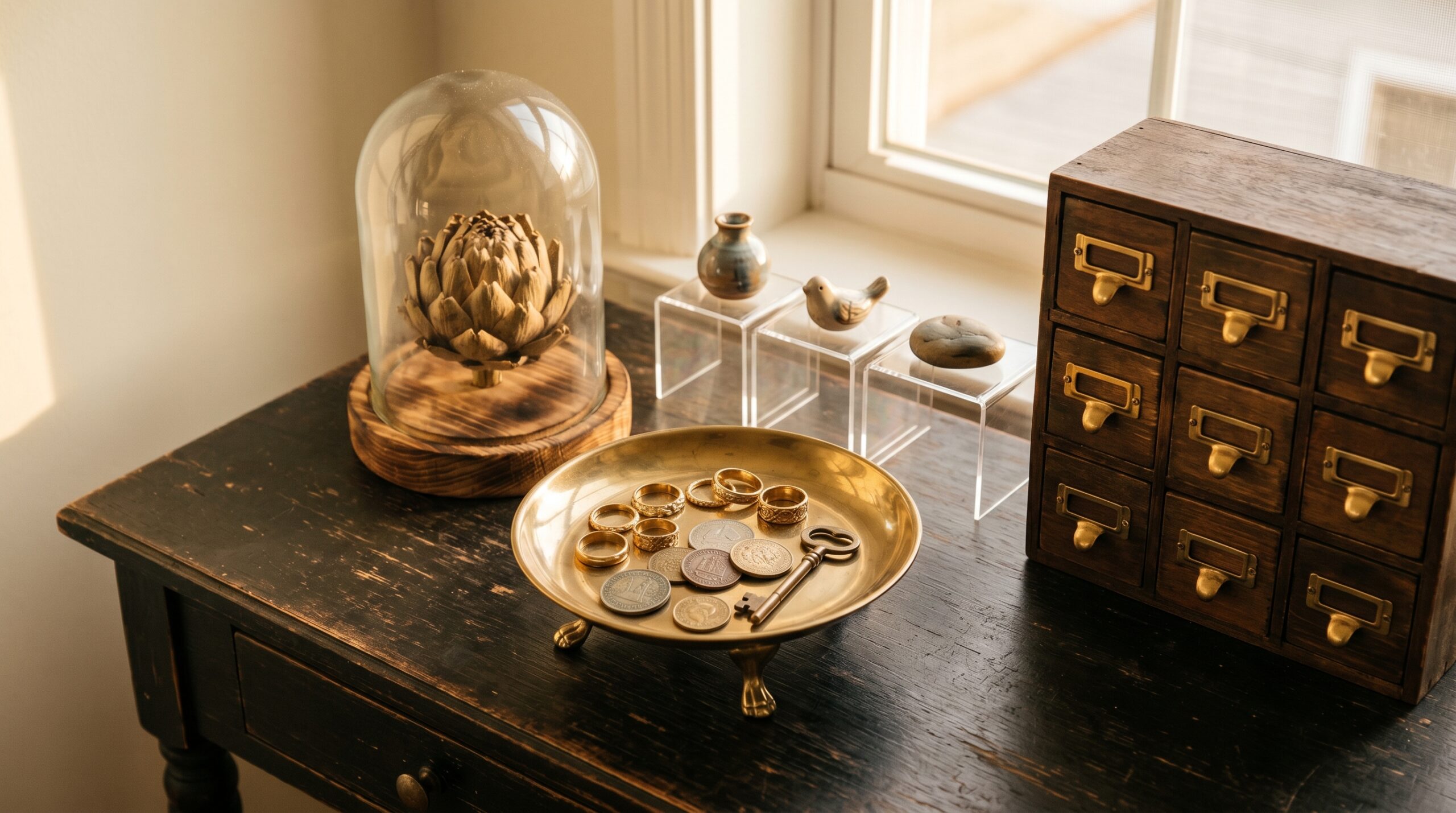
Cluttercore reads as chaos the moment small objects scatter. The fix is moving them onto a tray, a dish, or a riser so they cluster on purpose. A tray is the cheapest visual edit you can make to a room.
1. Hapton House Solid Brass Clawfoot Catchall Dish (my surface anchor)
I keep this on my entryway console for rings, hairpins, and the change that otherwise lives on the floor. It is small, four and a half inches across, but it is the kind of object that telegraphs intent. A solid-brass clawfoot pedestal sets the visual rule for the rest of the surface: every loose item now has somewhere to go. Hand-cast, antique brass finish, no faux-aging coating to chip off.
See the Hapton House Brass Clawfoot Catchall Dish on Amazon →
Hapton House · 4.5″L x 4.5″W x 1.37″H · solid brass
Not for: anyone who wants a generic IKEA-style dish. This piece reads vintage.
2. MyGift 10-inch Bell Jar Glass Cloche
The cloche is the most underused cluttercore tool. It elevates one object into a deliberate display, which gives the eye a place to land before it sweeps across the rest of the room. I put a dried artichoke under mine. A friend uses hers for a single ceramic bird. The point is that the glass dome converts an ordinary trinket into a curated one.
See the MyGift Bell Jar Glass Cloche on Amazon →
MyGift · 6.8″ base x 8.8″H, 10″ overall · solid burnt-wood base
Not for: rooms with cats who knock things over. Glass dome plus shelf edge equals trouble.
3. Clear Acrylic Display Risers (set of 6)
Risers are the technical layer underneath good cluttercore. I use them to stagger heights on a shelf, so the ten objects sitting there read as a composition rather than a row. The acrylic is the point. Wooden risers add visual weight; the clear ones disappear and let the objects feel taller than they are.
See the Clear Acrylic Display Risers on Amazon →
6-piece set · four sizes · clear acrylic
Not for: anyone after a warm, organic look. These are pure utility, invisible by design.
4. Flexzion 9-Drawer Apothecary Cabinet (splurge, but it organizes everything else)
This is the piece I would buy first if I were starting cluttercore from scratch. Nine labeled drawers, sixteen inches wide, sits on a console or a desk and absorbs the small inventory that has no other home. Buttons. Postage stamps. Loose beads. The kind of objects you want to keep but cannot display.
See the Flexzion Apothecary Cabinet on Amazon →
Flexzion · 4.1″D x 16″W x 11″H · solid wood with metal label holders
Not for: minimalists, obviously. Also not for renters who move every six months; it is tabletop but it is still 11 pounds.
A tray is the cheapest visual edit you can make to a small apartment.
Step 2: Take it vertical
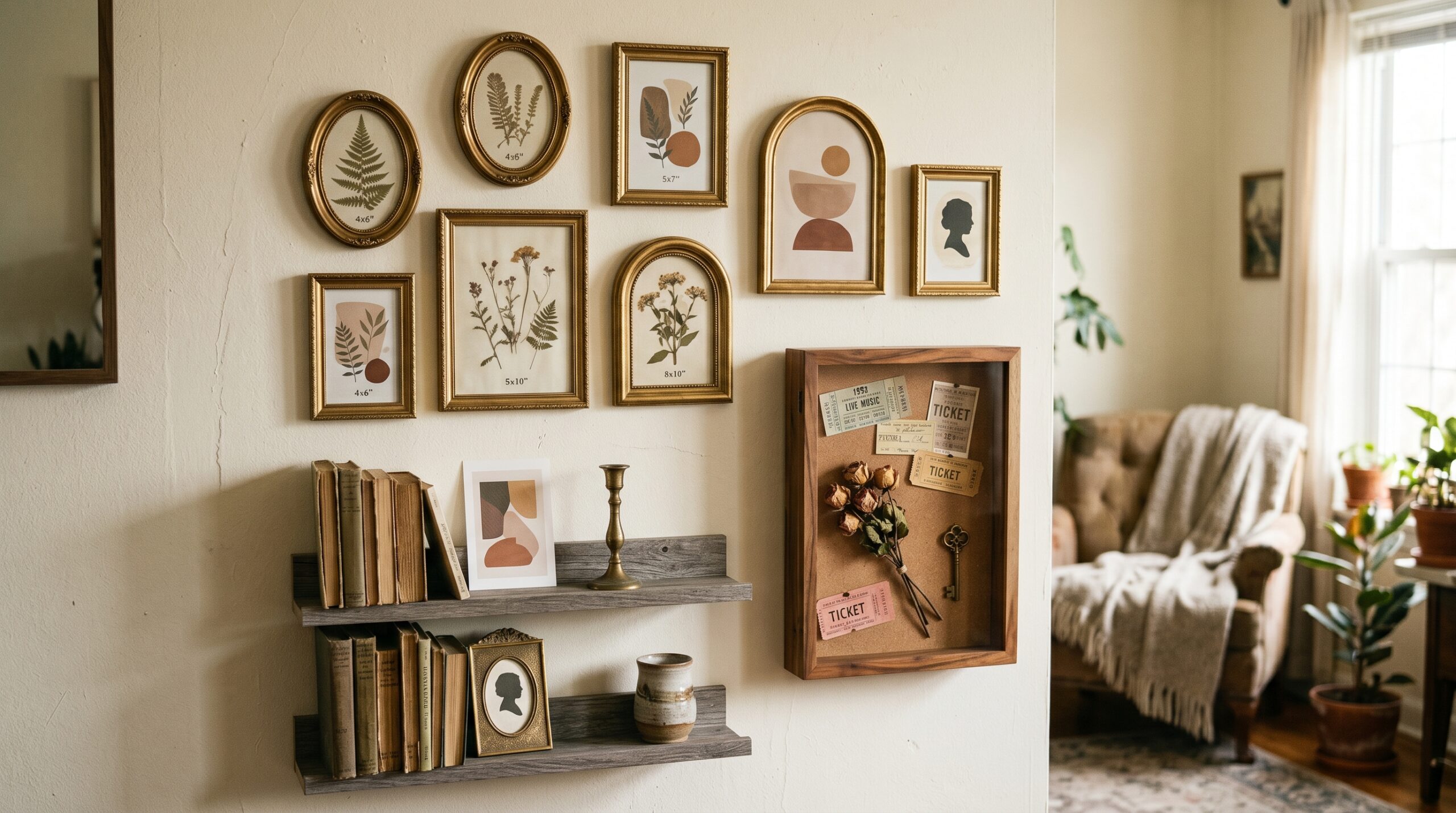
Once surfaces are anchored, the next move is up. Cluttercore wants gallery walls, picture ledges, and shadowboxes because they let you display ten times more objects without losing a square inch of floor. Vertical density is the small-space cheat code.
5. Emfogo Wood Picture Ledge Shelves (set of 3)
Picture ledges are the workhorses of small-space cluttercore. The front lip stops books and frames from sliding, which means I can lean four objects against the wall on a four-inch shelf without anything falling. I have three of these stacked vertically above my desk holding poetry books, a brass candlestick, a small framed print, and a postcard from 1962.
See the Emfogo Picture Ledge Shelves on Amazon →
Emfogo · each 4.3″D x 16.9″W x 1.5″H · set of 3 · weathered grey real wood
Not for: anyone wanting deeper shelves for chunkier objects. Stick to flat or small.
For a fully no-drill version of this wall, I broke down the best floating shelves for small apartments with no drilling separately.
6. MyGift Acacia Wood Shadow Box with Acrylic Panels
The shadowbox is what I use for objects that need protecting but should still be seen. Concert tickets, dried roses, a brass key from an old apartment. The cork back lets me pin items in place; the hinged magnetic door means I can refresh the contents whenever the layout starts to feel stale. Eleven by fifteen inches gives enough room for a thematic collage without overpowering a small wall.
See the MyGift Acacia Shadow Box on Amazon →
MyGift · 11.2″L x 6.1″W x 15.1″H · solid acacia · acrylic panels · hinged magnetic door
Not for: anyone who wants a frame they can swap out monthly. The cork pinning is permanent-feeling.
7. 8-Piece Vintage Gold Gallery Frame Set
The trick to a cluttercore gallery wall is using one frame language across mismatched art. This set gives you eight frames in three sizes and three shapes, all in the same hand-distressed gold. I mix family photos, thrifted prints, a pressed flower, and a postcard inside them, and the room reads as collected instead of accumulated. The gold ties everything together.
See the Vintage Gold Gallery Frame Set on Amazon →
Set of 8: 2x 8×10, 2x 5×7, 4x 4×6 · resin with distressed gold finish · sawtooth hangers + tabletop
Not for: anyone after a clean, modern gallery. These are baroque and proud of it.
8. Antique Brass Decorative Shelf Brackets (set of 2)
If you want the DIY version of a curio shelf, two of these and a board from any hardware store gets you a deeply cluttercore wall ledge. The Baroque profile turns a basic shelf into a focal point. I have a pair holding a thrifted oak board above my reading chair, which is where the heavier brass objects live.
See the Antique Brass Decorative Shelf Brackets on Amazon →
5.9″L x 4.17″H x 1.73″W · 2-pack · alloy with antique brass finish · 320 lb pair rating
Not for: renters who cannot drill. These need wall anchors and stud screws.
Step 3: Hide the rest
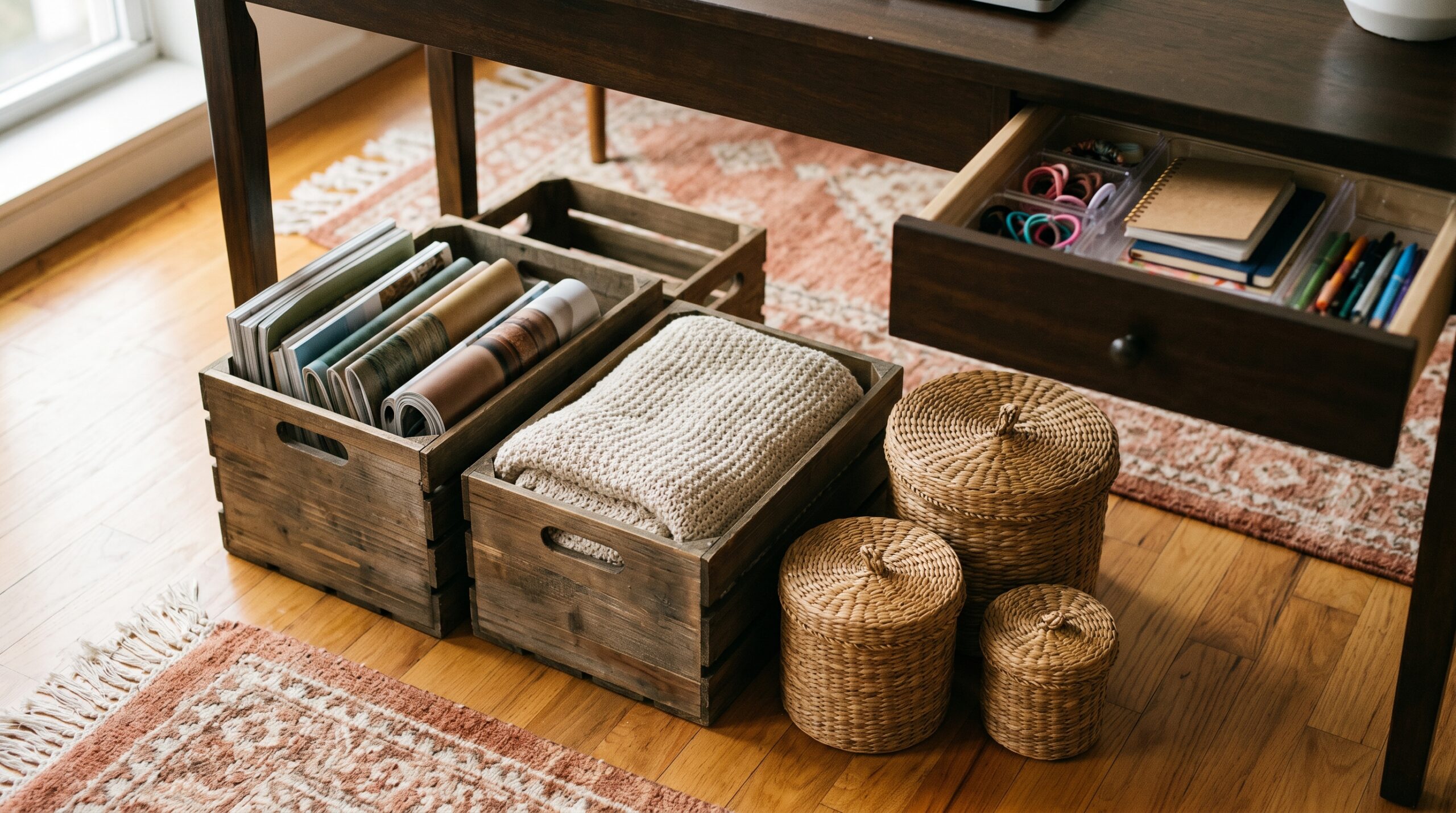
The part nobody talks about in cluttercore tutorials: half of any visible-clutter aesthetic depends on the invisible clutter being well-handled. Receipts, hardware, electronics, the boring overflow. If that lives on the same surfaces as the curated stuff, the whole room starts to look untended within a week.
9. TIMRIS Distressed Wood Nesting Crates (set of 3)
Crates are open storage that still photograph as cluttercore. I keep mine under a console: largest at the back holding magazines I am not done with, middle one for blankets, smallest for the cables I refuse to bin but do not want visible. The reclaimed wood matches the rest of my visual language, so the storage reads as part of the room rather than as utility.
See the TIMRIS Nesting Wood Crates on Amazon →
TIMRIS · largest 16.5″L x 12.5″W x 5.9″H · set of 3 · solid reclaimed wood, hand-distressed
Not for: anyone who needs uniform sizing. These are intentionally one-of-a-kind, no two finishes match.
10. Seagrass Wicker Baskets with Lids (4-pack)
Lids are what separate cluttercore from college-dorm-core. These nest into four sizes, take up the bottom shelf of any console or open bookcase, and absorb everything that should not be visually displayed. Phone chargers in the largest one, batteries and tools in the medium, hair ties in the smallest. Same texture across all of them keeps the visual coherent.
See the Seagrass Wicker Baskets with Lids on Amazon →
4-pack nested · XL 14.2 x 9.4 x 7.1H down to S 9.1 x 4.7 x 3.9H · 100% seagrass with iron wire frame
Not for: rooms where you want the storage to disappear. Seagrass is texture-forward; if you want hidden-hidden, go with linen bins.
11. Vtopmart 25-Piece Clear Drawer Organizers
The least photogenic recommendation on this list, and the most important. Cluttercore inside a drawer is just clutter. I use these inside every drawer in my apartment, especially the catchall by the front door and the bathroom vanity. Twenty-five trays in four sizes, clear so I can see contents at a glance, with non-slip silicone pads so they do not slide when I open the drawer.
See the Vtopmart Clear Drawer Organizers on Amazon →
Vtopmart · 25-piece set · four sizes (9x6x2 down to 3x3x2 inches) · clear plastic with non-slip pads
Not for: anyone after an aesthetic drawer. These are pure function.
Common mistakes I see on cluttercore tours
A few patterns I keep noticing on small-space cluttercore that read as chaos rather than curation.
Buying the look in one Amazon order. Cluttercore that arrives in five boxes from one retailer looks staged. Mix in thrift, family hand-downs, and one or two intentional buys. The contrast is what sells the aesthetic.
Skipping the through-line material. If brass is your spine, every shelf should have one brass element. If it is wood, same. Without the through-line, ten objects look like ten objects.
Open storage for everything. Cluttercore is not “let everything be visible.” It is “curate what is visible, hide what is not.”
Ignoring the floor. Cluttercore wants a layered rug or two, not bare laminate. A floor without texture undercuts the rest of the room.
If you want the moodier sister aesthetic instead
Cluttercore and dark cottagecore overlap on the love of collected objects, but they diverge on palette. Cluttercore is warm, mixed, and metal-led. Dark cottagecore goes deep green, burgundy, and matte black. If you want a darker version of this same instinct, the dark cottagecore bedroom in a small apartment covers the same containment-first approach in a moodier palette. If you want the glam-maximalist cousin, the mob wife aesthetic in a small apartment uses velvet and gold instead of brass and wood.
Frequently asked questions
Is cluttercore the same as maximalism?
They overlap but are not identical. Maximalism is about layered textiles, bold pattern, and saturated color. Cluttercore specifically celebrates collected objects: trinkets, books, frames, ceramics. A maximalist room can be cluttercore-free; a cluttercore room can be color-restrained.
How do I do cluttercore as a renter?
Lean on freestanding, tabletop pieces: cloches, catchalls, apothecary cabinets, crates, picture ledges that mount with Command strips. Skip the decorative brass brackets that need drilling, or use adhesive shelf mounts. The shelf brackets in this post are wall-mount; everything else is renter-friendly.
Will this make my small apartment feel smaller?
Done right, no. Vertical density (wall ledges, gallery frames) keeps the floor open. The empty corner and the through-line material both give the eye relief. A 400 square foot studio can hold a lot of objects if they are organized by intent rather than scattered.
What single piece should I buy first?
A catchall tray. Even before the apothecary cabinet. The tray sets the rule that loose objects get contained, and that rule is what stops cluttercore from drifting into actual mess.
How often should I refresh a cluttercore vignette?
I edit mine seasonally, more or less. Once the eye stops noticing a vignette, I rotate three or four objects out and bring something else forward. The collected look depends on the room feeling lived-in, and rotation is what keeps that alive.
The bottom line
Cluttercore is achievable in a small apartment, but only if you stop treating it as decoration and start treating it as containment. Trays, ledges, frames, lidded baskets, and one well-chosen through-line material. The rest is just collecting objects you actually care about, then giving them the right structure to be seen.
The aesthetic itself is tracked under cluttercore in the Pinterest Predicts 2026 report, which is where I keep an eye on whether the trend is still rising before I add another shelf.