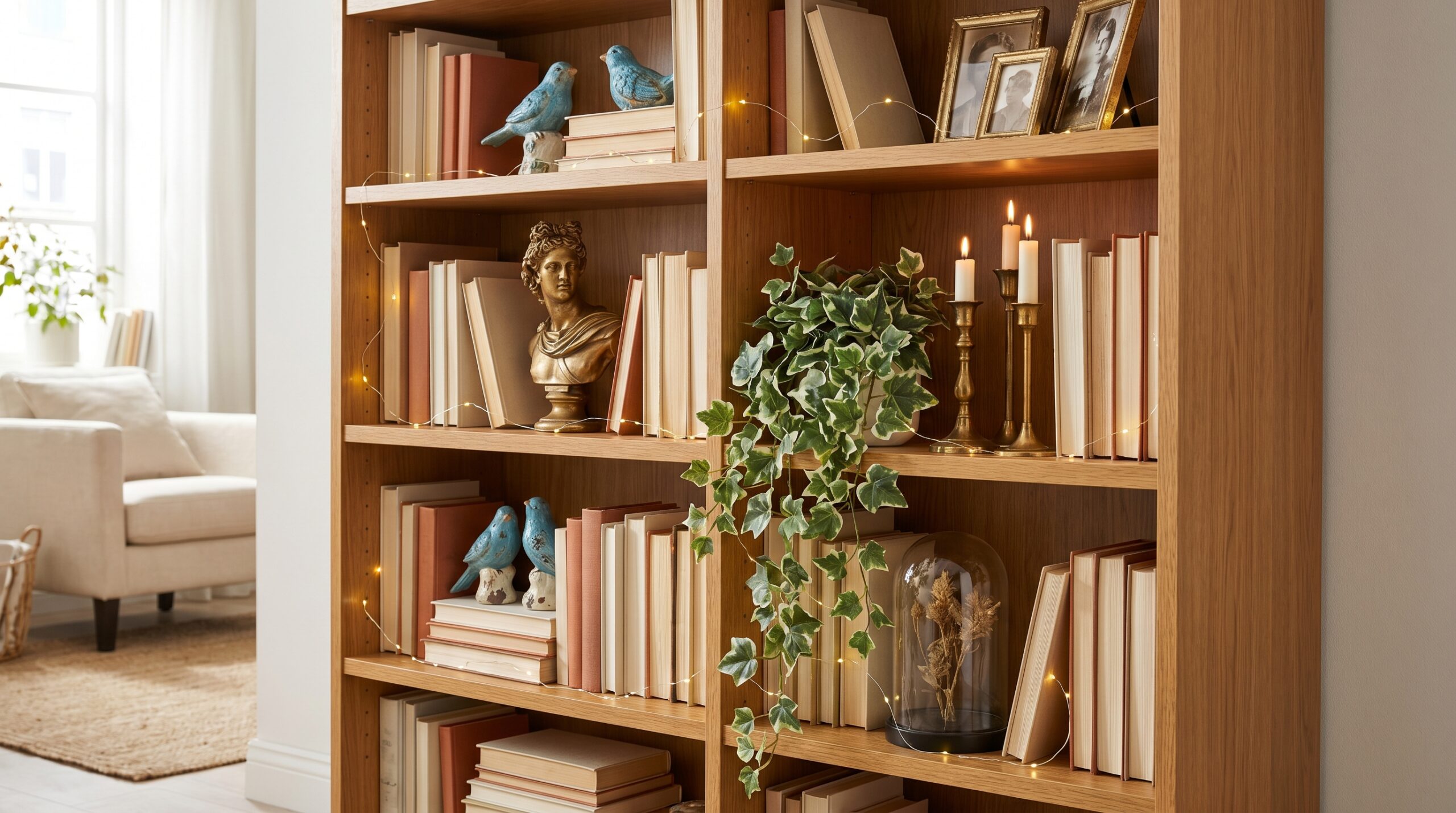
A bookshelf is the hardest piece of furniture to style in a small apartment, and cluttercore makes it harder on purpose. The aesthetic wants the shelf full: books stacked two ways, objects wedged between them, small things layered in front of bigger things. In a rambling house that reads as collected over a lifetime. In 400 square feet it tips into “junk drawer with a spine” within a week.
I have restyled the same five-shelf unit in my apartment more times than I want to admit, and the version that finally held up was not about owning more objects. It was about building the shelf in layers, in a fixed order, so the result looks gathered over years instead of unboxed last Tuesday. Below is the order I follow, plus the thirteen pieces that do the actual work.
This post contains affiliate links. If you buy something through one of my links, I may earn a small commission at no extra cost to you. I only recommend products I’d actually use myself.
As an Amazon Associate I earn from qualifying purchases.
Four rules that keep a cluttercore shelf from reading as mess
I come back to these every time a shelf starts to feel chaotic instead of collected.
- Build back to front, not left to right. Tall things and framed art go against the wall first, then mid-height objects, then the small stuff at the lip. Layering front to back is what gives a shelf depth instead of a flat row.
- Vary height on every shelf. A clean row of book spines is a library. Cluttercore needs a stack, a tall shape, and something low all sharing the same shelf.
- Pick one metal and one wood tone, then repeat them. Mine are brass and warm oak. The repetition is what makes mismatched objects look like one collection.
- Leave one empty pocket per shelf. Even a packed shelf needs a gap, or the eye has nowhere to land and the whole thing reads as noise.
Step 1: Build the skeleton before any decoration
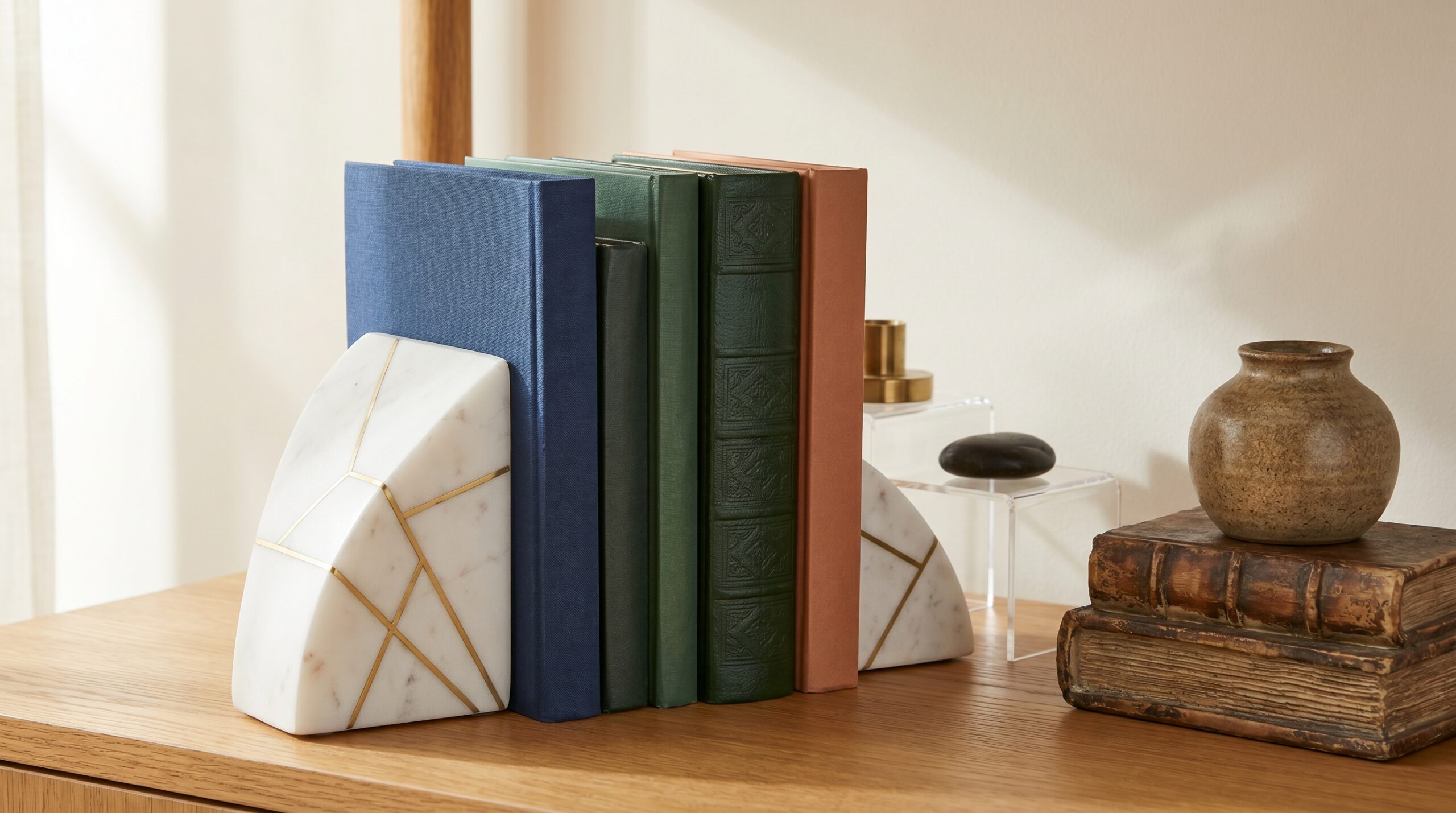
Before a single pretty object goes on the shelf, I set the bones. That means real books held upright by heavy bookends, a riser or two to stage height, and a faux stack to lift a small piece without sacrificing a real book to the job. Get the structure right and the decorative layer almost arranges itself.
1. Cork & Mill Marble Bookends (my anchor pick)
Bookends are the most overlooked structural tool on a shelf. These are solid carved marble with a brass inlay, and at nine pounds a pair they actually hold a run of heavy hardcovers upright instead of bowing under them. The white-and-brass combination also sets the through-line for everything else: marble and brass repeat across the shelf, so the rest of the objects read as one collection rather than a pile.
See the Cork & Mill Marble Bookends on Amazon →
Cork & Mill · solid marble with brass inlay · set of 2 · 9 lb pair · non-skid base
Not for: floating glass shelves with a low weight rating. Nine pounds of marble needs a sturdy shelf under it.
2. Guichifun Faux Book Stack
This is one solid resin block carved to look like three stacked antique books, dark-academia covers and all. I use it to lift a small sculpture or a vase a few inches without burying a real book I might want to read. It also reads as collected hardcovers from across the room, which is exactly the bookish density cluttercore wants on a small shelf where every inch counts.
See the Guichifun Faux Book Stack on Amazon →
Guichifun · 5.5″D x 4.5″W x 7.5″H · solid resin · no storage compartment
Not for: anyone hoping for a hollow keepsake box. It is a solid decor object, nothing opens.
3. Clear Acrylic Display Risers (set of 6)
Risers are the invisible technical layer under good shelf styling. I slip them under a stack of books or a ceramic so two objects sit at different heights and read as a composition instead of a line. The acrylic is the whole point. A wooden riser adds visual weight, while the clear ones vanish and let the object look taller than it is.
See the Clear Acrylic Display Risers on Amazon →
6-piece set · tiered heights · clear acrylic · wipe-clean
Not for: anyone after a warm, organic look. These are pure utility, invisible on purpose.
Step 2: Give every shelf one big shape
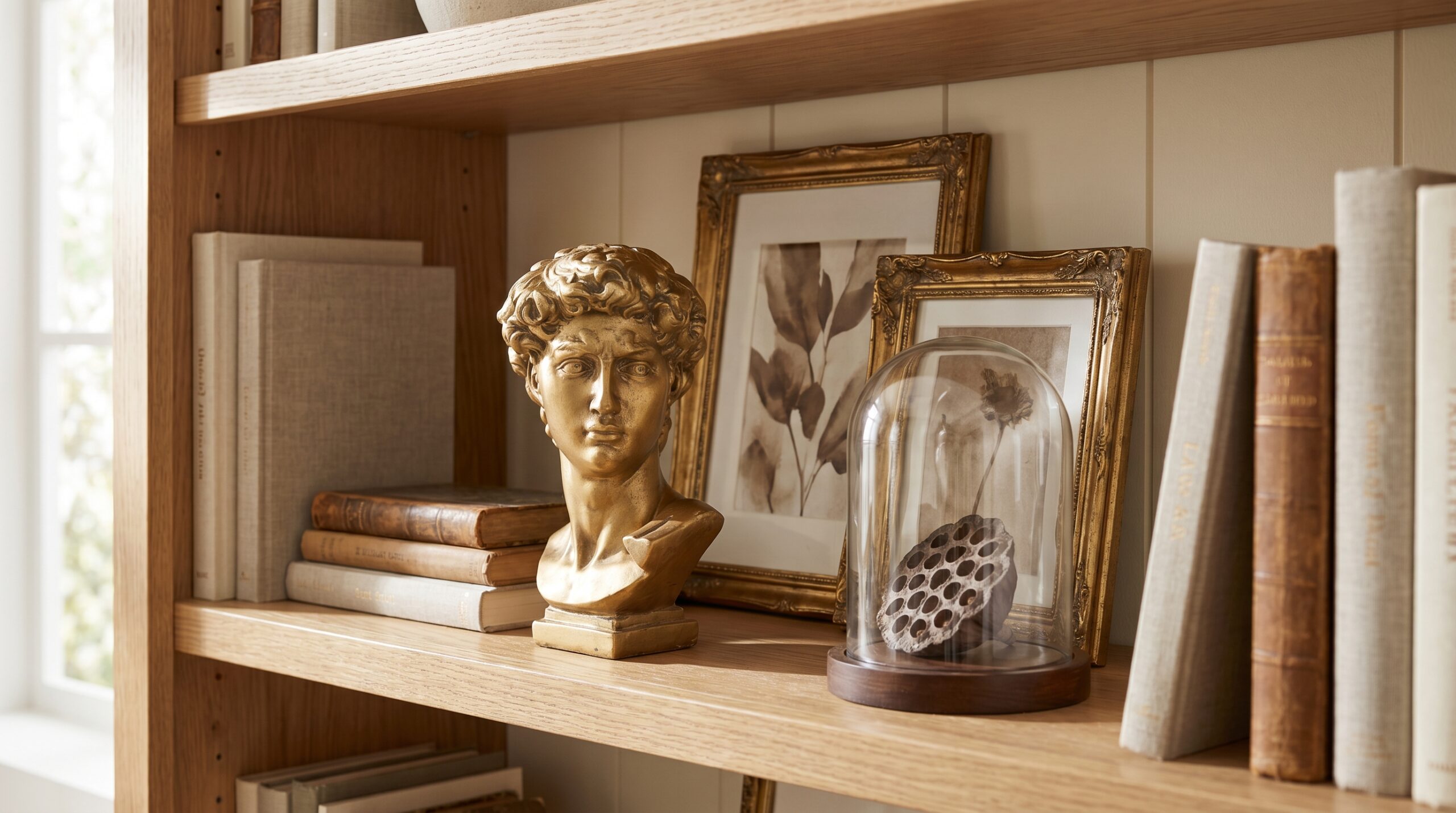
Once the skeleton is set, each shelf needs one object large enough to stop the eye. This is where most small-space shelves fail. When every object is the same small size, the shelf turns into visual static and nothing registers. One big shape per shelf gives the layer a center of gravity.
4. Gold David Bust (the shelf’s focal point)
An eight-inch resin David in a gold finish is the single object I would buy first for a cluttercore shelf. It is big enough to anchor a shelf without crowding a small room, and it leans dark-academia, which gives the bookish stacks around it a theme to hang on. Set it slightly off-center on a shelf, never dead middle, so the arrangement feels found rather than staged.
See the Gold David Bust on Amazon →
8″H · 3.75″D x 3.5″W · gold-finish resin · felt-padded base
Not for: a minimalist or coastal shelf. This piece is unapologetically classical.
5. MyGift Bell Jar Glass Cloche
A cloche is the cheapest way to turn an ordinary trinket into a deliberate display. The glass dome tells the eye “this one matters,” which buys you a focal moment on a shelf for the price of one object you already own. I keep a dried seed pod under mine. The wood base also brings in that second warm-wood tone the through-line rule asks for.
See the MyGift Bell Jar Cloche on Amazon →
MyGift · 10″H overall · 6.8″ base · glass dome with rustic wood base
Not for: homes with cats who patrol the shelves. A glass dome near a shelf edge ends one way.
6. 8-Piece Vintage Gold Gallery Frame Set
The back wall of a shelf is prime cluttercore real estate, and most people leave it bare. I lean two or three of these distressed-gold frames against the back of the upper shelves, mixing a thrifted print, a pressed flower, and a postcard. One frame language across mismatched art is the trick that makes the wall read as curated. The gold ties it to the brass everywhere else.
See the Vintage Gold Gallery Frame Set on Amazon →
Set of 8 · 2x 8×10, 2x 5×7, 4x 4×6 · distressed gold resin · stands on a shelf or hangs
Not for: a clean modern gallery. These frames are baroque and proud of it.
RENTER-FRIENDLY ALTERNATIVE
None of this needs a drill. Lean the frames against the back of the shelf instead of hanging them, which is the more cluttercore look anyway. If you want a frame on the wall above the unit, a couple of Command picture strips hold these resin frames fine. And if you are still choosing the shelf itself, I walked through the best ladder bookshelves for renters and the no-drill floating shelves that take this kind of styling without a single hole in the wall.
Step 3: Add the collected layer
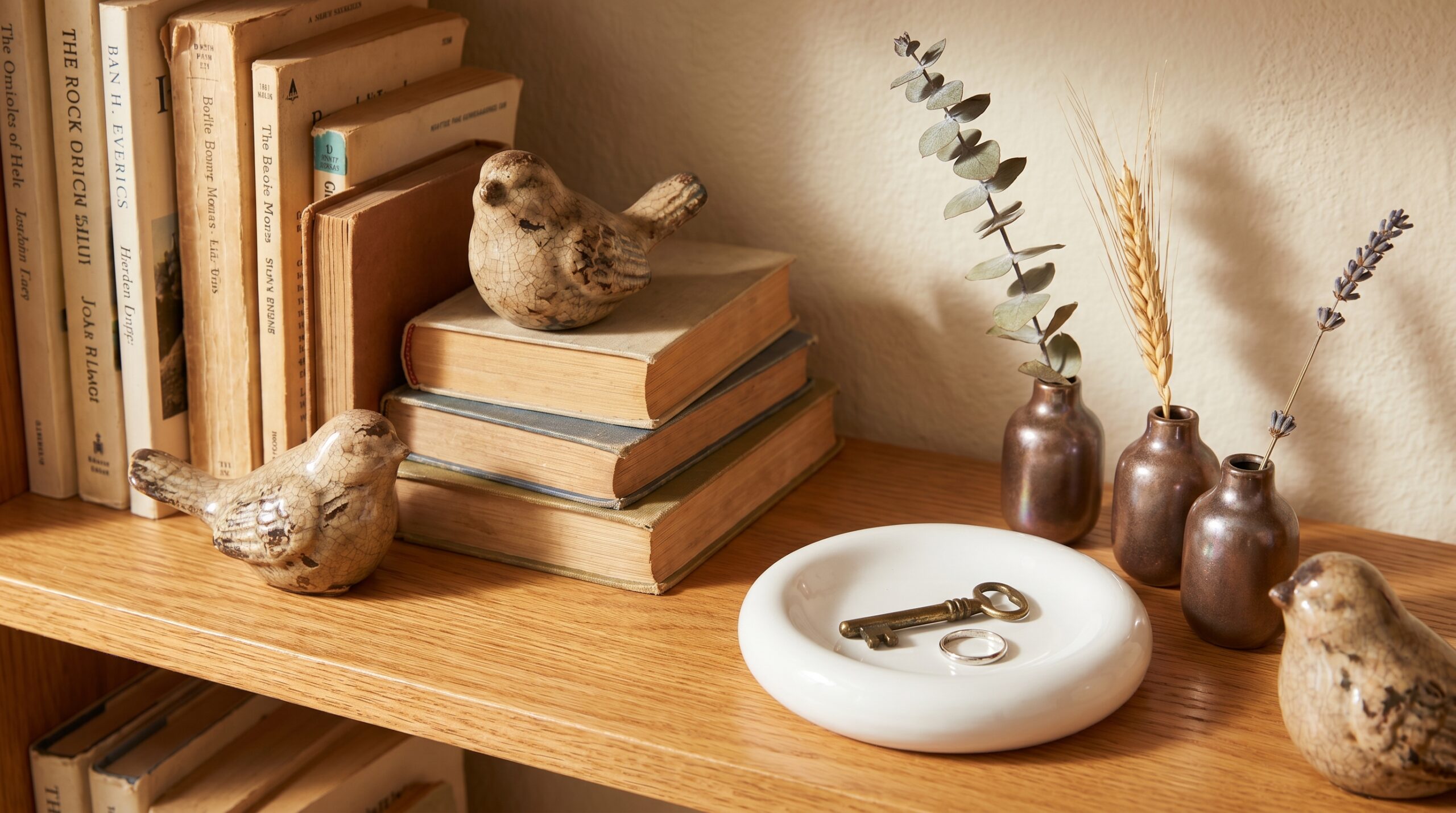
This is the layer that makes people ask where you found everything. Small ceramics, a dish for the tiny personal objects, a couple of bud vases with dried stems. They fill the gaps between the big shapes, and they are the pieces that should look inherited rather than ordered.
7. Distressed Ceramic Bird Set (set of 3)
These three plump ceramic birds carry an aged crackle glaze that reads like something handed down, not bought new. I scatter them across different shelves rather than grouping all three, so the eye keeps finding one as it travels the unit. At about four and a half inches each they slot into the gaps between book stacks without demanding their own shelf.
See the Distressed Ceramic Bird Set on Amazon →
Set of 3 · about 4.5″H each · distressed glazed ceramic · hand-painted
Not for: anyone who wants a matched set displayed together. These work better scattered.
8. Collective Home Ceramic Trinket Dish
A small dish is what stops the smallest objects from scattering across a shelf and reading as clutter. I keep a matchbook, a vintage key, and a single ring in mine. Four and three-quarter inches across is the right size to corral a few things without becoming a bowl. This is the personal layer, the part of the shelf you actually touch.
See the Collective Home Trinket Dish on Amazon →
Collective Home · 4.75″ round · lead-free ceramic
Not for: anyone wanting a deep catchall. This is a shallow dish, not a bowl.
9. ComSaf Ceramic Bud Vase Set (set of 3)
Three small bud vases in graduated metallic browns are the soft vessels that break up all the hard edges of books and frames. I put a single dried stem in each, eucalyptus or a wheat sprig, never a full bouquet. One stem per vase keeps the scale right for a small shelf, and the brown glaze pulls in the brass and wood tones doing duty everywhere else.
See the ComSaf Bud Vase Set on Amazon →
ComSaf · set of 3 · about 3″H · metallic-brown ceramic
Not for: fresh-flower people. The narrow necks suit single dried stems, not full arrangements.
Step 4: Soften, conceal, and light it
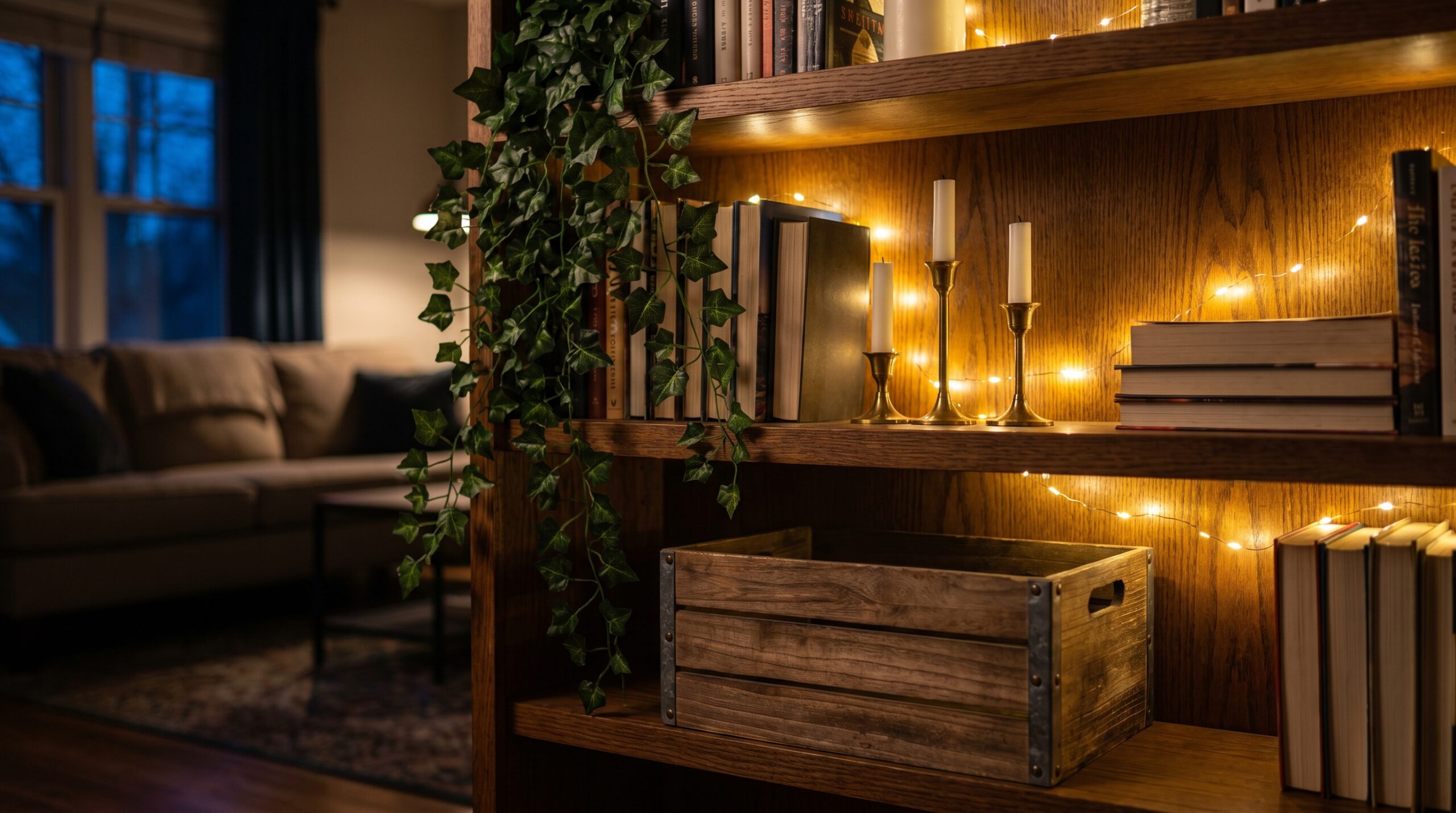
The finishing layer is what separates a styled shelf from a staged one. Greenery to break the hard grid, a crate to hide the overflow that has no business being seen, candlesticks to carry the brass through-line down to the lower shelves, and warm light so the whole thing still works after dark.
10. Faux Trailing Ivy Plants (set of 2)
A bookshelf is all right angles, and trailing greenery is the fastest way to soften it. I set one of these potted ivies on an upper shelf and let the vines spill down over the edge, which draws the eye vertically and hides the hard line of the shelf board. The vines reach about two feet, and there is no watering or light to worry about on a shelf that gets neither.
See the Faux Trailing Ivy Plants on Amazon →
Set of 2 potted · vines trail to about 24″ · weighted pot base · no maintenance
Not for: anyone who can spot cheap plastic greenery a mile off. Check the leaf reviews first; some faux ivy reads better than others.
11. TIMRIS Distressed Wood Nesting Crates (set of 3)
Half of any visible-clutter look depends on the invisible clutter being handled. I keep the smallest of these reclaimed-wood crates on a lower shelf for the cables, takeout menus, and chargers that would otherwise creep onto the curated surfaces. The distressed wood photographs as part of the aesthetic, so the storage hides in plain sight instead of looking like utility.
See the TIMRIS Nesting Wood Crates on Amazon →
TIMRIS · largest 16.5″L x 12.5″W x 5.9″H · set of 3, nesting · solid reclaimed wood
Not for: anyone who needs matching sizes. The three crates are intentionally one-of-a-kind.
12. Brass Taper Candle Holders (set of 3)
Three brass candlesticks in graduated heights are the cleanest way to repeat the brass through-line down low and add the staggered height rule in one move. I group all three on a single lower shelf rather than spreading them, since a tight cluster of varied heights is more striking than three lone candlesticks. The velvet base pads mean they will not scratch a wood shelf.
See the Brass Taper Candle Holders on Amazon →
Set of 3 · 7.5″ / 9″ / 10.25″H · brass-gold metal · fits standard 0.75″ tapers
Not for: a cool-toned, silver-and-chrome shelf. These commit hard to warm brass.
13. Warm-White Fairy Lights (4 strands)
Light is the layer almost everyone forgets, and it is what makes a shelf glow in a photo. I thread one warm-white strand along the back edge of the shelves, tucked behind the books so the wire disappears and only the glow shows. The remote with a timer means the shelf lights itself at dusk, and the bendable wire holds whatever shape you press it into behind the objects.
See the Warm-White Fairy Lights on Amazon →
4 strands · 33ft / 100 LEDs each · warm white · battery with remote and timer
Not for: anyone who hates feeding AA batteries. There is no plug-in option on this set.
Common mistakes I see on small-space shelf tours
A few patterns keep turning a promising cluttercore shelf back into mess.
Lining books up by height. A neat descending row of spines is a bookstore display, not cluttercore. Mix vertical runs with a few horizontal stacks, and put an object on top of the flat stacks.
Pushing everything to the back. Depth is what reads as collected. Let a few small objects sit right at the front lip, with taller pieces behind them, so each shelf has a foreground and a background.
Buying one matched set. Cluttercore that arrives in a single Amazon order looks staged. Mix the new buys here with thrift finds and hand-downs so the contrast does the work.
Forgetting the shelf has a back wall. Leaning art and small frames against the back is what turns a row of objects into a layered scene. A bare back wall flattens everything in front of it.
Where this fits with the rest of the cluttercore look
A styled shelf is one zone of a bigger aesthetic. If you want the whole-room version, I laid out how to do cluttercore in a small apartment without the chaos, which covers the containment approach across every surface, not just the bookshelf. For more objects to fill the collected layer, the best cluttercore knickknacks on Amazon roundup goes deeper on the trinkets and ceramics. And if you would rather take this instinct somewhere moodier, the dark cottagecore bedroom uses the same layered-objects logic in deep greens and matte black instead of warm brass.
Frequently asked questions
How many objects should go on each shelf in a small space?
I aim for one big shape, two or three mid-height pieces, and a couple of small objects per shelf, plus a run of books. That is enough density to read as cluttercore without the shelf feeling jammed. The empty pocket you leave on each shelf matters as much as what you put on it.
Is cluttercore bookshelf styling just a messy shelfie?
No. A messy shelf has no structure underneath it. Cluttercore looks abundant but it is built in deliberate layers, with repeated materials and varied heights doing the organizing. The whole point is that it looks collected, not abandoned.
How do I style a cluttercore shelf as a renter who can’t drill?
Everything in this post sits on the shelf rather than the wall, so it is renter-safe by default. Lean the frames against the back instead of hanging them, use a freestanding ladder or floating shelf for the unit itself, and keep the fairy lights on their battery pack so there is no wiring to install.
Do the books actually have to be real?
Mostly, yes. Real books carry the texture and color variation that the look depends on, and they are usually free since you already own them. The faux stack earns its place as a riser for lifting a small object, not as a replacement for a whole shelf of real spines.
How do I keep a cluttercore shelf from looking dusty and cluttered over time?
Fewer, better objects with space between them dust more easily than a packed shelf, and the cloche keeps your most delicate piece sealed off. I also rotate three or four objects every season so the shelf stays interesting and I am dusting it anyway when I swap things out.
The bottom line
A cluttercore bookshelf works in a small apartment when you build it as layers instead of dumping objects on a shelf. Skeleton first, then one big shape per shelf, then the collected small pieces, then greenery and light. Repeat one metal and one wood tone throughout, leave a little air on every shelf, and the result looks like a collection you have lived with for years.
Cluttercore sits in a long tradition of displaying collected objects, one that traces back to the cabinet of curiosities of sixteenth-century Europe. A well-styled shelf is the small-apartment version of the same idea.