This post contains affiliate links. If you buy something through one of my links, I may earn a small commission at no extra cost to you. I only recommend products I’d actually use myself. As an Amazon Associate I earn from qualifying purchases.
Cluttercore and maximalism get used like the same word, and they are not. Both are a reaction against the empty-white-box look, both say more is welcome, and both end up on the same Pinterest boards. So people in small apartments save fifty pins, try to copy the feeling, and end up with a room that is busy without being either one.
The difference is what the “more” is made of. Cluttercore is more objects: collections, books, trinkets, the stuff you actually own and want to see. Maximalism is more sensory: color, pattern, texture, scale. A cluttercore room can be entirely brown and beige and still read maximal because of sheer object density. A maximalist room can hold almost no small objects and still hit you over the head, because one saturated rug and a bold wall did all the talking.
This is the side-by-side I give friends who can’t tell which one they actually want. I’ll compare them on what they share, palette, what carries the look, and the small-space risk each one brings, then list the four renter-safe pieces I’d start with for each side. If you already know you want the object-dense one, my cluttercore-without-chaos guide goes deeper on keeping it from tipping into mess.
What cluttercore and maximalism actually share
More than the rivalry suggests.
Both are built on the idea that a room should look lived-in and full, not staged for a listing photo. Both are renter-safe at the core, because the look lives in objects, textiles, and tabletop pieces, not in anything you bolt to the structure. And both punish the same mistake: buying filler. A cheap cart of stuff reads as clutter in one and as noise in the other. Each look only works when the pieces are chosen, even when the goal is to look unchosen.
So borrowing from both is not starting over. You’re deciding what kind of “more” your small space can actually carry, and most rooms can carry a little of each.
Palette: personal story versus saturated color
This is the fastest way to tell them apart from the doorway.
Cluttercore is palette-agnostic. The color comes from whatever you collected, which is often thrifted, inherited, and a little mismatched on purpose. A shelf of aged paperbacks, brass odds and ends, and ceramic finds can be almost neutral and still feel maximal, because the richness is in the quantity and the personal story, not the hue.
Maximalism is palette-forward. It leads with saturated color and pattern, often colors that clash on purpose. The drama is the point, and in a small room it lands fast, sometimes from a single deep-burgundy rug or one inky accent wall. Maximalism is the loud end of the maximalism design tradition, the deliberate opposite of less-is-more.
My rule: if the colors in your favorite rooms come from the things people own, you’re drawn to cluttercore. If they come from the walls, the rug, and the upholstery, you want maximalism. Square footage barely changes that. Both work in 400 square feet.
What carries the look: objects versus gestures
Cluttercore is carried by small things and the way you stage them. A dense, layered surface only reads as styled instead of messy when you give it structure: risers to add height, trays to group the loose bits, one repeated frame style to tie a wall of mismatched objects together. The work is in the editing and the display, not in any single hero piece.
Maximalism is carried by big gestures. One saturated rug, one patterned wall, one velvet piece in a jewel tone, and the room is most of the way there. You can land it with a handful of decisions because each one is loud enough to count for several.
That changes how you shop. For cluttercore you collect over time and buy the infrastructure that makes a collection look deliberate. For maximalism you make a few confident, saturated buys and stop before the room gets heavy. If you like the collected look but want the curated version of it, my cluttercore bookshelf styling guide is the method I use shelf by shelf.
The small-space risk for each
Both can go wrong in a tiny apartment, just in opposite directions.
Cluttercore’s risk is reading as a genuine mess. The line between curated density and “you need to tidy up” is real, and in a small room it’s thinner. The fix is containment and elevation: corral the loose objects, give the collection vertical layers, and leave a little breathing room around the densest surface so the eye has somewhere to rest.
Maximalism’s risk is shrinking the room. Saturated color absorbs light, and a small space drenched in it on every surface can feel like a closet. The fix is restraint: keep the bold gestures to a few anchors, let the walls or the floor stay lighter, and the room stays open while still reading rich.
The short version: cluttercore fails by looking unfinished, so it needs structure. Maximalism fails by feeling claustrophobic, so it needs editing. Knowing which failure you’re more likely to hit tells you which look to be careful with.
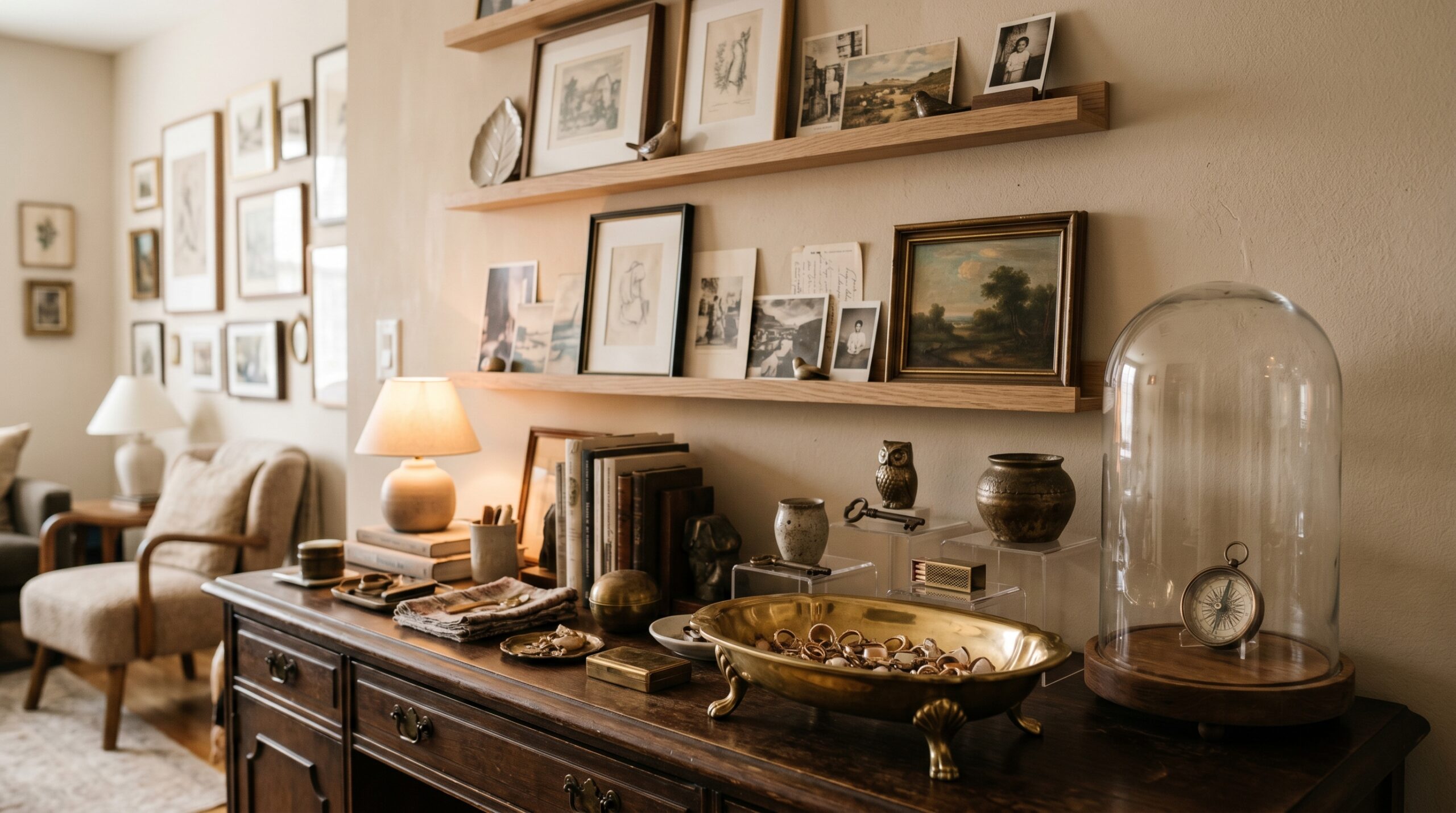
Cluttercore: the pieces I’d start with
Cluttercore isn’t a shopping list so much as a way to handle the things you already collect. These four are the infrastructure I’d buy first, because they turn a pile into a display. All of them are renter-safe and small-space scaled.
Solid brass trinket dish
Cluttercore lives or dies on whether the small loose objects look gathered or scattered. A solid brass clawfoot dish is the cheapest way to plant that flag, a single catchall that turns rings, matchbooks, and odd little finds into a deliberate vignette instead of debris. At 4.5 inches across it fits on a nightstand, a shelf, or an entry table, and the hand-cast brass reads collected rather than bought.
See the Brass Trinket Dish on Amazon
4.5”L x 4.5”W x 1.37”H, solid cast brass, clawfoot pedestal. Not for: anyone who wants surfaces clear, since this invites you to keep a small pile in view.
Clear acrylic display risers
The trick that makes a dense shelf look styled instead of crammed is height variation, and a set of six clear acrylic risers buys exactly that. Lift a few objects to different levels and a flat row of stuff becomes a composition. The acrylic disappears under whatever sits on it, so you get the vertical density cluttercore wants without adding visual weight.
See the Acrylic Riser Set on Amazon
Set of 6, varied heights, clear acrylic, wipe-clean. Not for: minimalist shelves, since these exist to pack more onto a surface, not less.
Wood picture ledge set
Cluttercore wants the walls in on it too, and a set of three wood picture ledges turns a blank vertical into a layered gallery you can rearrange anytime. Lean small frames, prop postcards, and stack tiny objects along the front lip. Because they hold an ever-changing pile rather than fixed nails, they suit a collection that grows, and the slim profile keeps them renter-friendly.
See the Picture Ledge Set on Amazon
Set of 3, each 16.9”W x 4.3”D with a front lip, real wood, weathered grey. Not for: walls where you can’t use any anchor at all, since ledges need light mounting.
Glass bell jar cloche
Every cluttercore room needs one spot that says this object matters, and a 10-inch glass bell jar cloche does it. Drop a single curio under the dome (a shell, a tiny sculpture, a dried bloom) and the surrounding density suddenly looks intentional, because you’ve shown you can edit. The rustic wood base grounds it on a crowded shelf without competing.
See the Bell Jar Cloche on Amazon
10” tall, removable glass dome, solid wood base. Not for: tiny shelves with no room for a standalone feature, since it needs a clear footprint to read.
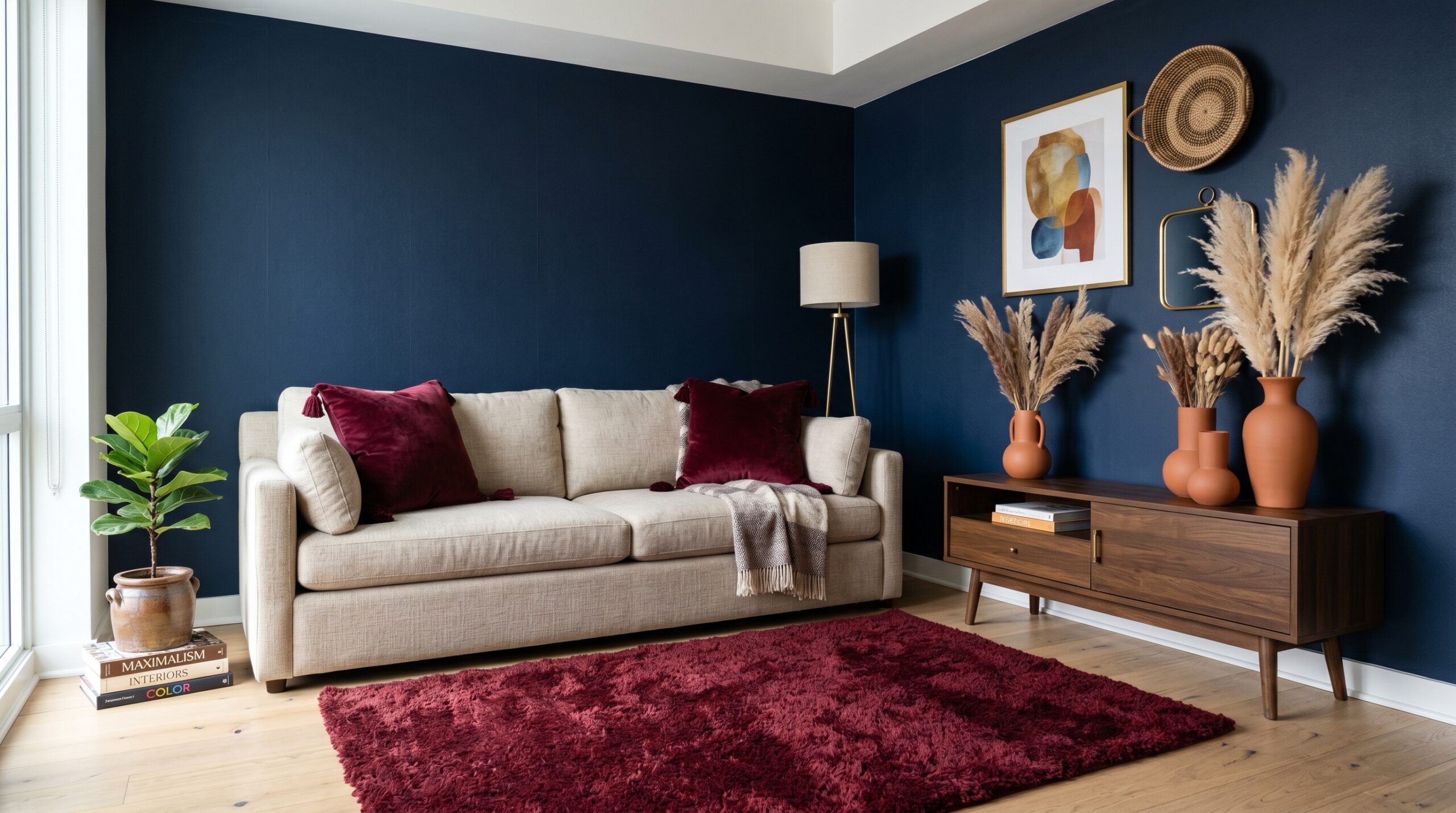
Maximalism: the pieces I’d start with
Same four-decision approach, opposite method. Notice these map to the cluttercore list one decision at a time, the entry buy, the foundation, the wall, and the hero object, so you can see exactly where the two looks split. Maximalism answers each with color and scale instead of objects and display.
Burgundy velvet pillow covers
Where cluttercore’s cheap entry point is a catchall dish, maximalism’s is a hit of saturated color, and a set of two burgundy velvet pillow covers is the lowest-friction way in. Deep burgundy reads warm against almost any upholstery, and velvet adds sheen that catches light, so two covers on a neutral sofa shift the whole room’s temperature for the price of takeout.
See the Burgundy Velvet Covers on Amazon
Set of 2, 18” x 18”, solid velvet, hidden zipper, inserts sold separately. Not for: anyone who wanted the color to come from objects, since this is color as the object.
Burgundy plush area rug
Where cluttercore builds up with risers, maximalism builds down with the floor. A 5×7 burgundy plush rug is the single biggest color gesture you can make without touching the walls, and at the small-apartment 5×7 scale it anchors a living zone or a bedroom without swallowing it. The velvet pile reads richer in person than in the listing photo, and it rolls up to move with you.
See the Burgundy Plush Rug on Amazon
5’ x 7’, fluffy velvet pile, non-slip backing. Not for: high-traffic entryways or homes that need a flat low-pile rug, since plush shows footprints.
Navy peel-and-stick wallpaper
Cluttercore turns the wall into a gallery of objects. Maximalism turns it into a block of color, and navy peel-and-stick wallpaper is the renter-safe way to do it. One deep-navy accent wall, or even just the back of a bookcase, gives the room the saturated depth maximalism runs on. It removes without residue when the lease ends, so the boldest move here is also the most reversible.
See the Navy Peel-and-Stick Wallpaper on Amazon
15.8” x 197” per roll (about 21.6 sq ft); roughly 4 to 5 rolls cover an 8×10 accent wall. Not for: textured or freshly painted walls, where peel-and-stick struggles to grip.
Terracotta vase trio
Where cluttercore spotlights one small curio under glass, maximalism makes one bigger sculptural statement instead of many tiny ones. A set of three terracotta vases in graduated heights does that with warm earthy color and real volume. Grouped on a console with a few dried stems, the trio reads as a confident color moment, the opposite of a crowded shelf, and it does it in one purchase.
See the Terracotta Vase Set on Amazon
Set of 3, graduated to about 12” tall, matte unglazed ceramic, wide mouths for dried stems. Not for: anyone after a high-gloss or jewel-tone finish, since these are warm and matte by design.
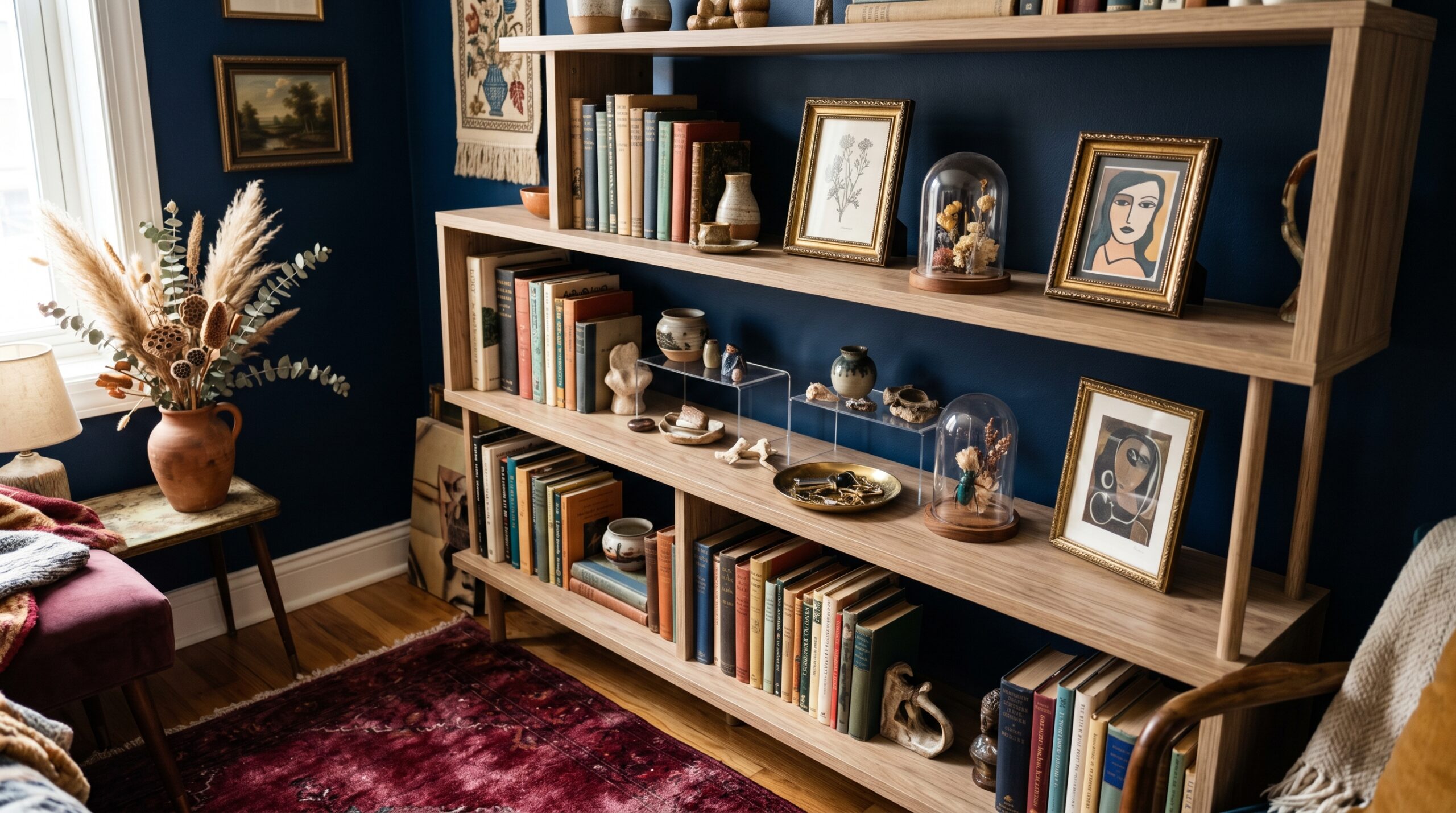
Which one should you actually pick?
Here’s how I’d decide, fast.
Choose cluttercore if your favorite part of decorating is the hunt, if you already own collections you want to show off, or if you want a room that feels personal and a little nostalgic the second you walk in.
Choose maximalism if you’d rather make a few bold decisions than curate a hundred small ones, if you’re drawn to saturated color and pattern, or if you want maximum impact from the fewest purchases.
And if you can’t choose, layer them, because they want the same thing, a room that feels full and alive. The move that works in a small space is to set a maximalist base (one saturated rug, one bold wall) and then let a cluttercore collection live on top of it: the dense, layered shelf reads as styled precisely because the bold backdrop frames it. You get color from the gestures and personality from the objects, and the room looks collected instead of copied off a board. For the bolder color direction specifically, my color-forward maximalism guide covers how saturated to go before a small room tips over, and my cluttercore knickknack roundup is where the collected layer comes from. If you like comparison breakdowns like this, I did the same for mob wife versus old money.
Frequently Asked Questions
What’s the real difference between cluttercore and maximalism?
What the “more” is made of. Cluttercore is more objects: collections, books, and trinkets you display on purpose, and it can be almost neutral in color. Maximalism is more sensory: saturated color, pattern, and texture, and it can hit hard with very few small objects at all.
Which one works better in a small apartment?
Both work in 400 square feet, but they fail in opposite ways. Cluttercore can read as a mess if you don’t contain and raise the objects, while maximalism can shrink a room if you saturate every surface. Pick the one whose failure mode you’re more willing to manage.
Can cluttercore be done with neutral colors?
Yes, and that’s a big part of why it differs from maximalism. A cluttercore shelf of aged books, brass odds and ends, and ceramic finds can be entirely brown and beige and still read maximal, because the density and personal story carry it, not the color.
Can I mix cluttercore and maximalism?
Yes, and in a small space it often looks the most intentional. Set a maximalist base of one saturated rug and one bold accent wall, then let a curated cluttercore collection live on top. The bold backdrop frames the dense shelf so it reads as styled rather than scattered.
Are both looks renter-friendly?
Both are. Neither needs paint or built-ins. Cluttercore lives in objects, risers, and ledges; maximalism lives in rugs, textiles, and peel-and-stick wallpaper that removes cleanly. You can take either entire look with you when the lease ends.