This post contains affiliate links. If you buy something through one of my links, I may earn a small commission at no extra cost to you. I only recommend products I’d actually use myself. As an Amazon Associate I earn from qualifying purchases.
A studio is one room doing five jobs. You sleep, eat, work, and unwind inside the same four walls, often in under 400 square feet. So when people tell me dark cottagecore is too heavy for a space that small, I get why they think that. A dim box painted in mood sounds like a recipe for a cave.
It isn’t, and I’d argue a studio is actually the easiest place to pull this look off. You have one palette to commit to, one room to light, and no hallway of competing styles fighting it. The trick is that a studio version of dark cottagecore is not the bedroom version shrunk down. It’s a zoning problem first and a decorating problem second.
Here is exactly how I’d build it in a sub-400-square-foot rental, zone by zone, with the renter-safe pieces I’d actually buy. If you want the deeper room-specific guides, I link them throughout, starting with my renter’s guide to dark cottagecore.
Why a studio is easy mode for this look
Dark colors want to wrap a room. In a sprawling open-plan place that can feel disjointed, because the gloom drifts off into corners with nothing to hold it. A studio gives the palette edges. The whole room reads as one deliberate envelope instead of a dark patch next to a bright one.
The enveloping quality that scares people in a big house is the entire point in a studio. You want it to feel like a retreat, a small lit room at the end of a long day, not a showroom. Low light and rich color do that better than white walls ever will.
The one real constraint is natural light. A north-facing studio that stays dim until noon needs you to lean on lamps hard, and to keep at least one large surface lighter so the room doesn’t collapse into shadow. If your windows are decent, you can push the dark palette as far as you want. I cover that light-versus-palette call in more depth in my dark versus traditional cottagecore comparison.
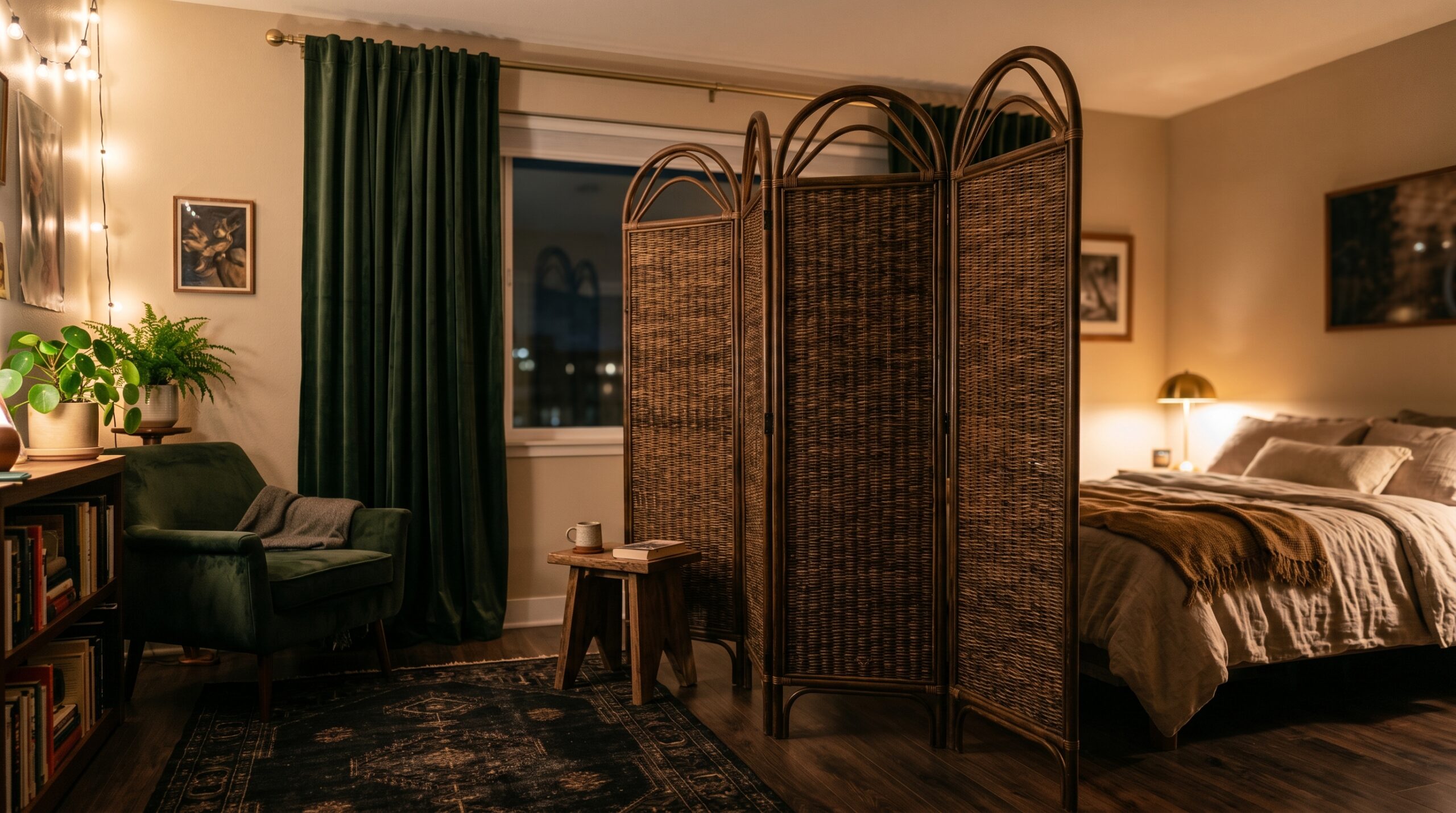
Step one: zone the single room
Before a single decorative object goes in, split the room. A studio that reads as one undivided box always feels like a dorm, no matter how good the bedding is. Three moves do the zoning, and none of them touch the walls in a way a landlord would notice.
A freestanding folding screen (the one piece that changes everything)
This dark-coffee four-panel folding screen is the single most useful thing you can buy for a studio. Stand it at an angle between the bed and the rest of the room and you have instantly invented a bedroom. The finish is a deep coffee brown, not blonde wood, so it sits right inside the dark palette, and the woven medallion panels read as vintage texture rather than office partition.
It arrives fully assembled and freestanding, so there is no drilling and nothing to patch when you leave. The two-way hinges let you fold it straight, into an L, or into a zigzag that stands on its own. That flexibility matters in a tiny floor plan where you might reposition it every few months.
See the Dark Coffee Folding Screen on Amazon
6 ft tall, 4 panels at 15.7 in each, woven natural fiber, freestanding, no assembly. Not for: anyone who needs a solid sound or sight barrier, since the open weave lets light and a little visibility through.
A dark vintage rug to anchor the sleep zone
A rug is how you tell the eye where one zone ends. I’d float this black boho vintage area rug under the bed so the sleep area sits on its own island. The dark farmhouse pattern hides everything a light rug shows, which is the whole reason I trust dark rugs in small rentals where you cannot baby the floor.
At 5 by 7 feet it is sized for a zone, not a whole apartment, which is exactly what you want in a studio. The low pile and washable construction mean it survives a vacuum and the occasional spill. If you are unsure how to place it, my guide to rug placement for studio zoning walks through the sizing.
See the Black Boho Vintage Rug on Amazon
5 x 7 ft, washable low pile, non-slip backing, black multi pattern. Not for: a whole studio floor, since one 5×7 defines a single zone rather than the room.
Velvet curtains that double as a soft divider
These dark green velvet panels do two jobs at once. On the window they block most of the daylight, which is how you control a dim studio’s mood instead of letting weather dictate it. Hung from a ceiling track, the same panels become a soft fabric divider you can pull across the sleep zone at night, an even cheaper partition than the screen.
Velvet is the material that reads dark cottagecore the second it catches light. It absorbs the room’s glare and gives back a quiet sheen, and the deep green keeps it from feeling like a hotel blackout panel.
See the Dark Green Velvet Curtains on Amazon
Set of 2, 52 in W x 84 in L, thermal velvet, blocks 65 to 85 percent of light. Not for: rooms where you want to keep maximum daylight, since velvet is heavy and dim by design.
A brass rod to carry the metal tone
Skip the white plastic rod the curtains will tempt you to reuse. This adjustable brushed-brass rod is a small spend that pulls the whole metal story together, since brass is the warm metal dark cottagecore lives on. It adjusts from 48 to 88 inches, so one rod fits almost any studio window, and the brackets are included.
See the Brushed Brass Curtain Rod on Amazon
Adjustable 48 to 88 in, 5/8 in diameter, brushed brass, brackets included, holds up to 15 lb. Not for: very heavy floor-to-ceiling drapery beyond its rated weight.
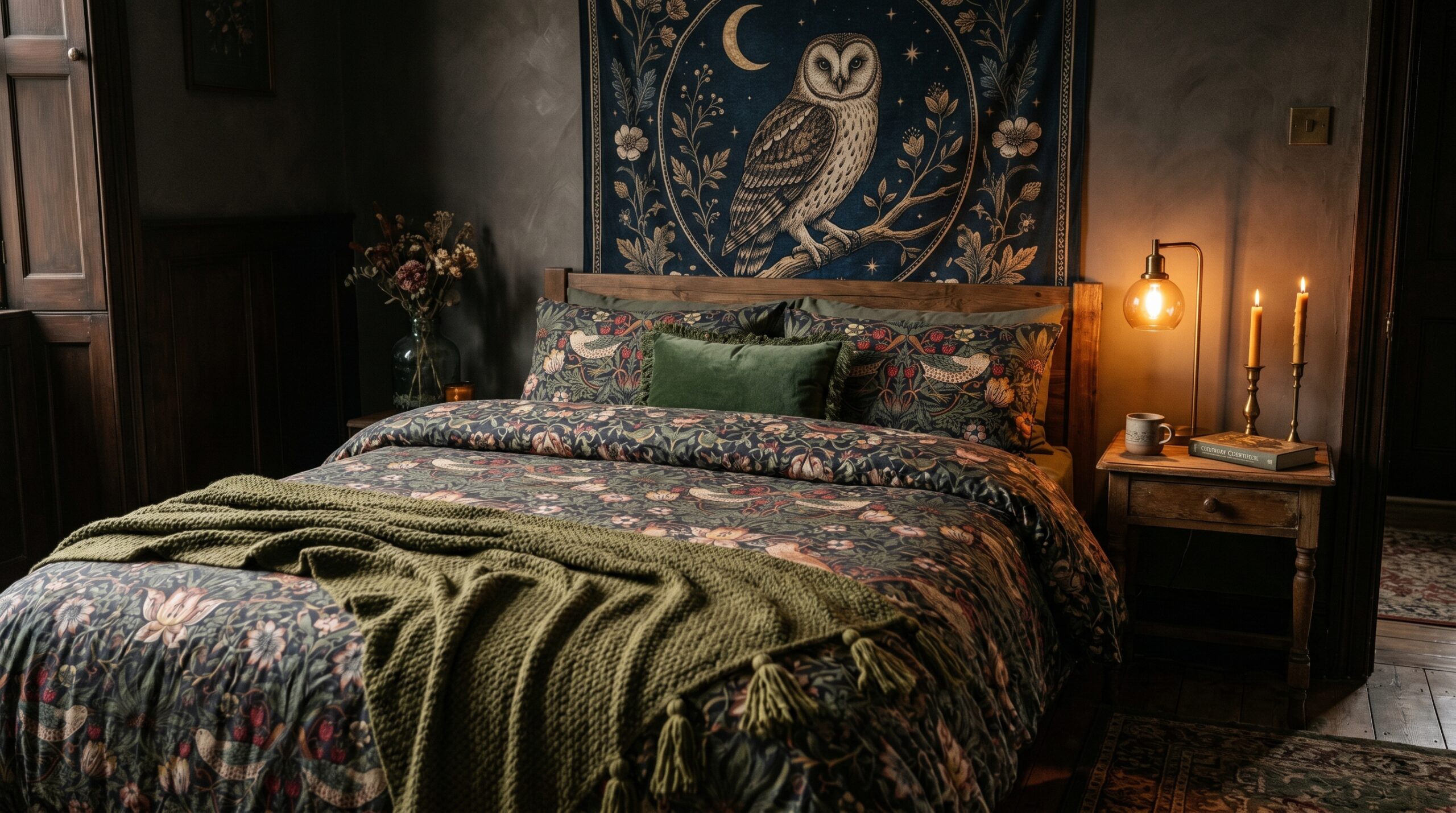
Step two: dress the sleep zone
The bed is the largest soft surface in any studio, so it sets the tone harder than anything else. Get these three right and the sleep zone carries the whole look.
A moody William Morris floral duvet
This William Morris wildflower duvet set is my anchor pick because it does the most work for the money. The print descends from William Morris’s botanical patterns, the genuine lineage dark cottagecore borrows from, on a moody ground that reads rich rather than black-hole dark. It comes as a three-piece set, so one order dresses the bed.
In a studio the bed is on display all day, so it has to look intentional, not slept-in. A patterned dark cover hides wrinkles and forgives a hurried morning, which is more than I can say for crisp white linen. For the full range of small-bed sizing, my dark cottagecore bedding roundup has more options.
See the William Morris Duvet Set on Amazon
Queen, 3-piece (duvet cover 88 x 88 in + 2 pillowcases), zipper closure, William Morris wildflower print. Not for: people who want a comforter included, since this is a cover set you fill yourself.
An owl and moon tapestry above the bed
A studio has limited wall, so the wall you do have should earn it. This dark academia owl-and-moon tapestry covers a big stretch of blank wall above the headboard in one move and costs a fraction of framed art at that scale. It hangs from non-marking hooks, so there are no nail holes to answer for.
Fabric also does something framed prints cannot: it softens sound and adds a layer of texture right where you sleep, which makes a hard-walled rental feel less echoey. If you want more wall ideas, my renter-safe wall decor guide goes deeper.
See the Owl and Moon Tapestry on Amazon
40 x 30 in, soft polyester, lightweight, hangs from non-marking hooks. Not for: anyone who prefers crisp framed prints over soft fabric.
A cordless brass lamp for the nightstand
Studios rarely have an outlet exactly where you want bedside light. This cordless antique-brass table lamp solves that by running on a rechargeable battery, so it sits anywhere with no cord trailing across the floor. The dimmer is the real win, because dark cottagecore lives or dies on warm, low, controllable light.
It was in stock and shipping when I checked, which matters because the good cordless lamps sell out fast. For the full lighting plan, my dark cottagecore lighting guide covers sconces and bulbs too.
See the Cordless Brass Lamp on Amazon
6.25 in W x 16 in H, antique brass, rechargeable battery, 3-level dimmer. Not for: anyone who wants a bright reading lamp, since the draw here is warm low light.
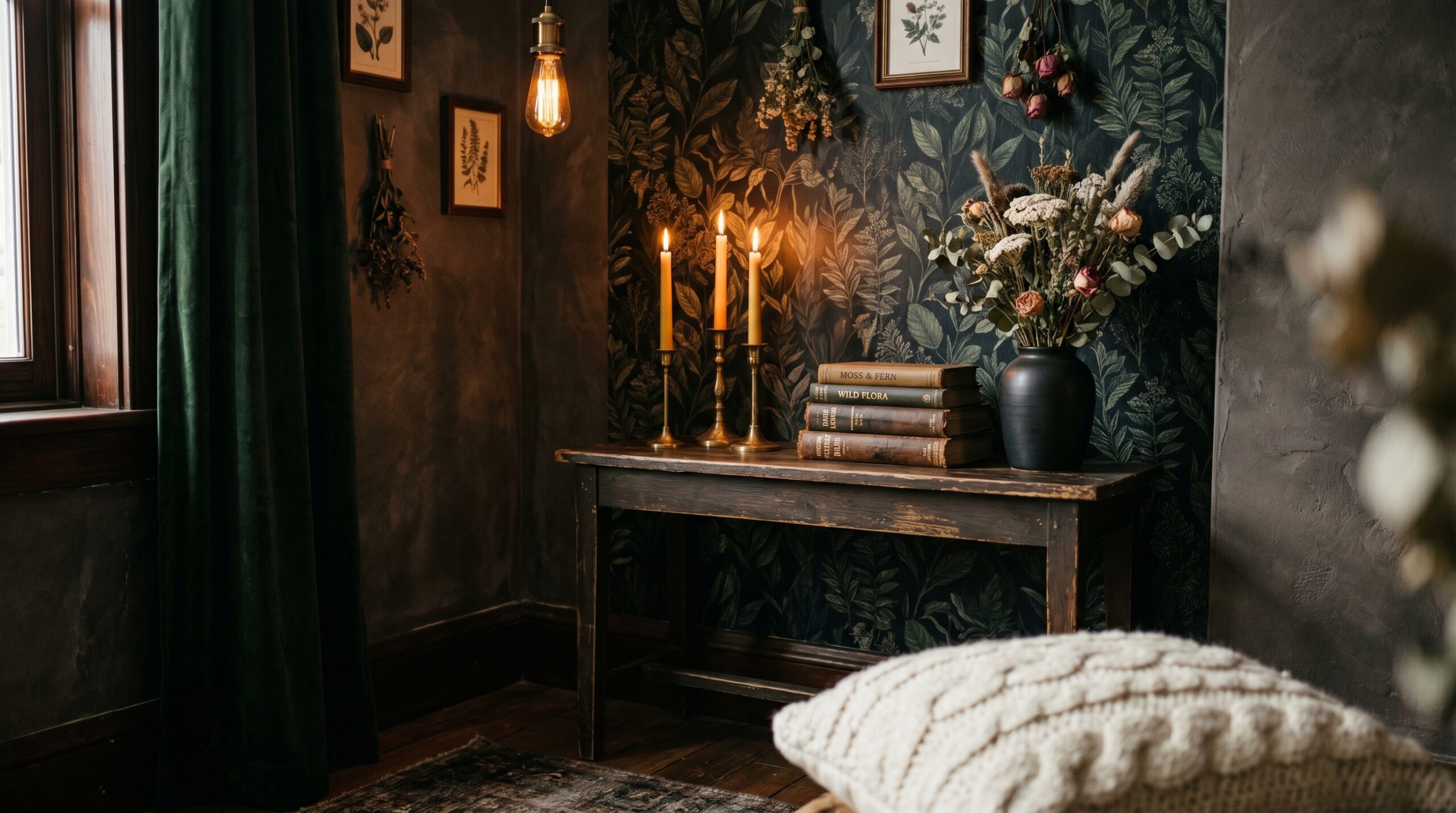
Step three: the layer that ties the studio together
Once the zones are set and the bed is dressed, the rest is the small stuff that makes a room feel built rather than bought. This is where the studio stops looking like a furnished rental and starts looking like yours.
A peel-and-stick botanical accent wall
You cannot paint a rental, but you can paper one wall and peel it off on the way out. This moody black-and-green botanical peel-and-stick mural is how I’d define the lounge zone visually without a single piece of furniture. Paper the wall behind the chair or sofa, leave the rest plain, and the room now has two clearly different areas.
One wall is the move in a studio, not all four. Cover everything and a small dim room closes in fast. Cover one and you get depth and a focal point that the eye reads as intentional.
See the Botanical Peel-and-Stick Mural on Amazon
17.7 in x 9.8 ft per roll, moody black-green botanical, fully removable. Not for: textured or brick walls, since peel-and-stick needs a smooth surface to grip.
Amber Edison bulbs (the cheapest fix on this list)
If you do one thing on this whole page, swap your bulbs. This six-pack of 2200K amber Edison bulbs replaces the cold builder-grade light that kills dark cottagecore dead. Warm amber light is the difference between a room that feels candlelit and one that feels like a waiting room, and it costs less than a takeout dinner.
See the Amber Edison Bulbs on Amazon
6-pack, 2200K warm amber, E26 base, dimmable, 60W equivalent. Not for: task areas like a kitchen counter, where you actually want cooler, brighter light.
Brass candlesticks for the styling moment
This set of three graduated brass candlesticks is the detail that reads cottagecore rather than generic-dark. Cluster them on the console by the divider or on a windowsill, add taper candles, and you have the flicker the whole aesthetic is built around. Three heights give you an arrangement instead of a row.
See the Brass Candlestick Set on Amazon
Set of 3, graduated heights, brass gold finish, standard taper compatible. Not for: homes where open flame is a problem, though they hold flameless tapers fine.
A tasseled throw to carry the palette across zones
A studio looks pulled-together when a color repeats in more than one spot. This olive green tasseled knit throw is how I’d echo the deep-green of the curtains over on the lounge chair or the foot of the bed. The texture adds the rumpled, layered quality dark cottagecore wants, and olive is a softer entry to the palette than going full black.
See the Olive Tasseled Throw on Amazon
50 x 67.7 in, olive green knit, tasseled fringe, textured solid. Not for: anyone wanting a heavy winter-weight blanket, since this is a decorative knit layer.
The mistakes that sink a dark studio
Three things go wrong most often, and all three are easy to avoid once you know them.
The first is leaving the overhead light on. A single ceiling fixture flattens the whole room and erases every bit of mood you built. Kill it, and light from two or three low sources instead.
The second is going dark on every surface at once. In 400 square feet that reads as a closet, not a cottage. Keep one big surface lighter, usually the walls or the floor, so the dark pieces have something to play against.
The third is skipping storage. Dark cottagecore looks romantic, but a studio with visible clutter just looks dim and messy. Hide the mess first. My guide to under-bed storage for small apartments is where I’d start, since the bed is your biggest hidden-storage opportunity.
Frequently Asked Questions
Will dark cottagecore make a 400-square-foot studio feel smaller?
Only if you darken every surface and rely on a single overhead light. Keep one large surface lighter, light the room from two or three low warm sources, and the dark palette reads cozy rather than cramped. In a small space the enveloping feeling is a feature, not a flaw.
How do I divide a studio without building anything?
Use a freestanding folding screen, a rug to anchor each zone, and curtain panels you can hang from a ceiling track. All three are renter-safe, need no drilling, and come with you when you move. Together they turn one room into a clear sleep zone and a lounge zone.
Is dark cottagecore renter-friendly?
Very. The look lives in textiles, tapestries, peel-and-stick wallpaper, and tabletop objects, none of which require permanent changes. Even the lighting can be cordless or plug-in, so you never need an electrician or a single nail hole.
What is the cheapest way to start?
Swap your bulbs for warm 2200K amber ones. It costs less than a takeout meal and instantly shifts the whole studio toward the candlelit mood the style is built on. From there, bedding and a tapestry give you the most visible change per dollar.
Do I need a lot of furniture for a studio version?
No, and that is the advantage. Dark cottagecore reaches a finished look with fewer pieces than lighter styles, because the rich colors and textures do more visual work. In a studio that restraint keeps the floor clear and the room breathable.