This post contains affiliate links. If you buy something through one of my links, I may earn a small commission at no extra cost to you. I only recommend products I’d actually use myself.
As an Amazon Associate I earn from qualifying purchases.
A rug is the cheapest thing you can do to a small kitchen, and the easiest thing to do wrong. Wrong size, wrong spot, wrong shape, and the rug shrinks the room instead of grounding it.
I’ve placed rugs in a 6-by-9 galley, a 38-square-foot studio kitchenette, and a tight L-shape with one workable corner. The rules are the same across all three. Most small kitchens want one rug, not two. Most small kitchens want a runner, not a square. And almost every small kitchen wants the rug pushed toward the work zone, not the room’s geometric center.
For more renter-safe small-kitchen ideas in the same vein, see my small kitchen counter storage roundup, my magnetic kitchen storage guide for renters, and my floating shelves for small apartments piece.
Step 1. Pick the work zone before you pick the rug
Walk through your kitchen and notice where your feet stop. The sink, the stove, the prep counter, the fridge door. One of those four is where you stand most. That spot, not the doorway and not the visual center, is where the rug belongs.
In a galley kitchen the work zone is almost always the sink. You stand there for dishes, rinsing produce, draining pasta water. A 2-by-3 mat or a 20-by-47 runner placed in front of the sink does ninety percent of the work a kitchen rug needs to do: it catches drips, it cushions your standing, and it visually anchors the longest stretch of floor.
In an L-shape or U-shape, the work zone shifts to the long arm of the L (where the stove usually is). Put the rug there. The short arm and the corner stay bare.
Step 2. Size it to the counter, not the floor
The single most common small-kitchen rug mistake is buying for the floor’s full dimensions. A 4-by-6 area rug in a 6-foot-wide galley fills the floor visually and the room feels half as long.
Two real rules:
- Runner rule. A runner should be roughly two-thirds the length of the counter it sits in front of, not the full counter length and never longer than the counter. A 36-inch sink section wants a 48-inch runner at the most. A full 8-foot galley wall wants a 5- to 6-foot runner.
- Square or mat rule. A standing mat should be just wider than the counter section it serves. If your prep counter is 30 inches wide, a 17 or 20 inch wide mat lines up; a 24-inch wide mat overhangs into the walking lane and trips guests.
When in doubt, go smaller in a small kitchen. A 2-by-3 reads honest in front of a sink. A 4-by-6 always reads like furniture that wandered in from another room.
Step 3. Choose the right shape for your floor plan
Three placements I keep coming back to.
Long runner along a galley. A 2-foot-wide by 4- to 6-foot-long rectangle, parallel to the counter, with maybe 12 to 18 inches of bare floor visible at each end of the rug. This is the default for any galley kitchen. It defines the standing zone and leaves the floor edges visible, which is what keeps the room from shrinking.
Round rug at the L-shape pivot. In an L-shape kitchen, the corner where the two arms meet is dead space. A 3-foot round rug placed exactly at that pivot fills the corner softly without creating a corner-on-corner rectangle pile-up. Round rugs visually break a small floor up better than rectangles when the room has more than one walking direction.
Two-piece set for one long counter run. When you have a 60-inch-plus run that wants both a sink mat and a stove mat, get a matched 2-piece set rather than two unrelated rugs. Matching color and weave reads intentional; mismatched reads accidental.
Step 4. Anti-fatigue, runner, or both?
Anti-fatigue mats and decorative runners are not interchangeable, and most small kitchens benefit from picking one or the other, not stacking them.
Pick anti-fatigue when you stand for more than 20 minutes a day at one spot (real cooks, anyone with knee or back issues, anyone with a standing desk job who treats the kitchen as a second standing station). A 3/4-inch memory foam mat under the sink does more for your body than any pretty cotton rug ever will.
Pick a decorative runner when standing time is short and visual warmth matters more (small kitchens that read cold because of white tile or laminate, kitchens visible from a living area where the rug becomes part of the larger room’s palette).
Pick both only if your kitchen has two distinct work zones (a separate sink and stove that are at least 4 feet apart). In that case: anti-fatigue under the spot where you stand longest, decorative runner under the spot where you stand briefly. Never stack a runner on top of a mat; the layering reads cluttered and trips people.
Step 5. Front-of-sink, front-of-stove, or both
If you can only place one rug in a small kitchen, place it in front of the sink. Here’s why.
The sink is wet. Water drips when you rinse, dishtowels drip when you grab them, you walk back from the sink to the stove with wet feet. A washable rubber-backed rug in front of the sink solves a real problem.
The stove is hot, and a rug under a stove is an actual fire risk. Standard guidance: keep flammable rugs at least 24 inches from the stove front. A wool-blend or polyester anti-fatigue mat 24 inches out, with the leading edge no closer than that to the burner front, is fine. A cotton rug right up against the stove is asking for trouble.
The third placement (in front of the fridge) is usually a waste in a small kitchen. You stand at the fridge for seconds, not minutes. Save the floor space.
Common placement mistakes
Centering the rug to the room. A rug centered to the room’s geometry instead of to the work zone reads dead. The eye expects a rug to mark where activity happens.
Buying matching square rugs for both ends of a galley. Two 3-by-3 squares in a 9-foot galley breaks the floor into thirds and shrinks the room. One 2-by-6 runner spans the whole galley and pulls the eye lengthwise.
Rug too long, runs into the doorway. Stop the rug 12 to 18 inches short of any threshold. A runner that crosses a doorway is a tripping hazard and reads sloppy in photos.
Cotton in front of a stove. Polyester, polypropylene, or wool blends are the right materials within 24 to 36 inches of a stove. Pure cotton is not.
Pad-less smooth-back rugs on tile. If the rug doesn’t have a rubber or TPE backing built in, it needs a separate non-slip pad. The “I’ll just lay it down for now” approach lasts about three days before it slides into the walking lane.
Rug shorter than the counter. A 3-foot runner under a 5-foot counter floats. A runner should hit at least two-thirds of the counter length to read intentional.
Shop the rugs I actually use
These are the ten washable kitchen rugs I would put in a small kitchen, sorted by placement zone. All are in stock on Amazon at the time of writing, all are renter-friendly (no installation, no adhesive, no damage), and all are machine washable.
For in front of the sink (rectangle runners)
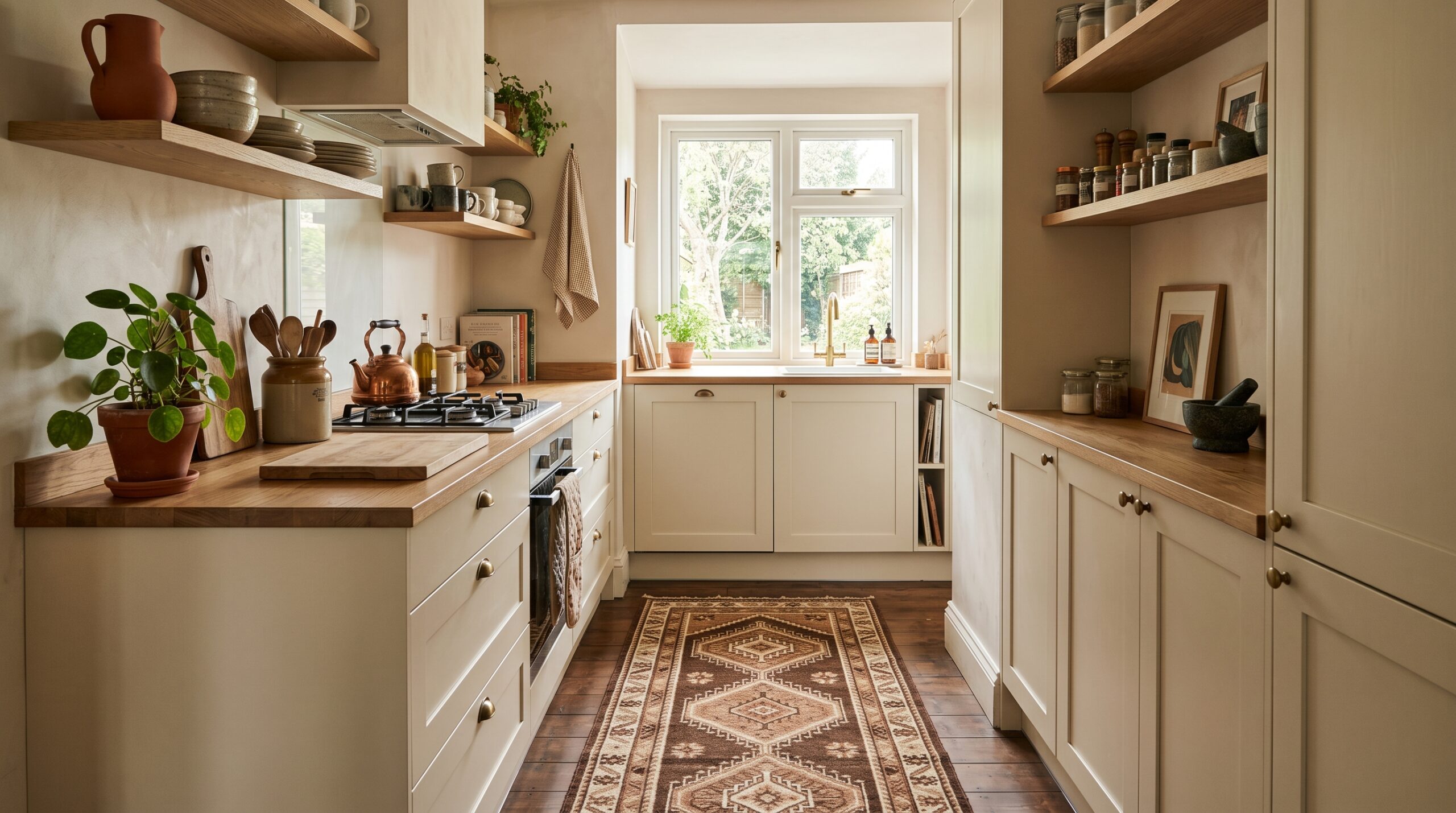
1. MontVoo Braided Kitchen Runner (20″x47″, beige) (default front-of-sink pick)
The default front-of-sink pick. Flat-woven polypropylene, rubber backing, washable, beige reads neutral with almost any cabinet color. Twenty inches wide is the right width for most galley counters; 47 inches long is exactly the two-thirds-of-counter rule for a typical 6-foot sink wall. Shop the MontVoo Braided Runner on Amazon
MontVoo · 20″ x 47″ · polypropylene with rubber backing · flat-woven, low pile · beige
Not for: kitchens where the sink wall is over 8 feet long. The 47-inch length will read too short; go to a 2×6 runner instead.
2. palohom Faux Wool 2×6 Runner (brown and beige boho)
When you want pattern in front of the sink instead of solid. Faux wool feels soft underfoot, the rubber backing is built in, and the boho brown-and-beige pattern hides crumbs and water marks. Six feet is long for a small kitchen, so save this one for a true galley wall, not a 3-foot sink section. Shop the palohom 2×6 Runner on Amazon
palohom · 2′ x 6′ (24″ x 72″) · faux wool with rubber backing · boho brown and beige
Not for: kitchens with a sink wall under 5 feet. The 6-foot length will overhang into doorways or walking lanes.
3. HY HAO YUN LAI Vintage 2×6 Runner (beige distressed budget pick)
The budget pattern pick. Distressed vintage print hides marks the way a solid never can. Non-slip backing is built in, so no separate pad. Polyester is the right material near a sink. Shop the Vintage 2×6 Runner on Amazon
HY HAO YUN LAI · 2′ x 6′ · polyester with non-slip backing · beige distressed vintage print
Not for: minimalist kitchens. The distressed print reads farmhouse, not modern.
For standing comfort (anti-fatigue mats)
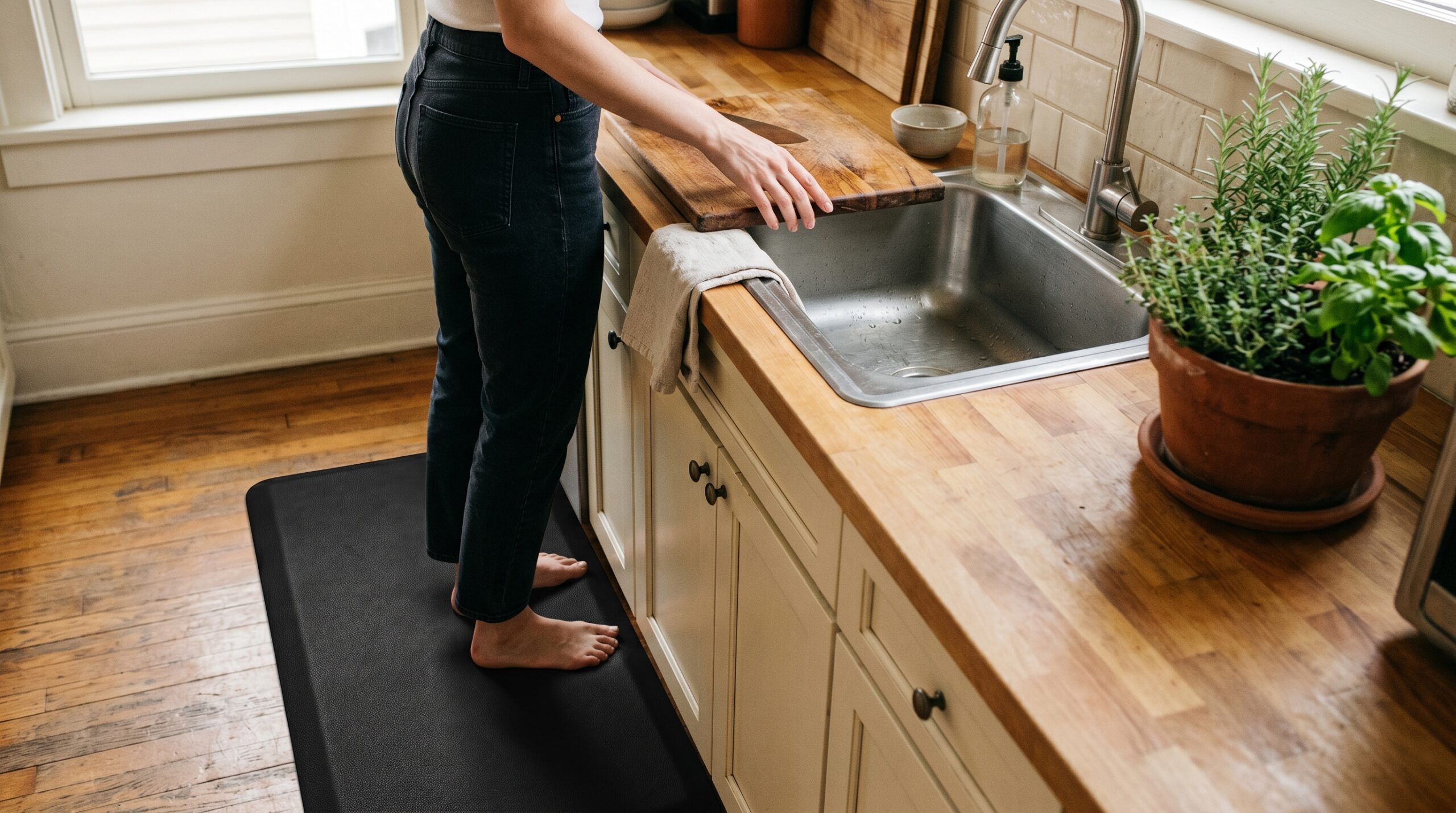
4. ComfiLife 20×39 Anti-Fatigue Mat (3/4-inch memory foam, premium pick)
The one to buy if you actually cook. Three-quarters of an inch of high-density memory foam is what your knees deserve after the first hour of weekend meal prep. Stain-resistant top wipes clean. ComfiLife backs it with a lifetime guarantee, which is the closest thing to “buy it once” in this category. Shop the ComfiLife 20×39 Mat on Amazon
ComfiLife · 20″ x 39″ x 3/4″ · high-density memory foam · stain resistant · lifetime guarantee · black
Not for: kitchens with under-counter dishwashers that swing into the mat zone. Measure the swing arc before buying 39 inches.
5. Amazon Basics Anti-Fatigue Mat (20″x36″ x 0.6″, black) (mid-tier pick)
The mid-tier pick. Five-eighths of an inch of foam is enough for shorter cooking sessions; the black is forgiving on a kitchen floor. Cheaper than the ComfiLife by a noticeable margin and still wipes clean. Shop the Amazon Basics Anti-Fatigue Mat on Amazon
Amazon Basics · 20″ x 36″ x 0.6″ · polyurethane foam · non-slip back · black
Not for: daily multi-hour cooks. The 5/8-inch foam compresses under sustained use; step up to the ComfiLife if you stand for hours at a time.
6. KitchenClouds 17.3×28 Cushioned Mat (compact pick)
The compact pick when 36 inches is too long. Seventeen by twenty-eight inches fits in front of a narrow sink or a 24-inch dishwasher gap. Half-inch PVC foam, beveled edges, no trip lip. Shop the KitchenClouds Mat on Amazon
KitchenClouds · 17.3″ x 28″ · PVC foam · beveled edges · water resistant · black
Not for: anyone over 5’10”. The shorter length means you only get coverage for two foot-positions, not a full standing shift.
For L-shape pivots and entry zones (round rugs)
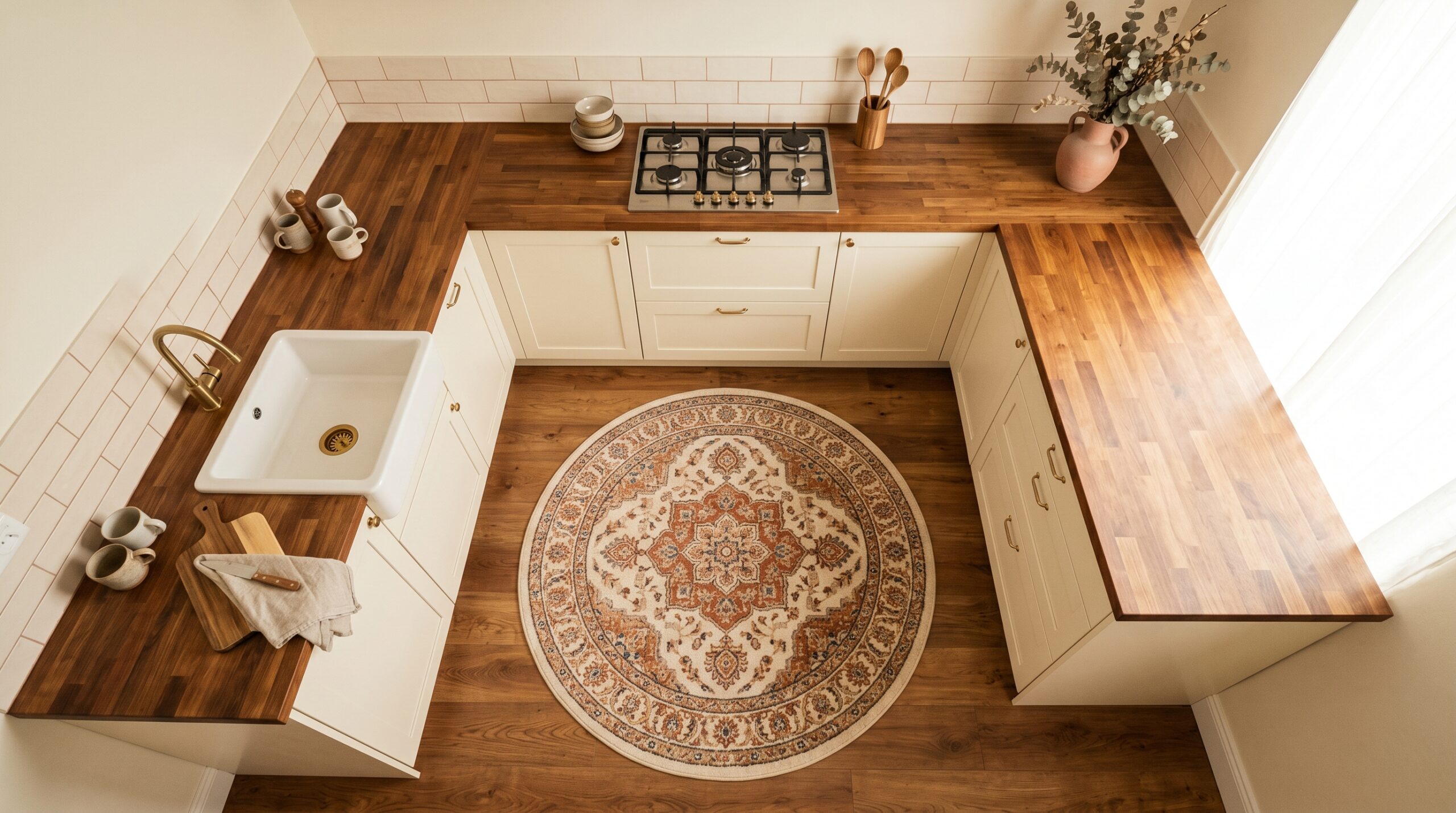
7. Lahome Belle Boho Round 3ft (khaki with tassels, pretty pick)
The pretty pick. Cotton-blend top, tassel edges, ultra-thin profile that lays flat under a kitchen chair if you move it. Khaki tone reads warm without competing with cabinet color. Machine washable. Shop the Lahome Boho Round on Amazon
Lahome · 3′ round · 45% cotton / 45% polyester / 10% viscose · tassel trim · khaki
Not for: within 24 inches of a stove. The cotton blend is a fire risk that close to flame.
8. Easy-Going Round 3ft (vintage multi distressed)
The pattern pick for an L-shape pivot. Faux wool top, distressed medallion print, non-slip backing. The pattern is busy enough to hide a season of kitchen wear without looking dirty. Shop the Easy-Going Round on Amazon
Easy-Going · 3′ round · faux wool with non-slip backing · vintage distressed medallion
Not for: minimalist or all-white kitchens. The pattern reads warm and busy; it needs a kitchen with some existing color to balance.
9. KUTA Vintage Round 3ft (grey-blue-white floral, cool palette pick)
The cool-palette pick when your kitchen leans toward white and stainless. TPE non-slip backing (a rubber alternative, slightly softer underfoot), washable, low pile that rolls flat under chairs. Shop the KUTA Vintage Round on Amazon
KUTA · 3′ round · polyester with TPE non-slip backing · grey-blue-white floral medallion
Not for: warm-toned kitchens (terracotta, brass, oak). The cool grey-blue palette will clash with warm wood and brass hardware.
For two-zone kitchens (matched 2-piece sets)
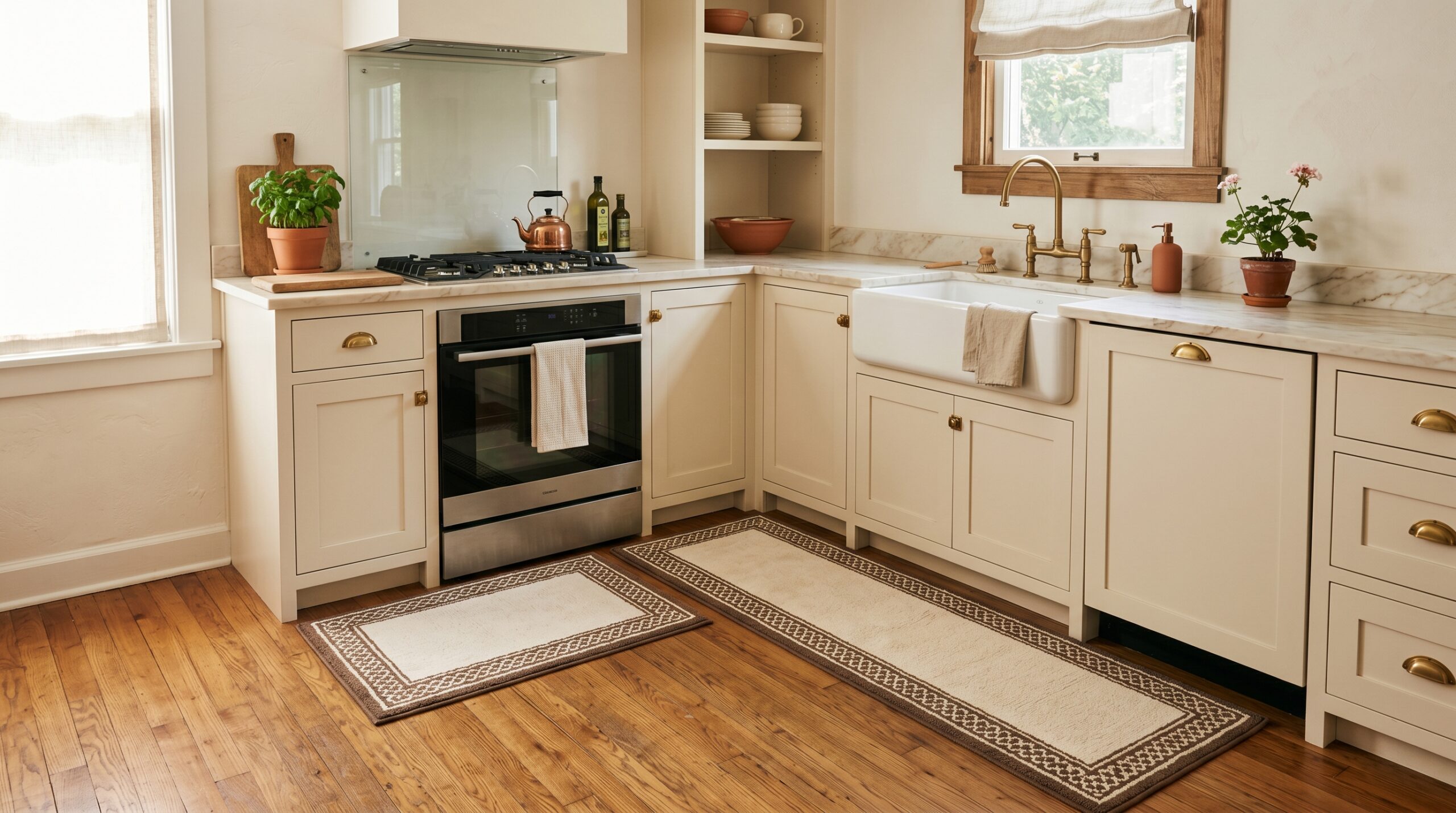
10. HEBE Kitchen Rug Sets 2-Piece (20″x32″ + 20″x48″, border coffee)
The matched set pick when you need both a sink mat and a stove mat or a longer runner. Rubber backing on both pieces, polypropylene, both machine washable. Buying matched is the difference between “intentional kitchen styling” and “two unrelated rugs that happen to share a floor.” Shop the HEBE 2-Piece Set on Amazon
HEBE · 20″ x 32″ + 20″ x 48″ set · polypropylene with rubber backing · border coffee colorway
Not for: kitchens where you only need one rug. The two-piece value disappears if you’re not actually using both pieces.
For the engineering side of why a rubber or TPE backing matters near a sink and a stove, the Consumer Product Safety Commission guidance on slip and fall prevention is the underlying standard the rug industry follows.
Frequently asked questions
How big should a kitchen rug be in a small kitchen?
For a galley under 8 feet long, a 2-by-3 mat in front of the sink covers the work zone, or a 2-by-4 to 2-by-6 runner if you have a longer counter run. A rug should be roughly two-thirds the length of the counter it sits in front of, and at most the same length as the counter. Wider than 24 inches eats walking room in tight kitchens.
Where should a kitchen rug go: in front of the sink or the stove?
Put it in front of the sink first. The sink is where the water is, where you stand longest for dishes, and where a rubber-backed washable rug solves a real moisture problem. A stove-side rug is fine as a second placement, but the rug must be a low-pile polyester or polypropylene material and stay at least 24 inches back from the burner front for fire safety.
What’s the right material for a small kitchen rug?
Polypropylene, polyester, or wool blends. All three handle moisture and stains better than cotton. Avoid pure cotton within 24 inches of a stove. Choose rugs with a rubber, TPE, or built-in non-slip backing so you don’t have to buy a separate pad.
Should I use a round rug or a runner in a small kitchen?
Runner for a galley. Round for an L-shape pivot or a square kitchen where the rug needs to mark a single zone, not a hallway. Square rugs are usually wrong in small kitchens because they break the floor into chunks instead of stretching it lengthwise.
Can I put an area rug under my kitchen table in a small kitchen?
Only if the rug is at least 24 inches larger than the table footprint on every side, so chairs stay on the rug when pulled out. In a small kitchen this is usually a 5-by-7 minimum under a 4-person table, which is larger than most small kitchens can spare. A 3-foot round under a 30-inch round bistro table is the small-space-friendly version.