This post contains affiliate links. If you buy something through one of my links, I may earn a small commission at no extra cost to you. I only recommend products I’d actually use myself. As an Amazon Associate I earn from qualifying purchases.
Tomato Girl is the Italian-summer kitchen look that took over Pinterest: red gingham, sun-warmed terracotta, a bowl of tomatoes on the counter, and basil growing on the sill. It started as a Gen Z reaction against cold gray minimalism, and it has real staying power because it is built on warmth, not trend pieces.
Here is the problem. Almost every inspiration photo you save is a big sunlit farmhouse kitchen with a six-burner range and a window the size of a door. That is not the kitchen most of us rent.
So this is the small-space, renter-safe version. Every step below works in a galley kitchen or a studio kitchenette, and not one of them asks you to paint a cabinet, drill a hole, or lose a deposit. I am going to build the look in the order I would actually shop for it, starting with the one thing that sets the whole tone.
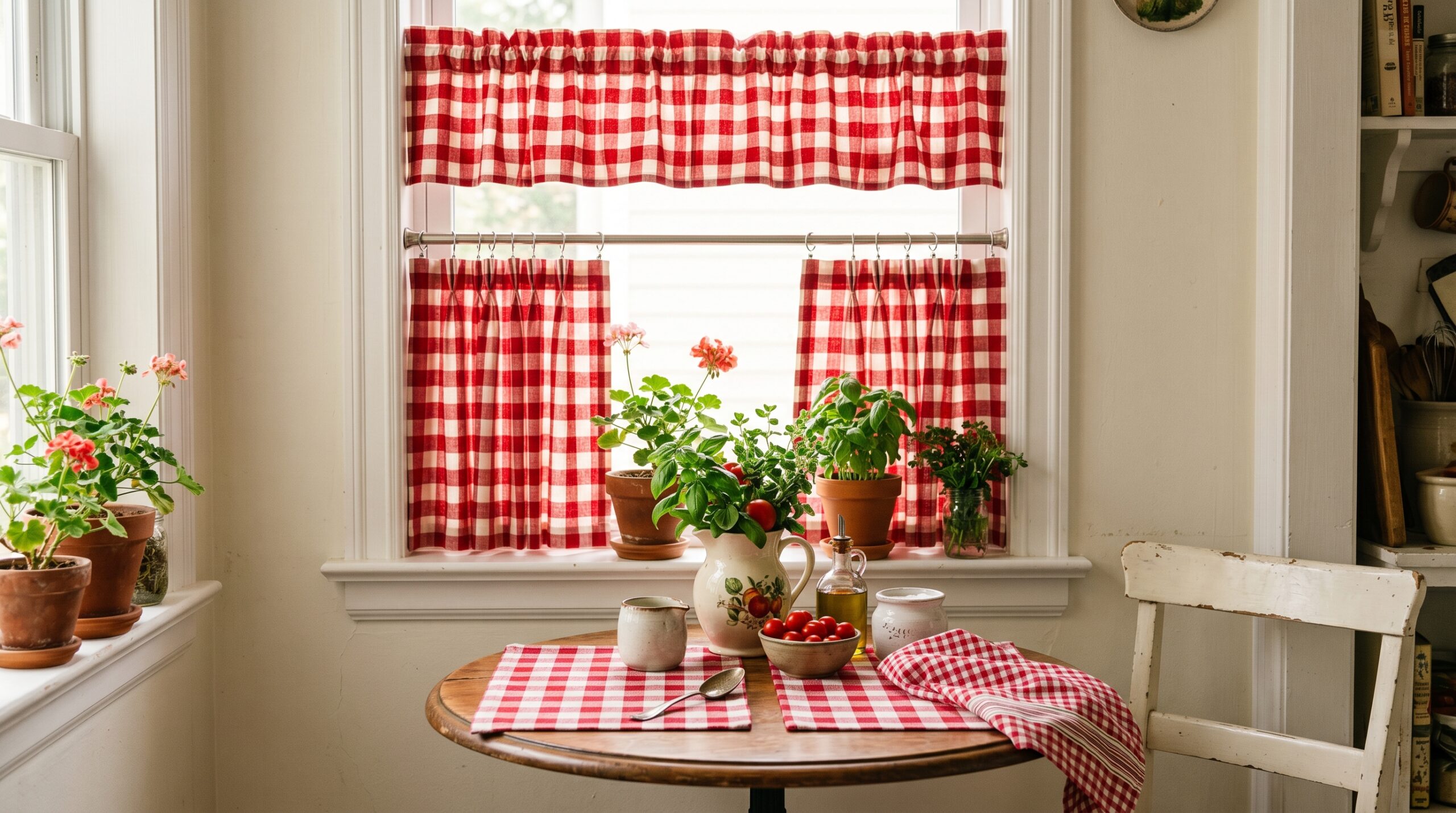
Step 1: Put the gingham at the window first
The window is where Tomato Girl lives or dies. Bare blinds read “rental.” Red-and-white check reads “someone who loves to cook lives here.” Start there before you spend on anything else.
I would hang cafe-style tier curtains rather than full-length panels. In a small kitchen the bottom half of the window is the part you want softened, and tiers leave the top open for light. The COTTON CRAFT Cafe Kitchen Curtain set is my pick because it comes as three pieces, two tiers plus a matching valance, in a proper buffalo-check cotton that hangs heavy enough to look intentional.
See the COTTON CRAFT 3-piece gingham cafe curtain set on Amazon
100% cotton, 3-piece set (two tiers plus valance). Not for: oversized picture windows, this is sized for a standard small-kitchen window.
The trick to keeping it renter-safe is the rod, which is the next step.
Step 2: Use a tension rod so the wall stays untouched
You do not need to drill anything to hang a kitchen curtain. A spring-tension rod wedges inside the window frame and holds the weight of cotton tiers without a single screw.
I reach for the Ivilon Spring Tension Rod here. The 24-to-36-inch range covers most small-kitchen windows, the brushed-nickel finish disappears behind the fabric, and Ivilon rods hold their grip instead of slowly drooping by month two, which is the failure mode of the cheapest rods.
See the Ivilon tension curtain rod on Amazon
Renter-Friendly Alternative
If your window has no inside frame to grip (some aluminum-framed rentals do not), skip the tension rod and use two adhesive hooks rated for three pounds at the top corners, then hang a lightweight rod across them. It comes down clean and takes the spackle with it.
Extends 24 to 36 inches, brushed nickel. Not for: windows wider than 36 inches, size up to a longer tension rod.
Step 3: Carry the check onto the table and counter
Once the window is done, echo it. Repetition is what makes a palette read as a choice instead of an accident. The good news is this is the cheapest part of the whole project.
A set of red gingham kitchen tea towels does most of the work. Drape one over the oven handle, fold a couple on the counter, and the room already feels styled. These are 100% cotton and actually absorbent, so they earn their place instead of sitting there as props.
See the 4-pack gingham tea towels on Amazon
If you have any kind of eating surface, even a counter bar, add buffalo-plaid placemats. The Native Fab cotton set is heat resistant and lays flat after a press, and four mats on a small two-top instantly reads trattoria. This is also the move if you want the gingham without committing to a full tablecloth, which can swallow a small table.
See the Native Fab gingham placemats on Amazon
Tea towels: 16 x 26 inches, set of 4, 100% cotton. Placemats: 13 x 19 inches, set of 4, heat resistant. Not for: round bistro tables, the mats are rectangular.
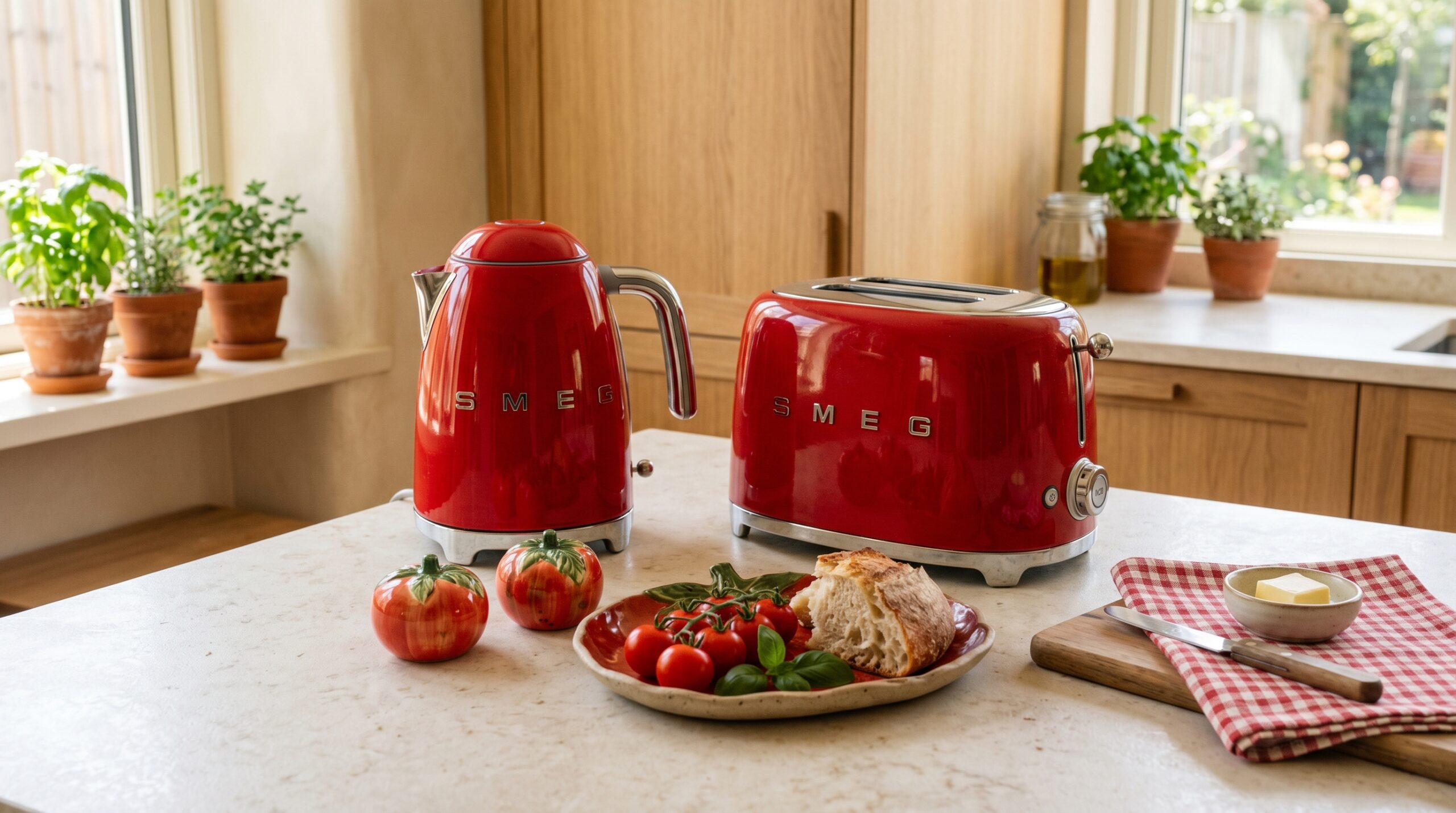
Step 4: Anchor the palette with one cherry-red appliance
Now the color. One genuinely red appliance, left out on the counter on purpose, is the spine of the whole look. It tells the eye the red is deliberate.
I would make it the kettle. The Moss & Stone 1.2L Electric Kettle is a true cherry red, and the 1.2-liter body is small enough to live permanently on a tight counter without eating your prep space. Cordless base, fast boil, auto shut-off. It is the best value of any red appliance I looked at, and a kettle is the one you will actually use every morning.
See the Moss & Stone red electric kettle on Amazon
1.2 liter, cordless, 1500W. Not for: anyone who needs to boil for a crowd, this is single-household scale.
Step 5: Add a second red piece only if your counter can spare it
This is the small-space discipline that the big-kitchen inspiration photos never have to think about. Two red appliances is the ceiling. Three starts to look like a showroom.
If your counter has room, the Nostalgia Retro 2-Slice Toaster in red is the piece I would add. I confirmed the red colorway is in stock, and the rounded retro silhouette is exactly the vintage-Italian-kitchen shape the aesthetic wants. Sitting next to the red kettle, the two of them make the palette feel collected.
See the Nostalgia retro toaster in red on Amazon
2-slice, wide slots, crumb tray, 5 browning levels, red. Not for: kitchens with under a foot of free counter, in that case stop at the kettle.
If your counter cannot spare the space, genuinely stop at the kettle. A cramped, crowded counter undoes the whole relaxed Italian feeling faster than a missing toaster ever could. If counter space is your real bottleneck, my small kitchen counter storage guide covers how to claw some back first.
Step 6: Bring in the literal tomato, but keep it ceramic
The aesthetic is named after a fruit, so at some point you do want an actual tomato in the room. The mistake is buying a fridge magnet. The fix is ceramic.
A pair of hand-painted tomato salt and pepper shakers from Two’s Company is the smallest possible version, and at 2.75 inches tall they tuck onto the stovetop ledge or the table without claiming space. They arrive in a gift box, so they double as a housewarming present for the friend who started all this.
See the Two’s Company tomato salt and pepper shakers on Amazon
For something that works as decor and dishware at once, the Now Designs tomato-shaped stoneware dish is the grown-up version of the motif. It is 8.5 inches across, dishwasher and microwave safe, and it holds bread or fruit when company is over and reads as a sculpture when it is empty. One literal tomato object plus one tomato-shaped piece is plenty. You do not need the matching twelve-piece set.
See the Now Designs tomato dish on Amazon
Shakers: 2.75 inch height, ceramic, gift-boxed. Dish: 8.5 inch diameter, 100% stoneware, dishwasher and microwave safe.
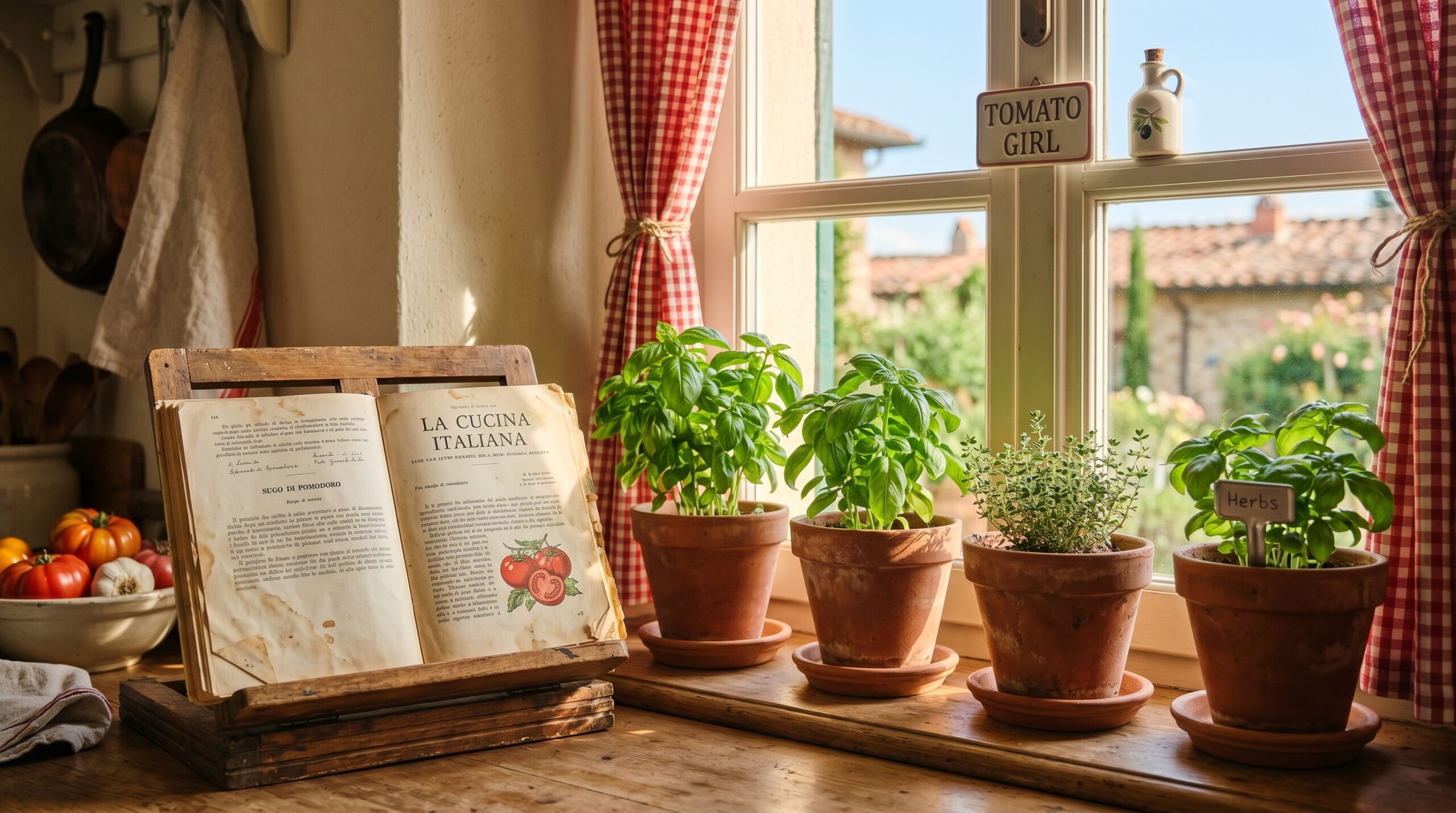
Step 7: Grow a real basil row in terracotta
Nothing fakes the Italian-summer feeling like a living herb. Terracotta is the material that carries it, because raw clay warms the whole palette in a way that a glazed pot never does.
A graduated set of four terracotta pots from vensovo gives you a windowsill row at the right scale, 3.5 to 6 inches, with drainage holes and matching saucers. The saucers matter in a rental: they keep water off the sill and the paint underneath it. Plant basil in the bigger two and something low like thyme in the smaller ones.
See the vensovo terracotta pot set on Amazon
Keeping basil alive on a windowsill is mostly about light and not overwatering. Basil wants roughly six hours of direct sun and soil that stays evenly moist but never soggy, per the University of Minnesota Extension’s basil guide. If your only kitchen window faces north, grow it there in summer and move it to your brightest sill in winter.
3.5 / 4.2 / 5.2 / 6.0 inch pots, set of 4, drainage holes plus saucers.
Step 8: Prop a vintage Italian cookbook where you can see it
The detail that turns a red kitchen into a Tomato Girl kitchen is evidence that someone actually cooks. A propped-open cookbook does that better than any sign or print.
A solid wood cookbook stand holds a book open at an angle so the pages become the art. The warm wood tone is also the quiet bridge between the red textiles and the terracotta, which keeps the room from splitting into two unrelated color stories. It folds flat when you need the counter back.
See the solid wood cookbook stand on Amazon
Then find the book. This is the one thing I would not buy new. A used Marcella Hazan or a battered mid-century Italian cookbook from a thrift store or library sale costs a couple of dollars and brings the patina the whole look is chasing. Splattered pages are a feature here.
11 x 8 inches, solid wood, folds flat. Not for: heavy coffee-table cookbooks over 600 pages, it is built for standard hardbacks.
How to keep it from looking like a theme restaurant
The line between charming and kitschy is restraint, and small kitchens are actually better at this because they force you to edit.
Three rules keep it on the right side. First, hold the palette to red, white, terracotta, and the green of the basil. The moment a fourth bright color shows up, the Italian-summer spell breaks. Second, mix old and new. A vintage cookbook and a thrifted bowl next to the new gingham is what stops it feeling like a kit you ordered in one click. Third, leave negative space. An empty stretch of counter is what separates a styled kitchen from a cluttered one, and it is the hardest discipline in a room this size.
If you want more renter-safe warmth in the same vein, the same logic drives my dark cottagecore kitchen guide, which is the moodier cousin of this palette. And if your walls are bare metal or tile where adhesives struggle, magnetic kitchen storage is a better mounting route than hooks.
Frequently Asked Questions
Is Tomato Girl just red stuff in a kitchen?
No, and that is the trap. The look is a specific palette (red, white, terracotta, basil green) plus evidence of real cooking. Red alone, with no terracotta, no living herb, and no worn cookbook, just reads as a red kitchen. The warmth comes from the natural materials and the lived-in details, not the color count.
Will any of this damage my rental?
No step here drills, paints, or uses permanent adhesive on a finish. The curtains hang on a tension rod, the pots sit on saucers that protect the sill, and the appliances and ceramics just sit out. It is fully reversible on move-out day.
Do I need a big kitchen for this?
The opposite. A small kitchen is easier to pull off because the gingham window and one red appliance fill the visual frame fast. The whole guide is built around a galley or kitchenette, and the restraint a small counter forces is exactly what keeps the look from tipping into kitsch.
What if I cannot keep basil alive?
Start with one pot, not four, and put it in your brightest window. Basil is forgiving if you water when the top inch of soil dries and never let it sit in a soggy saucer. If your kitchen genuinely has no light, grow rosemary or thyme instead, which both tolerate less, and keep the terracotta look intact.
Is the tomato aesthetic still worth doing in 2026?
Yes, because it is not really a trend, it is a return to warm, personal, cook-friendly kitchens. Even as the hashtag cools, red gingham and terracotta and a basil plant are going to keep reading as inviting. You are buying a warm kitchen, not a meme.