This post contains affiliate links. If you buy something through one of my links, I may earn a small commission at no extra cost to you. I only recommend products I’d actually use myself. Full details on the affiliate disclosure page.
Apartment living means a sofa has to clear three separate tests before you ever sit on it. It has to fit through the front door. It has to survive the hallway turn, which in 1920s walk-ups can narrow to 32 or 34 inches. And once it’s inside, it has to not dominate an 11-by-13 living room that’s also doubling as a home office and a place to eat dinner.
I spent three weeks measuring, sitting, and staring at sofas under $1500 to find the ones that actually solve this. Most brands design for suburban rooms with 300 square feet to work with. The rest of us are squeezing a real sofa into the footprint of a loveseat, and getting it up two flights of stairs without a handcart.
Below: four picks, each for a different apartment renter. A modular sectional that ships in six boxes and fits through any door. A 54-inch sleeper for a studio. A 71-inch chenille loveseat for a tight 1-bedroom on a real budget. And a boucle sofa built to survive a cat, a dog, or both.
Every sofa here has been cross-checked against standard apartment door widths, hallway turns, and delivery windows as of mid-April 2026. Prices and stock verified the day this went live.
What makes an apartment-sized sofa work
Four things have to be true before I’ll recommend an apartment sofa. Almost every disappointing purchase I’ve seen in a friend’s living room fails at least one of them.
It has to be under 75 inches wide, or ship in pieces. Standard interior apartment doors run 30 to 32 inches. An older walk-up with a tight landing can drop to 29. A fully assembled 84-inch sofa with fixed arms is physically not getting into a third-floor unit in Park Slope or Somerville. If it’s wider than 75 inches, it has to be modular, have removable arms, or come in a box that fits up the stairs.
Modular or splittable beats fixed-frame, every time. Even if you’re not moving soon, apartment layouts are weird. You rearrange because the AC unit goes in a different window, or because you finally admit the couch should face the TV. A sectional you can swap from left-chaise to right-chaise without buying a new piece is worth the extra 80 bucks.
Fabric has to hide wear, pet hair, or both. Light velvet looks incredible for six months and then looks tired. Chenille, boucle, and performance weaves hide fuzz, spill rings, and the scuffs that happen when you drag an IKEA box across it. If you have a pet, the fabric decision matters more than the frame.
Under $1500 without looking like you settled. The tell on a cheap apartment sofa is almost always the legs. Thin chrome pins or chunky plastic blocks read like dorm furniture no matter how expensive the cushions were. Tapered wood legs, a real frame, and tufted or welted details make a $600 sofa read like a $1200 one. That’s the bar.
Pick 1: The modular sectional for reconfiguring as you go
This is the one I’d buy if I knew I was moving in the next two years. It ships in six boxes, the chaise swaps left or right in about ten minutes with a hex key, and it folds down into a sleeper when your sister visits. At 999 dollars it’s the top of the apartment-sofa budget, but you’re getting a sectional, a sleeper, and storage in one piece of furniture.
The velvet is the part I’d flag. It’s dramatic and warm in person, but it shows cat hair and dark-fabric lint clearly. If you have a shedding pet, this isn’t the pick for you. It’s for a renter who’s rearranging, not a renter who’s defending the cushions.
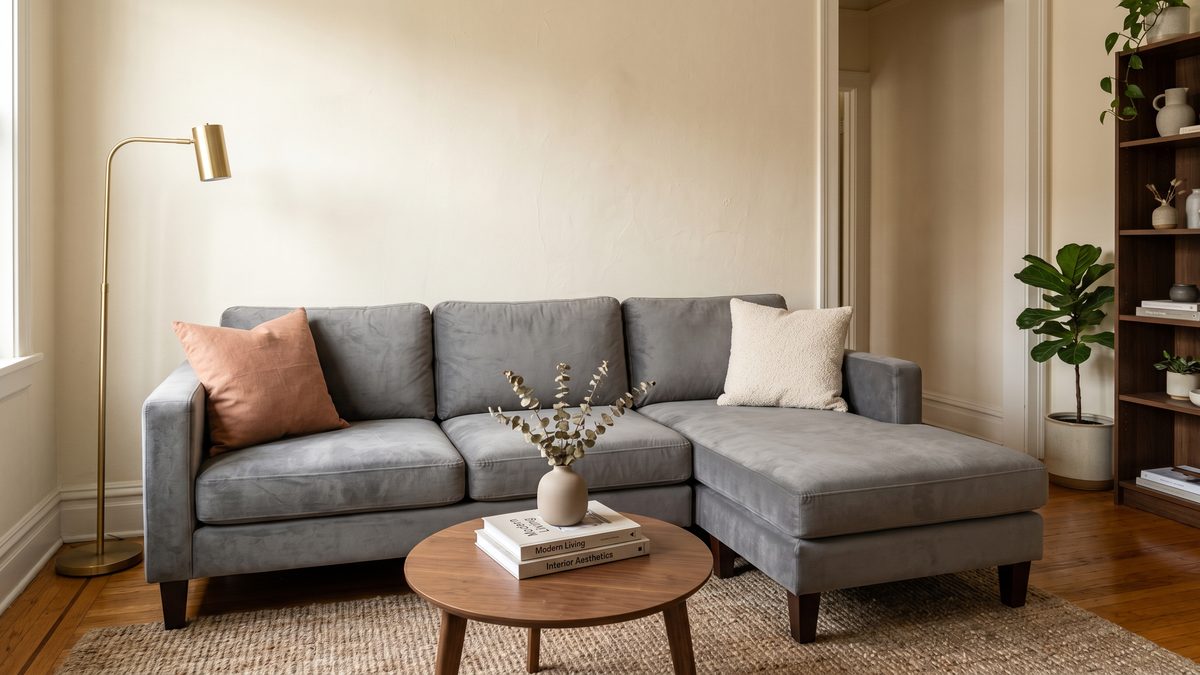
The Belffin Modular Velvet Sectional Sleeper is a sectional, a pull-out bed, and a storage chaise bolted together in the smartest way I’ve seen at this price. The chaise lifts open for blanket storage, the back cushion folds flat into a sleeper surface, and every module ships in its own box small enough for an elevator. The adjustable backrest is the feature I didn’t expect to use and now can’t live without for Sunday afternoon reading. See the Belffin modular sectional on Amazon
Dimensions: 90.2″ W × 58.3″ D × 33.5″ H · velvet upholstery · modular sectional with sleeper and storage · 6 pieces, ships in multiple boxes · lifetime frame warranty
Not for: shedding pets (velvet shows every hair), or anyone who wants a set-and-forget permanent arrangement (the modular flex is the point).
Pick 2: The studio sleeper that’s actually studio-sized
Most sleeper sofas marketed to apartment dwellers are 72 to 80 inches wide. That’s a 1-bedroom sleeper, not a studio one. In a real studio, where the sofa is also the bedroom, the couch has to end closer to 54 inches so you can fit a dresser, a chair, and a path to the kitchenette.
LINSY’s 54-inch is the smallest proper sleeper I’d actually endorse. It’s a convertible (pull-out plus recline), has a USB charging station built into the arm, and the chenille fabric takes a weekly vacuum without pilling. For overnight guests, the pull-out bed is fine for a weekend. For anyone planning to sleep on it every night, get a real mattress instead.
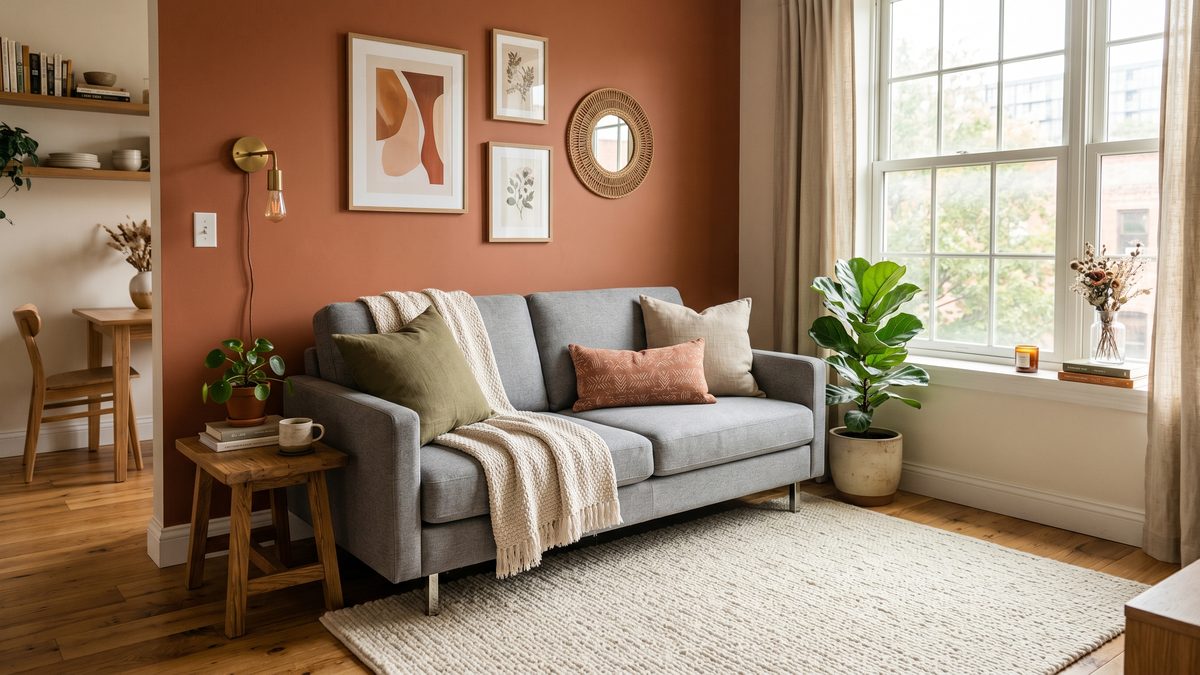
The LINSY 54-inch Pull Out Couch is the rare sleeper sofa that doesn’t lie about being small. The metal frame carries 660 pounds, the pull-out mechanism is a three-in-one (sofa, recliner, twin bed), and the built-in charging port and cup holder mean you’re not running a power strip across the floor. At 440 dollars this is the cheapest pick on the list, and the one I’d put in a first apartment. See the LINSY 54-inch sleeper on Amazon
Dimensions: 53.8″ W × 33.5″ D × 28.6″ H · chenille upholstery · 3-in-1 convertible sleeper with USB port and cup holder · 660 lb weight capacity · ships in one box
Not for: nightly sleeping (the pull-out is weekend-grade, not primary-bed-grade), or tall guests (twin-width pull-out tops out around 6 feet of sleep surface).
Pick 3: The compact loveseat for a tight 1-bedroom on a real budget
Loveseats get dismissed because the word sounds dated, but they’re the honest pick for a lot of 1-bedrooms. If the living area is 10 by 12 or smaller, a 71-inch loveseat leaves room for one accent chair, a coffee table, and a rug that actually anchors the space. An 84-inch sofa in the same room eats the floor plan and forces the chair into an awkward corner.
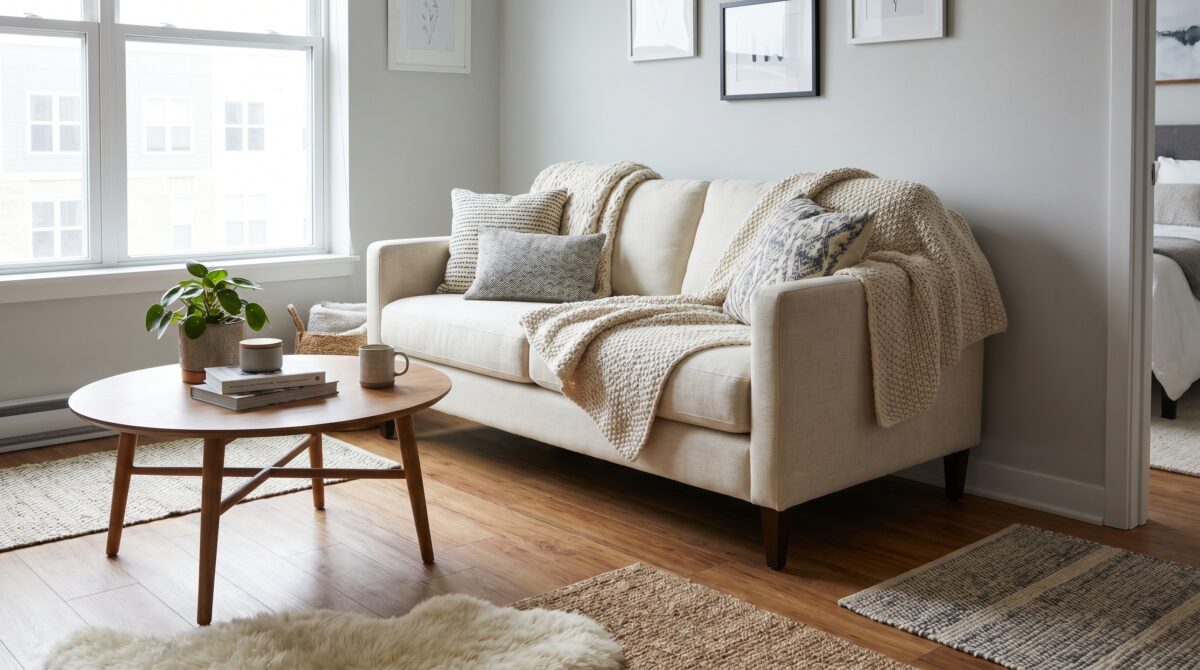
I kept coming back to the Upvilla for its deep 8-inch cushion and the removable slipcover, which matters when you have an apartment-sized sofa that has to last two moves. The chenille fabric hides more wear than linen, and the tapered wooden legs are what pull this out of the budget-sofa category visually.
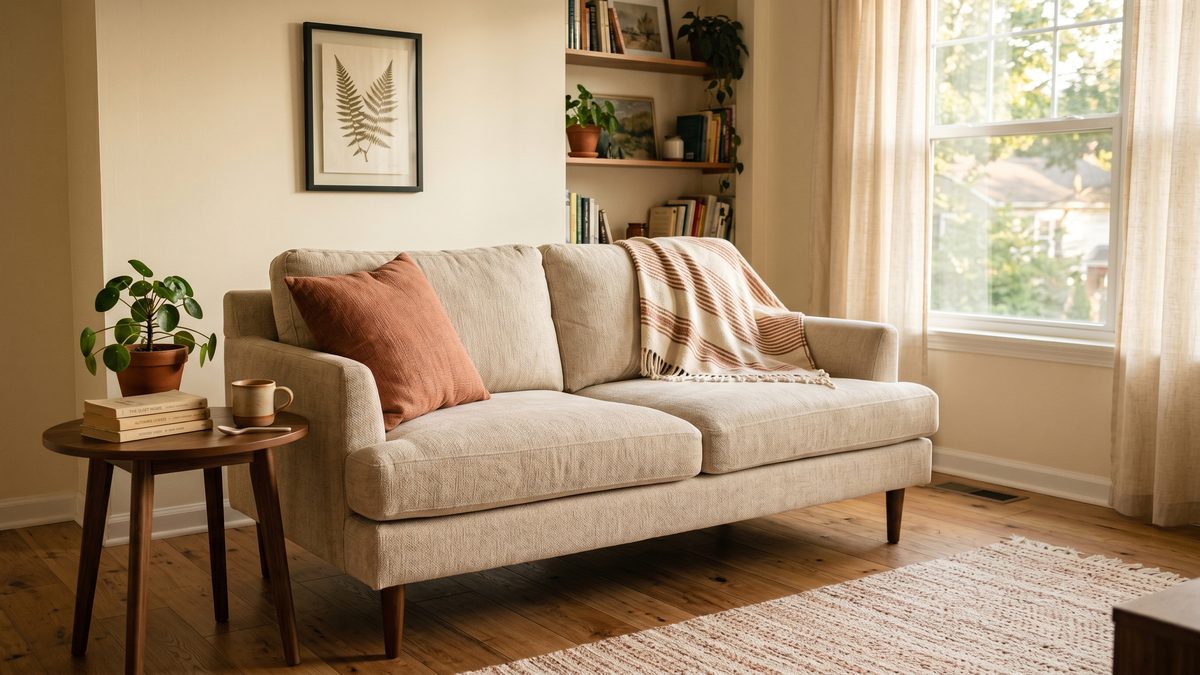
The Upvilla 71.25-inch Chenille Loveseat is the sofa I’d buy if I were stocking a real first apartment and had to keep the whole living room under 600 dollars. The 8-inch deep seat cushion is the reason people end up napping on it, the convertible armrest tilts flat for a daybed moment, and the slipcover lifts off for washing. At 320 dollars this punches well above its price tier. See the Upvilla chenille loveseat on Amazon
Dimensions: 71.25″ W × 34.6″ D × 36.3″ H · chenille upholstery with removable slipcover · 8-inch deep seat cushion · tapered high wooden legs · ships in one box
Not for: tall users who want to fully stretch out (it’s a proper 2-seater, not a 3-seat-pretending-to-be-2), or rooms where you need a sleeper function.
Pick 4: The pet-friendly boucle sofa that actually survives a cat
Boucle looks like it shouldn’t last a week with a cat, and most of them don’t. The looped yarn snags on claws and pulls into long crooked lines across the seat. The Morden Fort gets around this by using a tighter weave with a shorter loop, which my cat’s tested opinion is that it’s less fun to dig into.
This is the design-forward pick. At 833 dollars it’s the splurge of the four, but it’s the one that reads like Article or Interior Define at a fraction of the price. Wooden legs, three-cushion construction, deep seat. It’s 86 inches wide, so measure your door twice before you order. If your hallway is 32 inches or tighter, you’ll want the frame to come apart.
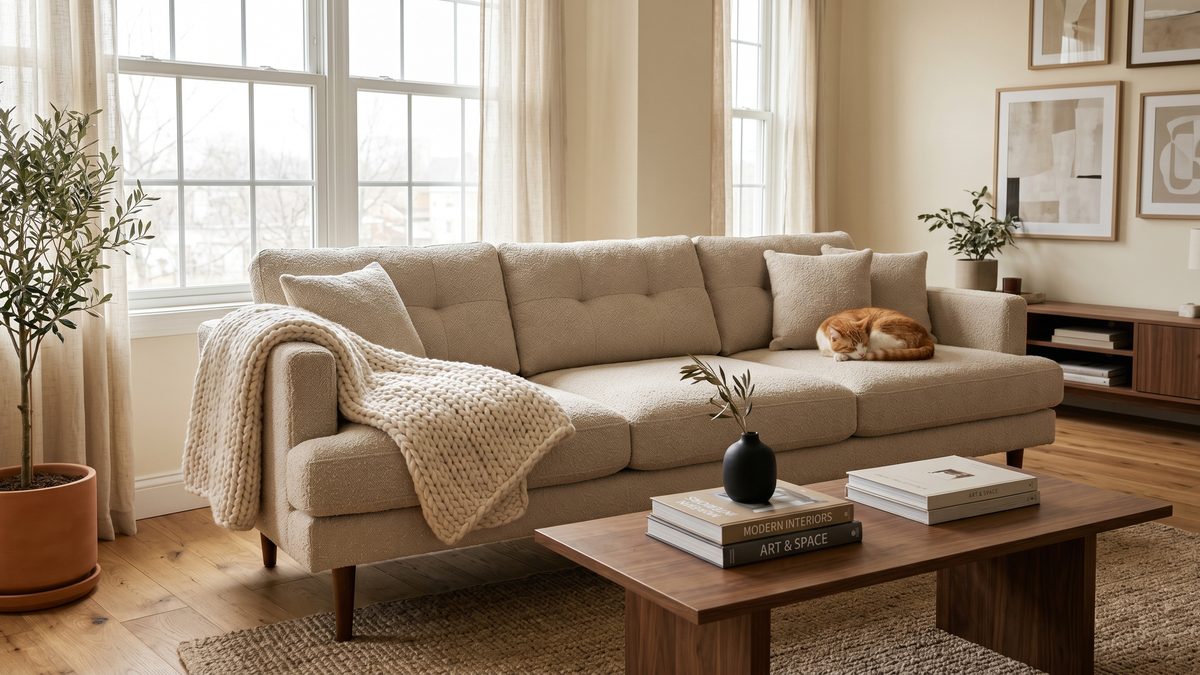
The Morden Fort Pet-Friendly Boucle Sofa is the one I’d point someone toward if they’ve been coveting a Sabai or an Article Haven and can’t make the numbers work. Deep seat, high-density foam, real wooden frame, the tighter boucle weave that marketing calls pet-friendly (and that actually holds up in practice). The beige color is genuinely beige, not grey pretending to be warm. See the Morden Fort boucle sofa on Amazon
Dimensions: 85.83″ W × 34.06″ D × 31.89″ H · tight-loop boucle upholstery · high-density foam over solid wood frame · 3-seater cloud silhouette · wooden tapered legs
Not for: apartments with sub-32-inch doorways where the frame can’t come apart, or anyone who wants a crisp tailored shape (this is intentionally a plush cloud look).
Common mistakes buying an apartment sofa
Measuring the room but not the route. The living room is 12 feet wide, great. But the front door is 30 inches, the hallway turn is 33, and the elevator is 42 deep. A 40-inch-deep sofa that’s only 72 inches wide can still get stuck in an elevator diagonally. Measure every chokepoint from the truck to the wall.
Buying by couch width when depth is the real killer. A 78-inch-wide sofa that’s 40 inches deep eats more floor area than an 84-wide that’s 34 deep. In a small room, depth matters twice as much as width because it shortens the walking path in front of it. Under 36 inches deep for anything 11-by-13 and smaller.
Going dark because it feels sophisticated. Dark sofas shrink small rooms. Cream, oatmeal, terracotta, and warm grey reflect more light and make a 120-square-foot living area read bigger. If you want a dark moment in the room, put it on the rug or a single accent chair, not the biggest piece of furniture.
Skipping the legs check. Raised legs under the frame (meaning at least 3 inches of daylight) make a sofa look lighter in a small room. Skirted bases absorb floor space visually and make the sofa feel bigger than it is. In apartments this difference is louder than in a big living room.
How to measure before you buy
I use a 25-foot self-locking tape measure, the kind contractors carry. The stubby 8-foot tapes fold under their own weight past 5 feet, which is exactly the distance that matters. 3M’s Command catalog is also what I use to stage a mock-up on the wall with painter’s tape before anything gets ordered.
Steps, in order:
1. Measure the front door opening at its narrowest point. Not the frame. The actual gap between the open door and the doorstop. In old apartment stock this can be 28 to 30 inches even though the stated opening is 32.
2. Measure the hallway turn width. The critical number is the diagonal swing, which for a 72-inch sofa needs about 34 inches of clearance at the turn. If the hall turns 90 degrees into the living room, the sofa depth has to clear the far wall.
3. Tape the sofa footprint on the floor with painter’s tape. Full outline. Walk around it. Sit where you’d actually sit. You’ll know in 10 minutes if it’s too big.
4. Measure the elevator or stairwell if you’re on a higher floor. Not just the door into the elevator. The interior depth. A box that goes in flat has to come out upright if the ceiling is tight.
5. Add 2 inches everywhere for breathing room. Measurements are never quite right, packaging adds bulk, and you don’t want to find out at the door.
Frequently Asked Questions
What’s the maximum sofa width for a standard apartment door?
Seventy-five inches is the safe ceiling if the sofa ships fully assembled. Apartment interior doors average 30 to 32 inches, which in practice means the sofa depth (not width) has to come in under 32 inches to fit through upright. Anything wider than 75 inches needs to be modular or have removable arms.
Is a sleeper sofa worth it in a studio apartment?
Only if guests actually come. If you sleep on it every night, the pull-out mechanism compresses the foam in about eight months and you end up with a lumpy sofa. If the guest count is a weekend a quarter, a 54-inch convertible like the LINSY is the sweet spot. Nightly sleepers should price a real Murphy bed instead.
What fabric is best for apartment sofas with cats or dogs?
Tight-loop boucle, chenille, and performance-grade polyester. Avoid velvet (shows hair), linen (snags and stains), and any loose-weave boucle with long loops (cats shred it). A removable slipcover is worth the upcharge because a vacuum alone won’t save you past year one.
Modular sectional or traditional sofa for a small apartment?
Modular almost every time. The ability to rearrange the chaise without buying new furniture is worth the 80-dollar premium, the boxes fit through any door, and if you move the sectional reconfigures to fit the next apartment. The exception is a very narrow room where a straight sofa under 72 inches simply fits better along one wall.
How long should an apartment sofa under $1500 realistically last?
Three to five years of daily use for cushions, five to eight for the frame. Removable slipcovers extend the visible life by a couple of years because you can wash or replace the fabric without buying a new sofa. Expect to flip and rotate the seat cushions every three months and spot-clean the fabric monthly.