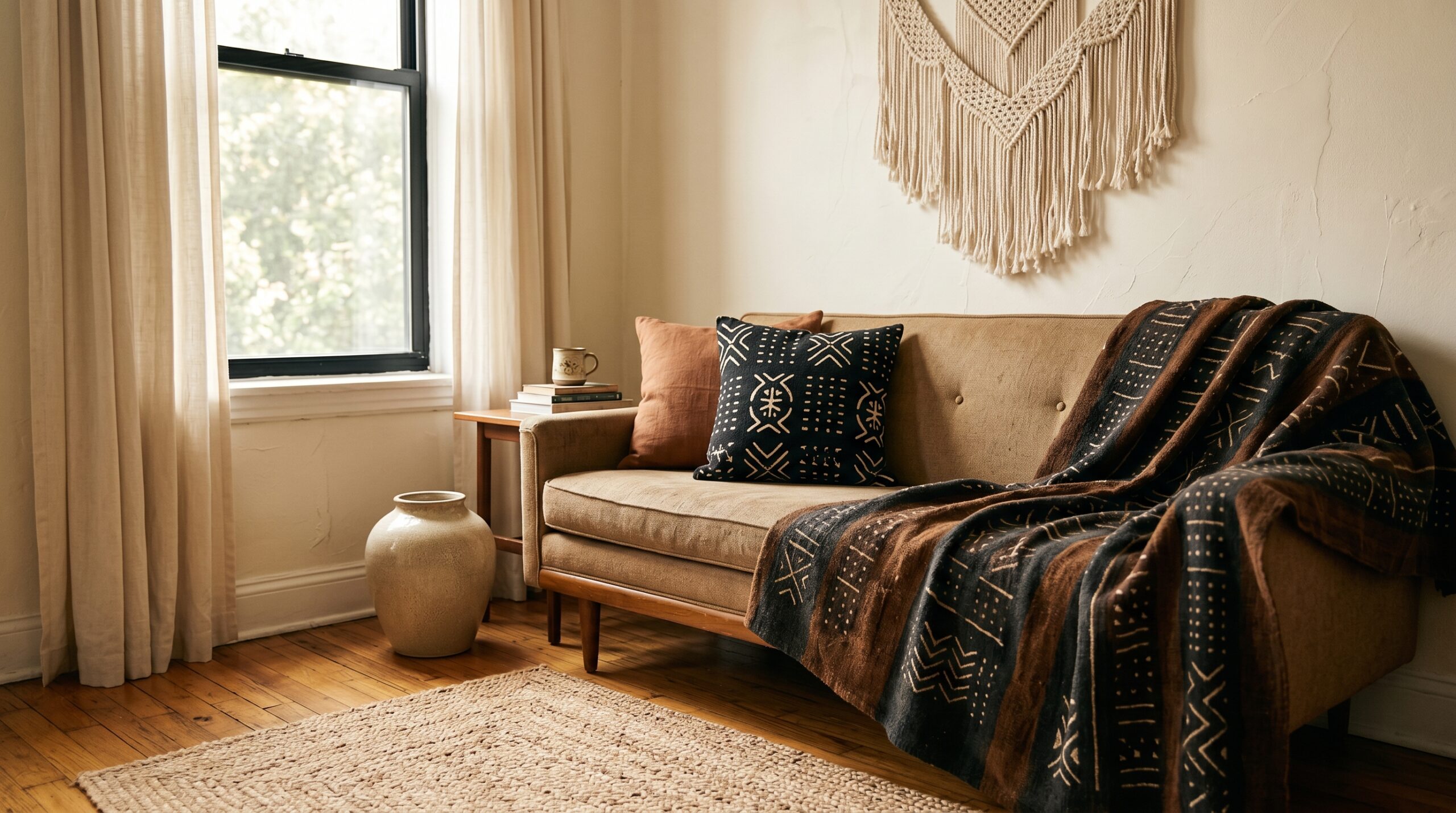
Pinterest searches for “afrohemian fusion” are up 220% year over year, and most of the boards getting saved right now belong to people who rent. That tracks. The look reads expensive, but the pieces that carry it (mudcloth, raffia, carved wood, warm clay tones) cost less than the velvet-and-brass aesthetics trending alongside it. The trade-off is that afrohemian style asks more of the person styling it. It pulls from real textile traditions, and shortcuts that ignore those traditions read flat fast.
I’ve built three iterations of this look in apartments under 700 square feet, two of them rentals. Below is the eight-step version, sequenced for someone who can’t drill into walls, can’t paint, and is working with a budget under $1,200 for the full room.
This post contains affiliate links. If you buy something through one of my links, I may earn a small commission at no extra cost to you. I only recommend products I’d actually use myself.
As an Amazon Associate I earn from qualifying purchases.
Before you buy anything: what afrohemian decor actually is
“Afrohemian” is a contemporary aesthetic term, not a traditional one. It blends West African and East African textile traditions (Bogolanfini mudcloth from Mali’s Bambara people, kuba cloth from the Democratic Republic of the Congo, Ethiopian gabi and netela weaves) with the layered global-collected feel of bohemian styling. The look works because those textiles already do the heavy lifting. The patterns are bold, the dye process gives them depth no factory print matches, and the geometry carries meaning the maker put there on purpose.
That means two things for how you shop.
First, where you can, source the real thing. Authentic Bogolanfini takes about four days to make: hand-spun cotton woven into narrow strips, painted with fermented mud and a plant-leaf solution, washed, sun-dried, painted again. The artisans who do this work still exist, and the cloth funds a living tradition. The Citizenry, Swahili African Crafts, and a number of Mali-based shops on Etsy sell pieces that go directly to the maker. I link to a few Amazon-stocked authentic pieces below, but for hero items like the throw or the wall fabric, I’d rather you spend the extra $40 with an artisan source if you can.
Second, when you do use mass-market versions (the printed pillow covers, the woven-look rugs), call them what they are. They’re styling pieces in the same vocabulary, not the textile itself. I separate the two in every step below so you can make that choice yourself.
How I picked the products in this guide
- Renter-safe installation only. Command hooks, plug-in cords, single ceiling swags. No drilling into walls or ceilings.
- Scale that fits 600 to 900 square feet. Big enough to read, small enough not to dominate.
- Earth-tone palette specifically: clay, terracotta, charcoal, deep brown, cream. I rejected anything in saturated jewel tones because it pulls the room toward Moroccan rather than afrohemian.
- A clear distinction between authentic, artisan-made pieces and printed or mass-market alternatives. Both have a place. The article tells you which is which.
- Every product is verified in-stock at the time of writing (2026-05-19). Amazon’s authentic-mudcloth listings turn over fast, so the artisan picks may shift quarterly.
Step 1: Start with a single mudcloth pillow
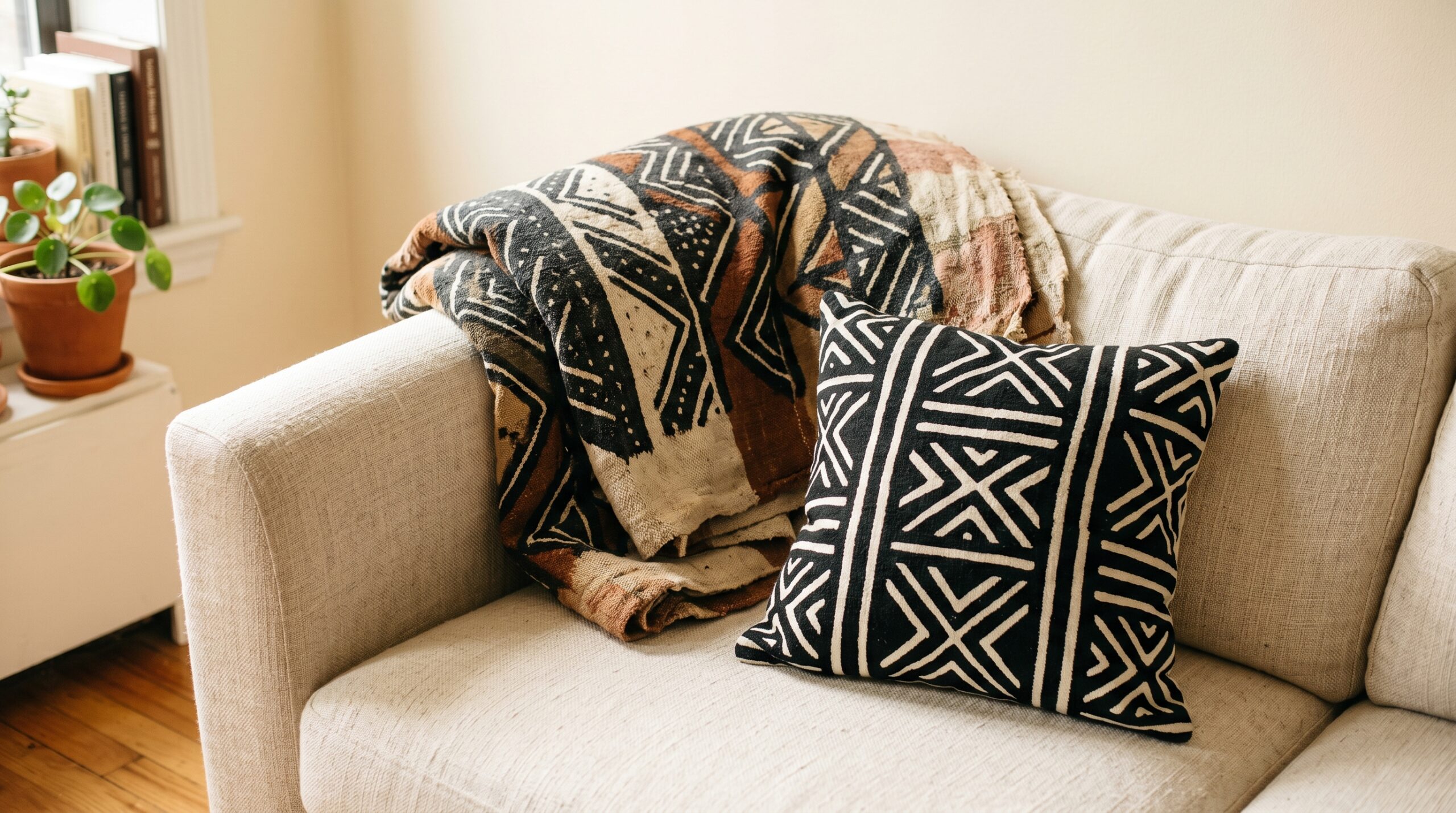
If you only do one thing on this list, do this. A 16- or 18-inch mudcloth-pattern pillow on a neutral sofa or chair is the visual that anchors the entire aesthetic. The geometry of the print reads from across the room.
For the budget version, the Mugod 18×18 mudcloth-print pillow cover is a cotton-linen blend with a hidden zipper. It’s a print, not a hand-dyed Bogolanfini, and I’d be lying if I told you it has the same weight or depth. What it does have: a clean afrocentric geometric pattern in black and white that works as a starter piece while you save for the real thing.
The artisan version of this same item, if your budget allows, is an authentic Bogolanfini pillow cover from a Mali-based Etsy seller. Expect to spend $60 to $120 instead of $12. The difference shows up in the cotton hand and the slight irregularity of the mud-dyed lines.
Step 2: Add a mudcloth throw or wall panel
This is the piece that takes the look from “I have one cool pillow” to “the room has a point of view.” A full Bogolanfini panel, draped over the back of a chair or hung as a wall textile, gives the warm earth-tone palette its biggest visual chunk.
The Mali Vib authentic Bogolan mud cloth panel is one of the only artisan-direct Mali pieces consistently stocked on Amazon. It runs 63 by 45 inches, which is big enough to fold as a sofa throw or hang as a wall accent. The 4-color variant pulls cream, charcoal, rust, and a soft brown out of the same panel, which makes the rest of the palette decisions easier.
For wall installation without drilling, sew two fabric tabs to the top edge (or use iron-on no-sew adhesive tabs), feed a half-inch wooden dowel through them, and hang the dowel from two Command medium hooks rated for 3 pounds each. The cloth weighs about a pound.
Step 3: Build storage with raffia and seagrass baskets
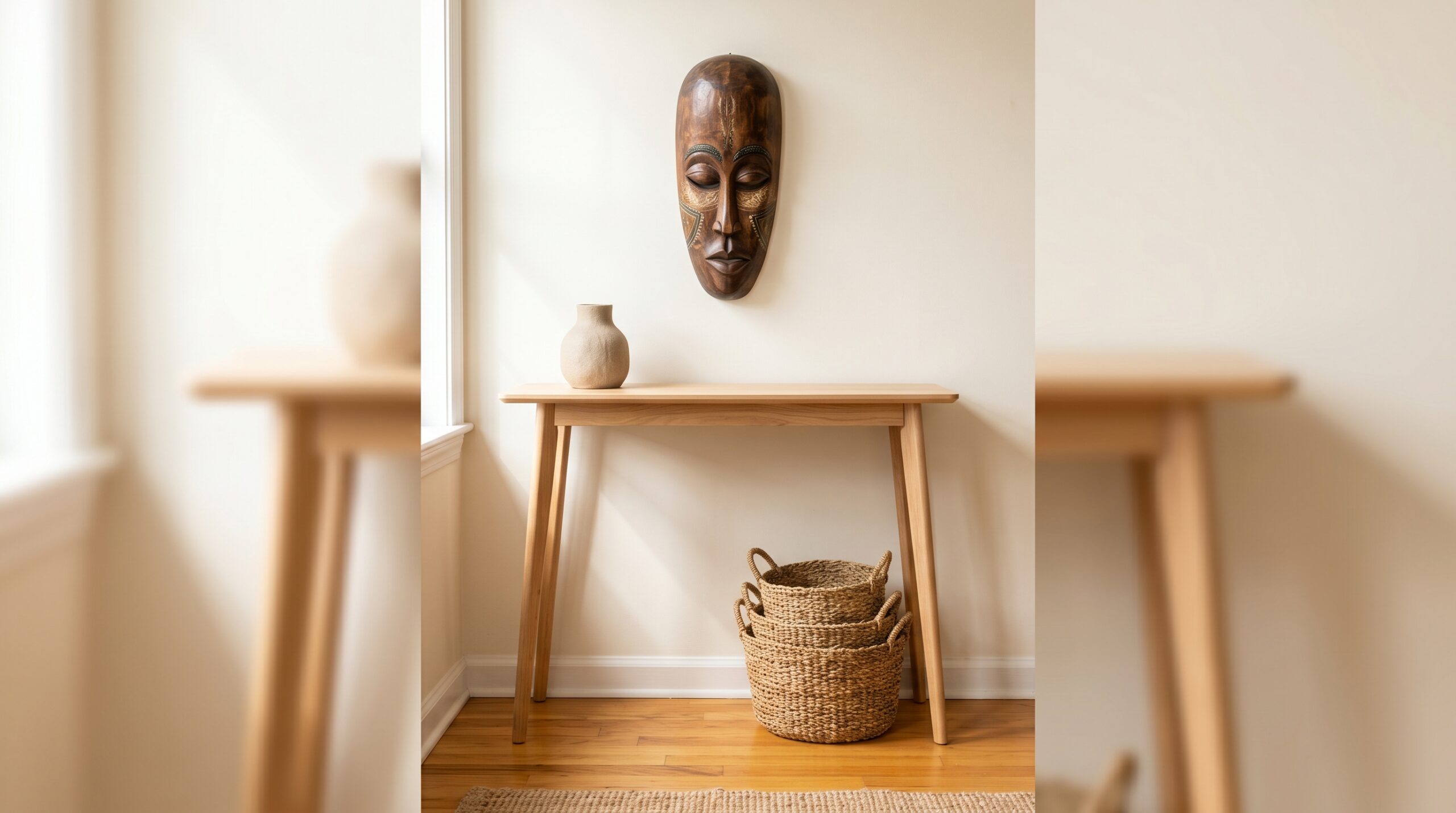
This is the renter-storage step that doubles as styling. Open-weave natural baskets do three jobs at once: they hide the small-apartment problem of nowhere to put things, they add tactile texture in a palette that’s mostly flat textile and ceramic, and they read as on-brand for the look without feeling forced.
The FairyHaus 3-pack seagrass nesting baskets is the set I keep coming back to. They nest when you don’t need them and stack when you do, the linen liners come out for washing, and the large one fits a folded throw blanket. I use mine for shoe overflow by the door, mail and chargers on a console, and craft supplies under a side table.
For something more sculptural, look for the seagrass-and-raffia hybrid baskets from artisan cooperatives in Ghana and Senegal (Bolga baskets are the type to search for). They cost three to four times more, but one large Bolga used as a floor basket near the sofa does the work of two of the FairyHaus set.
Step 4: One carved wood piece, no more
Carved wood is the easiest place to overdo this aesthetic. One thoughtful piece is a statement. Five pieces is a curio shop. I limit myself to a single wall-mounted carving in any room.
The OTARTU hand-carved African mask is a small-format mask (about 10 inches tall) carved from a single piece of wood and hand-painted in tribal patterns. It hangs from a single nail or Command hook. The scale is right for a renter wall, where you don’t want a piece that demands a second piece next to it to feel balanced.
A note on sourcing here that I want to be direct about. African masks are ceremonial objects in many of the cultures they come from. Decorative reproductions like this one are styling pieces, and the makers who carve them for the global home-decor market know that. If you want a piece with documented provenance, the Smithsonian’s National Museum of African Art has a gallery shop with masks sourced through ethical channels, usually in the $200 to $600 range. For decor purposes, the Amazon pick is fine. For collecting, it isn’t the path.
Step 5: A woven wall hanging that hangs from one Command hook
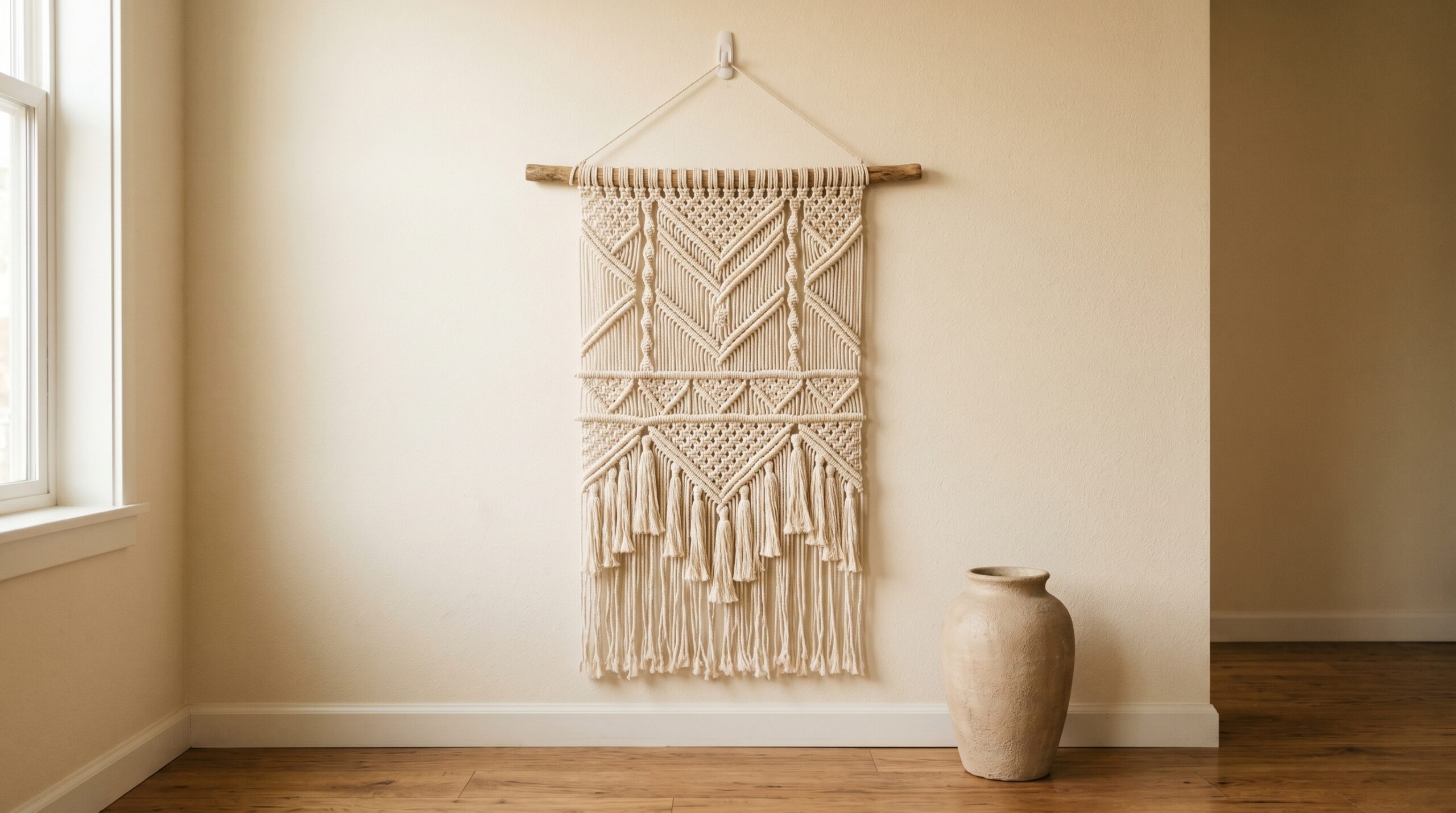
This is the no-drill structural piece that fills wall space without art. Renters benefit twice: nothing to patch when you move, and the woven texture adds the same warm earth-tone tactile layer the mudcloth gives the sofa.
The 43-inch macrame wall hanging with included wooden rod hangs from a single Command medium hook rated for 3 pounds. The full assembly weighs about a pound and a half. Cream cotton fringe, hand-knotted, big enough at 43 by 39 inches to fill the wall above a small sofa or a queen-size headboard.
Macrame isn’t part of the African textile tradition I cited earlier. It’s macro-knotted cordwork with roots in 13th-century Arabic weaving that traveled through Spain and into the European and American craft revival. I include it in this guide because it carries the same tactile language as raffia and mudcloth, and the cream tone reads as the warm neutral the palette needs. If you’d rather stay closer to a specifically African source, look for a Senegalese baobab-fiber wall hanging or a hand-woven sisal panel.
Step 6: Anchor the palette with one earth-tone vase
The trap in this aesthetic is that everything ends up brown. The visual rhythm needs at least one piece in cream or matte beige to give the eye a place to rest between the saturated charcoal and rust pieces. A single tall vase does it.
The HUBUISH 12.6-inch textured beige vase is a matte ceramic with a roughened exterior that catches light differently than a smooth piece. It stands on a console, on the floor next to a sofa, or on top of a stack of books on the coffee table. I leave it empty more often than I fill it. Dried stems work, but the silhouette is strong enough that nothing is also a real option.
The terracotta version of this is a small handmade clay vessel from a Moroccan or Tunisian potter, sold through fair-trade marketplaces. If you go that route, look for “unglazed terracotta” specifically. The matte clay surface holds the palette better than anything glazed.
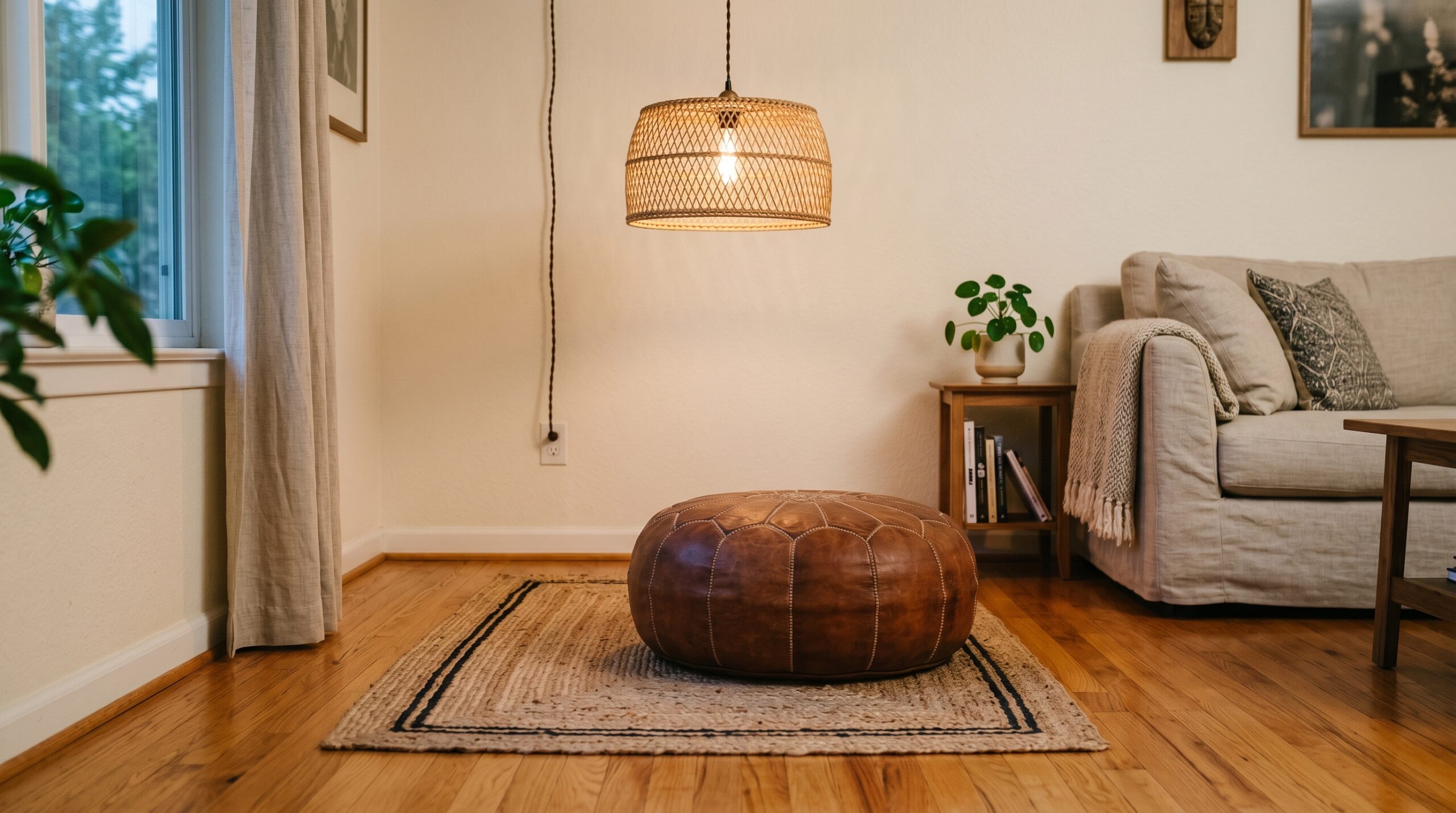
Step 7: Layer the floor with a jute rug and a leather pouf
The floor is where the room’s tactile layering happens, and it’s the layer renters skip most often because rugs feel like commitment. They aren’t. A 5×7 jute rug rolls up in two minutes and moves with you.
The Chardin home 5×7 jute and cotton braided rug is the base layer. Natural jute with subtle black cotton braiding, reversible so you can flip it when one side starts wearing, big enough to anchor a small living room without crowding a studio. The black detailing keeps it from reading purely beige, which matters when the wall textile and pillow are also in the brown family.
The Marrakesh Gallery 20-inch leather pouf is the second layer. Hand-stitched in Morocco from vegetable-tanned leather, ships unstuffed (you fill it with sheets, old blankets, or thrift-store pillows), and works as a footrest, extra seat when someone comes over, or a small side surface for a coffee cup. The leather darkens with use and starts to look better after about six months. Moroccan poufs come from Berber leather artisans specifically, which is worth knowing when you’re styling it next to West African pieces. The geographic lineage is different, but the craft language is consistent enough that the room reads cohesive.
Step 8: Light it with one plug-in rattan pendant
This is the step that makes everything else read as warm rather than busy. Overhead apartment lighting is almost always wrong for this aesthetic. The fix is one plug-in pendant with a woven shade that filters the bulb into a warm pattern on the ceiling.
The ZECOXOL plug-in rattan pendant hangs from a single ceiling swag hook (no electrical work), comes with about 15 feet of plug-in cord, and has an in-line dimmer so you can drop the brightness to evening levels. The hand-woven wicker drum shade casts a faint basket-weave shadow upward when it’s on, which is exactly the texture this look needs at night. Use a warm-tone Edison bulb in the 2700K range. Daylight bulbs ruin this aesthetic instantly.
Common mistakes I keep seeing on Pinterest
Too many wood masks. One is a statement. Two is a wall. Three is a stage set.
Cool-tone whites. Bright white walls or bright white throw pillows fight everything else in the palette. Cream and warm beige only.
Overhead lighting that stays on. The whole look depends on warm-tone plug-in lighting after sunset. The macrame and the rattan shade are doing visual work the ceiling fixture cannot.
Treating mass-market prints as the real thing. It’s fine to start with the budget mudcloth-print pillow. Just don’t write the post or tag the photo as if it’s authentic Bogolanfini. The makers who do the real work deserve the credit.
Forgetting plants. A single trailing pothos or a sansevieria in a terracotta pot is the one thing the product list above doesn’t cover, and it’s the piece that takes the room from “decorated” to “lived in.”
Where to shop beyond Amazon
If you want to go deeper into authentic textiles, three sources worth bookmarking:
- The Citizenry carries Bogolan, kuba cloth, and Moroccan poufs through direct artisan partnerships, with pricing that’s roughly 2 to 3x Amazon’s mass-market equivalents.
- Etsy’s “Bamako” search returns Mali-based sellers shipping authentic Bogolan panels and pillow covers, usually $40 to $120.
- Local African import shops (most major US cities have at least one) often carry kuba cloth, baskets, and carved pieces that don’t show up online at all.
The Amazon picks above are the renter-friendly entry point. The pieces from the sources above are what the room grows into.
FAQ
Can I do this look in a studio under 400 square feet?
Yes, but cut the product list to four pieces: one mudcloth pillow, the jute rug, the macrame wall hanging, and the plug-in pendant. Skip the basket set, the mask, and the leather pouf until you move. In tight square footage, more pieces stop adding and start subtracting.
Will the look date?
Mudcloth and kuba cloth are 200-plus year old textiles. They’ve outlasted every trend cycle so far. The macrame and rattan pendant are the pieces that read most “trend” right now. If you’re worried about longevity, lean harder on the textile and basket pieces and lighter on the macrame.
How much should I budget total?
For the full eight-step setup using the Amazon picks above, you’re at roughly $250 to $350. Substitute the artisan versions of the mudcloth, the basket, and the wall hanging, and you’re at $600 to $900. Both budgets produce a room that reads cohesive. The difference is in tactile weight and how the pieces hold up.
Is it appropriation to style this look if I’m not African?
This is the question the aesthetic raises and I’d rather answer it directly than dodge it. Buying authentic pieces from the makers who produce them and naming the traditions accurately is appreciation. Buying $8 mass-market prints, calling them “tribal,” and skipping the credit is appropriation. The difference is the same as with any culturally-rooted aesthetic: source carefully, name the origin, and put your money where the tradition lives.
What’s the closest aesthetic if I want to stay nearby but avoid the cultural-sourcing questions?
Cluttercore in a small apartment uses similar layered-texture logic with neutrally-sourced pieces. The earth-tone palette and tactile layering carry over; the specific textile traditions don’t.
Related reading on SquareFoot Decor
- Dark cottagecore renters, another no-drill aesthetic that leans hard on textile and lighting
- Mob wife aesthetic small apartment, a richer, more saturated take on warm-toned styling
- Wall bookshelves renter-safe installation, the no-drill wall-fixture guide I reference for hanging textiles