This post contains affiliate links. If you buy something through one of my links, I may earn a small commission at no extra cost to you. I only recommend products I’d actually use myself.
As an Amazon Associate I earn from qualifying purchases.
The bookshelf problem in a rental is the same problem every time: you want vertical storage, your lease says “no holes larger than a thumbtack,” and most floating shelves you see online are designed by people who own their walls.
I figured this out the hard way over a stretch of moves where the walls kept getting weirder. Plaster that crumbles if you breathe on it. Textured drywall a previous tenant had patched in seven different shades of off-white. None of those walls were getting traditional brackets without a fight.
This is the wall bookshelves renter safe installation playbook I wish someone had handed me on day one. Four install methods that actually work, when to use each one, and the nine wall bookshelves I’d put up tomorrow if I were starting from scratch.
How I think about “renter safe”
Renter safe is not the same as no-drill. A clean drywall anchor hole patches with thirty cents of spackle and a swipe of touch-up paint. Most landlords will not flag a perfectly patched anchor hole on move-out, because it does not look any different from where the previous tenant hung a picture frame.
What actually ruins a deposit is the failure mode, not the install. A Command Strip rips off a strip of paint. An over-loaded adhesive shelf craters and pulls out a chunk of wallboard. A too-aggressive anchor crumbles plaster on the way in. Each of those leaves visible damage. A clean anchor hole does not.
So the four methods I use, in order from least to most invasive, are:
- Pure adhesive (Command-strip systems, adhesive brackets). Best for shelves under 5 lb of static load.
- Traceless / micro-pin (J-hook nails, photo-hanger pins). Tiny holes that close themselves when pulled.
- Drywall anchor, single point (toggle or self-drilling). One small hole per bracket, fully patchable.
- Multi-point bracket on stud or anchor. Reserved for actual book-loaded shelves.
Most “renter friendly” listings only cover method 1. That ceiling is too low for anything heavier than paperbacks.
Step 1: Audit your wall before you buy anything
The wall decides the install method, not the shelf. So before you click buy, figure out what kind of wall you actually have.
Push a tack into an out-of-sight spot. Drywall takes a tack easily and feels chalky. Plaster resists, then crunches. Plaster walls hate Command adhesive because the surface texture is too irregular for the strips to fully bond, and they need pre-drilled pilot holes for any anchor.
Then look at the paint. Adhesive of any kind has a nasty habit of taking new paint off with it on removal. If your unit was repainted within seven days of you moving in, the paint has not cured and adhesive will fail. Wait the full week.
Last, run a fingernail across the wall. If you can feel grain, you have textured drywall, which eats adhesion. Textured walls need traceless nails or anchors, not stickers. Smooth walls give you the most options.
I write the answer to all three on a sticky note before I shop. It saves me from buying products that physically cannot stay on my wall.

Step 2: Match the method to the load
| What you’re storing | Method | Roughly how heavy |
|---|---|---|
| Decorative books, photo frames, plants | Pure adhesive | Under 5 lb per shelf |
| Paperback row, candles, small ceramics | Traceless / micro-pin | 5–12 lb |
| Hardcovers, art books, full bookshelf wall | Single anchor per bracket | 12–25 lb per shelf |
| Reference shelves, cookbook libraries | Multi-point on anchor or stud | 25 lb+ |
Most renters fail because they pick a shelf for its look and discover at install that the load rating is half what they need. Pick the method first. Then pick the shelf.
Step 3: My nine picks, sorted by install method
Method 1: Pure adhesive shelves
These go up in ten minutes with no tools. The trade-off is weight capacity and surface restrictions.
Command Picture Ledge 21″ Slate (Command-strip pick)
The original Command-brand 3M adhesive ledge in slate finish. Five-pound capacity, ten medium strips in the box, removes clean if you pull straight down. I keep one of these in every rental for the same reason: it works on first install, every time, and it’s the one product I actually trust to come off without taking paint with it. Shop the Command Picture Ledge in slate on Amazon
Command (3M) · 21″ L · 5 lb capacity · 10 medium strips included · slate finish
Not for: hardcovers or anywhere your wall has not cured for a full week post-paint.
Fixwal Floating Shelves, 3-Pack 15.7″ (adhesive multi-pack)
Three paulownia wood shelves with two install options in the box: adhesive stickers for smooth walls, traceless nails for painted or wallpapered walls. Twelve-pound rating per shelf. The flexibility is the whole point. If your apartment has a smooth tile backsplash and a textured living room wall, you can mount one shelf each way. Shop the Fixwal 3-Pack on Amazon
Fixwal · 15.7″ x 5.9″ each · 3-pack · 12 lb capacity per shelf · adhesive or traceless nail install
Not for: oily kitchen walls. Adhesive will not hold to a greasy surface.
Heavy-Duty Adhesive Shelf Brackets, 6-Pack (DIY pick)
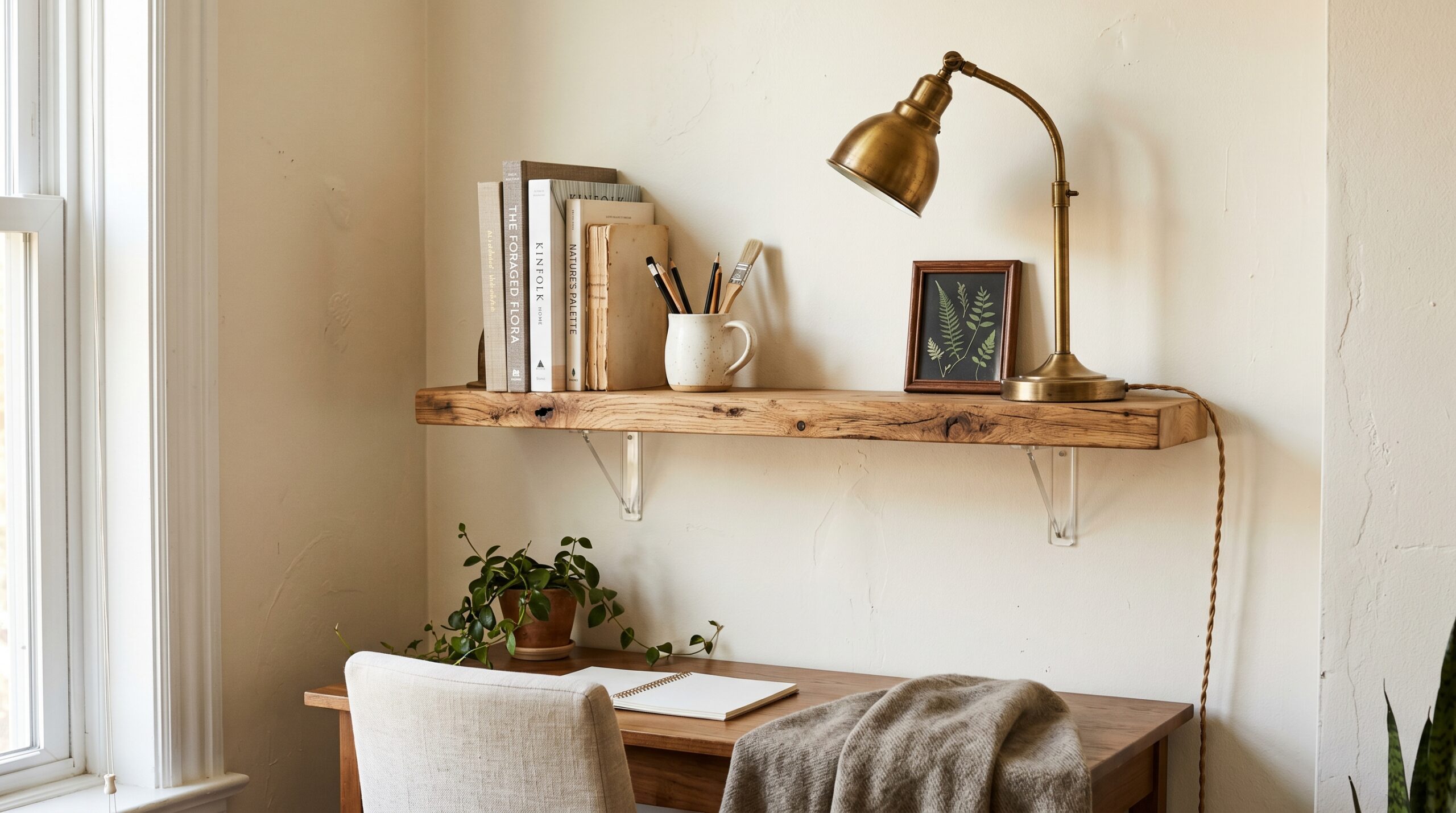
This is the renter’s secret weapon. Six 6″x4″ acrylic brackets with a double-row dual structure. They peel and stick to any smooth surface, and you supply the plank. Pair them with a thrifted oak board, a 1×6 from the hardware store, or even a piece of MDF cut to length. Twelve-hour cure time before you load them. Custom shelves at any width, fully removable. Shop the 6-Pack Adhesive Brackets on Amazon
Generic acrylic bracket system · 6-pack · 6″ x 4″ each · 12-hour cure time · transparent acrylic
Not for: textured walls or matte-finish painted walls. Smooth surfaces only.
Method 2: Multi-method shelves (your call on the install)
Floating Shelves No Drilling, 16.53″, 2 Sets, Dark Brown (most flexible)
The label says “no drilling” but the box ships with three options: sticky hooks, traceless no-trace nails, and expansion screws. That makes this the most flexible pick on the list. Rustic dark brown solid wood, two sets per order, and a real install instruction sheet that tells you which method to pick for which wall. Shop the No-Drilling Floating Shelves on Amazon
Generic rustic wood · 16.53″ L · 2 sets · sticky hooks, traceless nails, or expansion screws
Not for: gloss-painted walls. The sticky hook side struggles on glossy paint.

Method 3: Invisible bookshelf brackets (single small anchor)
These are the L-shape steel brackets that disappear behind a stack of books. They use a single anchor each, which means a single small hole per bracket. With self-drilling drywall anchors and a dab of spackle on move-out, they’re as renter-safe as it gets without going pure adhesive.
CRIZTA Invisible Floating Bookshelf, Set of 4, White (gallery wall)
Four white powder-coated L-brackets, twenty-pound capacity each. Stack books on top, the bracket hides behind the spine of the bottom book, and you get the floating-stack illusion. The white finish vanishes on white walls, which is exactly the trick. Shop the CRIZTA 4-Pack on Amazon
CRIZTA · set of 4 · 20 lb capacity each · white powder-coated steel
Not for: anyone who shelves books vertically by spine. The trick only works with horizontal stacks.
2-Pack Floating Bookshelves, Hidden Metal (starter pair)
Same concept, two-pack instead of four, designed specifically for bedroom and living room placement. Heavy-duty steel L-brackets, hidden under stacked books, anchor-mounted. Shop the 2-Pack Hidden Metal on Amazon
Heavy-duty hidden metal · 2-pack · L-bracket design · single anchor each
Not for: paperback rows. The bracket can show under a thin paperback stack.
Floating Book Shelves, Hidden Steel, 2-Pack, Black (workspace pick)
Black powder-coated version of the invisible bookshelf. Pairs better with darker book spines and dark-painted walls. Same single-anchor install. I like the black version above a desk where the brackets blend with monitors and electronics rather than competing with a clean white gallery wall. Shop the Black Hidden Steel 2-Pack on Amazon
Heavy-duty steel · 2-pack · black powder coating · single anchor per bracket
Not for: textured plaster walls. Anchor crumbles plaster on the way in.
Method 4: Cube shelves (small holes, big payload)
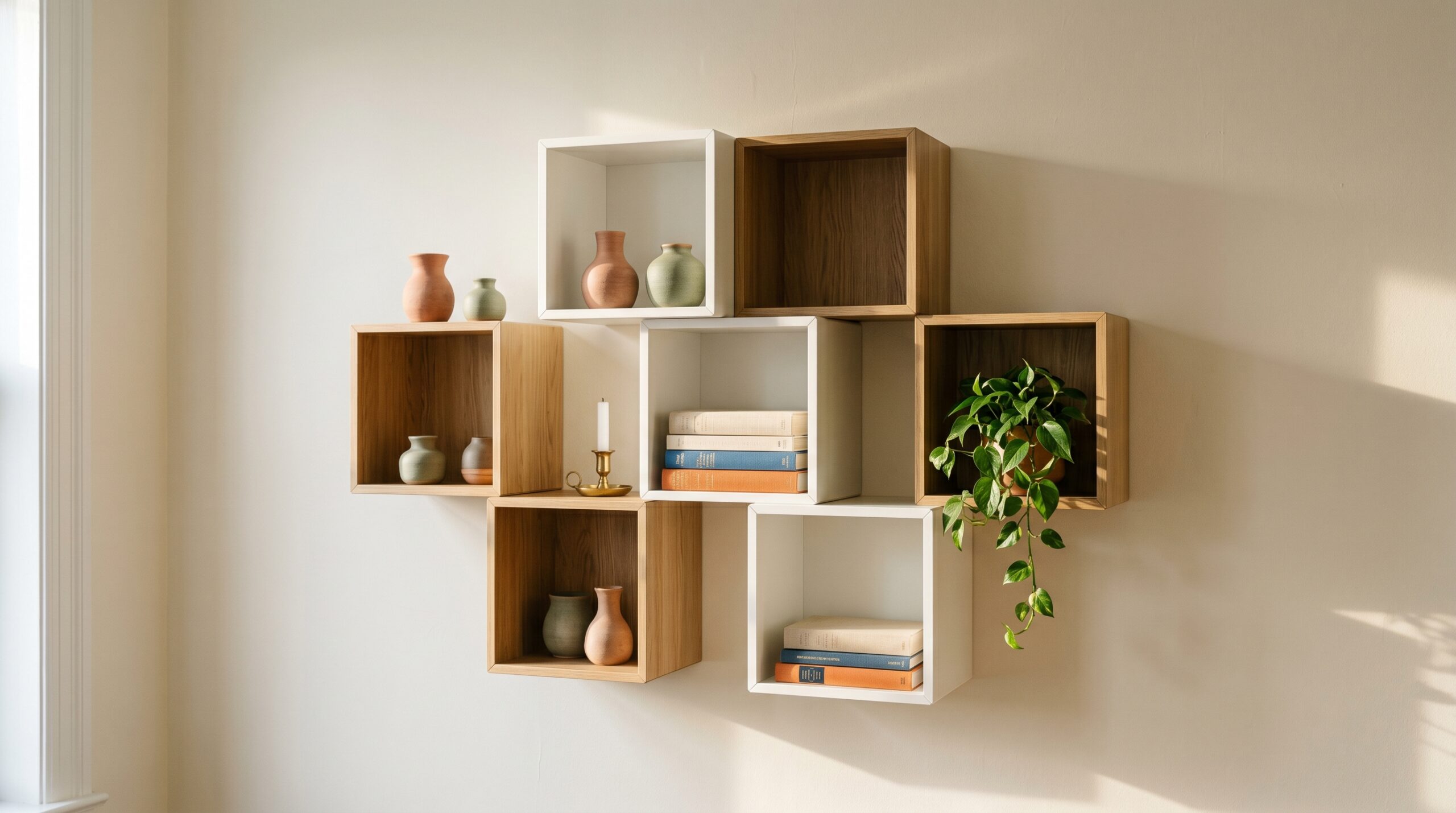
Cube shelves use two small nails or anchors per cube. Two pinhole-sized patches per shelf is well within “renter safe” for any reasonable landlord.
Kaboon Wall Mount Cube Shelves, Set of 4, Oak (woodgrain pick)
Four oak-laminate cubes that hang on two nails each. The oak woodgrain looks more expensive than the price suggests, and the cubes can be arranged as a stack, a stair-step, a cross, or scattered. P2 grade CARB board core, so they hold real books without sagging. Shop the Kaboon Oak Cube Set on Amazon
Kaboon · set of 4 cubes · oak laminate · P2 CARB board core · two-nail hang
Not for: anyone who needs a single long shelf. This is a cube system, not a board.
Organize It All Floating Cube Shelves, Set of 3, White (budget classic)
The classic. Three different sizes, white MDF, 200 lb per shelf rated. They’ve been on Amazon for over a decade because they earn it. The matte white finish disappears against a white wall, which makes them look like they’re floating at zero install cost. Shop the Organize It All Cube Set on Amazon
Organize It All · set of 3 different sizes · white MDF · 200 lb per shelf rated
Not for: dark paint colors. The white finish stands out against anything but white.
Common mistakes I made so you don’t have to
The first one cost me a row of cookbooks. I had just stuck up a set of the 6-pack acrylic brackets, loaded them maybe an hour later, and went to bed. By morning they were on the floor. The brackets need a full twelve hours undisturbed before any load goes on. Every adhesive product has a cure time and ignoring it is the most common reason a “renter-safe” shelf fails. Now I install at night and load the next morning.
The second one is a buying mistake, not an install mistake. The shelf you want and the shelf your wall can hold are often two different shelves. If you fall in love with a 5-tier wood bookshelf because it looks great in the listing photo, but your wall is plaster and you can’t drill, that shelf is a bad pick no matter how good it looks. The wall picks the shelf. Not the other way around.
The third is paint. Modern latex paint cures slowly, and if your unit was painted right before move-in, the paint film is not bonded to the wall yet. Stick adhesive to it and the strip pulls the paint film off when you remove it. The rule I follow: seven full days after any visible repaint before any adhesive product touches the wall.
The fourth is a level. Books make uneven shelves obvious. A two-degree tilt looks fine on installation day and visibly wrong by the time the shelf is full of hardcovers. Use a real bubble level, not the level app on your phone, which is calibrated to your phone’s case and not the wall plane.
The last one is something nobody tells you: removal is part of install. When you first mount a shelf, write the brand and adhesive type on a piece of tape and stick it on the underside of the shelf. On move-out day, eighteen months later, you will not remember which removal method goes with which product. Past me writes notes for future me. It works.
What I’d actually buy if I were starting fresh
If I had one wall and one shelf budget, I’d buy the 3-pack Fixwal for the kitchen, the CRIZTA invisible 4-pack for the living room book wall, and the Command Picture Ledge in slate above the bed for paperbacks. That’s three different methods covering three different load profiles, all renter-safe, all reversible.
If you want decorative shelves that don’t even pretend to hold books, my full pick list lives at 11 floating shelves for small apartments you can install without a drill. For the related no-drill bathroom problem, see small bathroom storage ideas that skip the drill. And if your storage problem is closet doors, not walls, closet door storage hanging organizers covers that bracket.
Wall installation is the easy part. Picking what your wall can actually hold is the rest of the job.
For the load math behind these capacity ratings, the 3M Command engineering data sheet on adhesive performance goes deeper than any product page does.
FAQ
Will Command Strips really hold a shelf full of books?
No. Command strips are rated for 5 lb per pair on the standard medium size. A row of paperbacks is at the upper edge of that. Hardcovers are not. If you’re shelving real books, use a single-anchor bracket, not pure adhesive.
What’s the cleanest way to remove an adhesive shelf without ripping paint?
Pull the strip straight down toward the floor, slowly, parallel to the wall. Never pull it forward off the wall. The 3M Command system specifically uses a tab that stretches the adhesive bond apart when pulled down. Do not pry the shelf off the wall first.
Does my landlord count drywall anchor holes against my deposit?
In my experience, no. A patched anchor hole is indistinguishable from a patched picture-frame nail hole. Use a self-drilling anchor, drop the bracket on it, and on move-out spackle the hole and dab matching paint. Most leases consider that “ordinary wear and tear.”
Are these shelves safe over a bed?
Pure adhesive shelves: no. The 3M Command system explicitly says not to hang over beds. Anchor-mounted shelves: only if the anchor is rated above the load and you have used a level. I personally do not put any wall shelf above where my head sleeps.
What about plaster walls?
Plaster is the hardest case. Adhesive struggles because the surface is too irregular. Anchors crumble the plaster on the way in unless you pre-drill a small pilot hole. If you have plaster walls, the safest pick on this list is the Fixwal 3-pack with traceless nails using the nail option, not the adhesive option.